Best Shade-Tolerant Climbing Roses for North-Facing Walls
Discover the best shade-tolerant climbing roses for north-facing walls, including New Dawn and Madame Alfred Carrière, with planting and care tips.
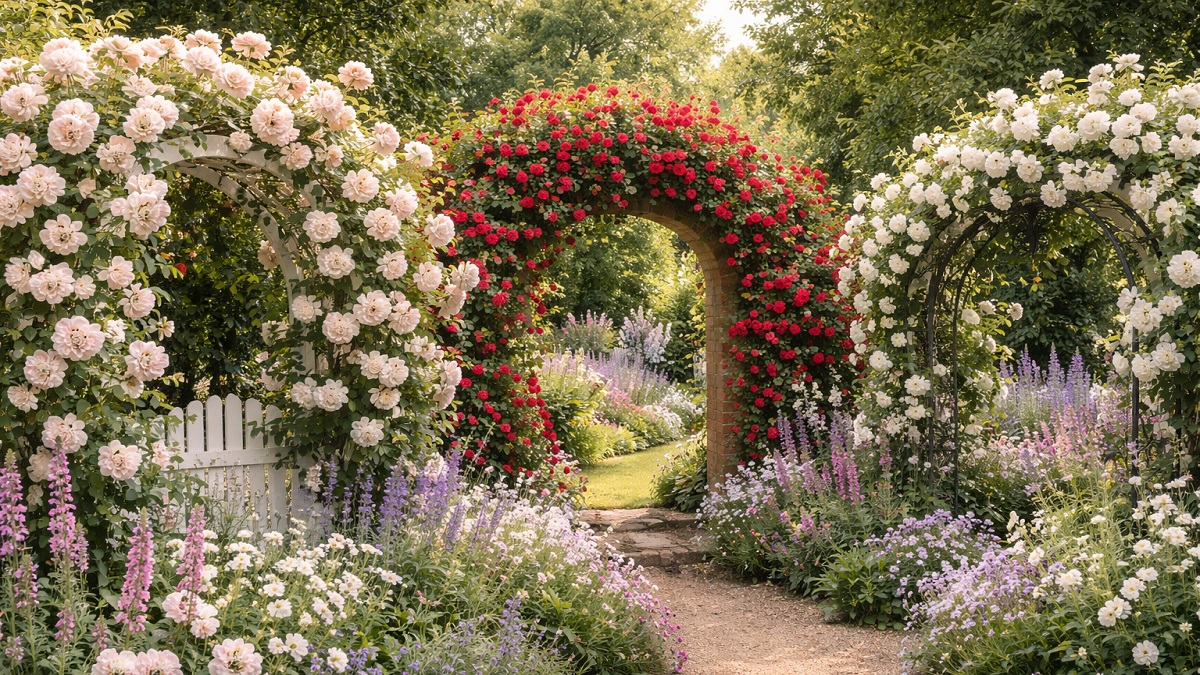
Climbing roses are among the most useful flowering plants for adding height, color, fragrance, and structure to a garden. Instead of spreading only across the ground like many shrub roses, climbing types produce long canes that can be guided over trellises, arches, pergolas, fences, pillars, and other sturdy supports. When trained correctly, a single rose can turn an otherwise plain vertical surface into a living display of flowers.
Despite their name, climbing roses do not climb in the same way as ivy, clematis, or grapevines. They do not have tendrils, adhesive pads, or twining stems that naturally attach themselves to a support. Their long, flexible canes need to be tied or otherwise secured to a suitable framework. This distinction is important because good training is one of the main factors that determines how well a climbing rose flowers.
The best approach is to give the rose plenty of sunlight, fertile but well-drained soil, regular moisture during establishment, a strong support, and enough room for its mature size. Pruning also needs a different strategy from ordinary bush roses. Rather than repeatedly cutting the plant back into a compact shape, gardeners generally focus on removing old or weak growth, renewing the framework, and positioning the main canes so that flowering shoots have room to develop.
Climbing roses reward good placement and training. Their long canes need support, sunlight, airflow, and room to mature.
Climbing roses are roses selected or bred for their ability to produce long, vigorous canes that can be trained vertically or horizontally along a support. They belong to the genus Rosa, but “climbing rose” describes a growth habit rather than one single botanical species.
Depending on the cultivar, a climbing rose may produce large individual flowers, clusters of smaller blooms, highly fragrant blossoms, repeat flowers throughout the growing season, or a more concentrated flush of flowering. Mature height also varies considerably. Some compact climbers may remain relatively manageable, while vigorous varieties can eventually cover a large arch, wall, or pergola.
Their value in garden design comes from their vertical growth. A rose that would occupy a modest area when viewed as a shrub can create a much larger visual effect when its canes are trained across a fence or arch. This makes climbing roses particularly useful where horizontal garden space is limited but vertical structures are available.
Not in the botanical sense used for true climbing plants. A climbing rose usually relies on long canes that lean against or are attached to a support. Gardeners guide these canes into position with soft ties, clips, or other non-damaging fasteners.
This is why a strong support should be installed before the plant becomes large. Trying to add a weak trellis after several years of vigorous growth can result in damaged stems and an unstable structure.
Climbing roses and rambling roses are often confused because both can produce long stems. Their growth and flowering habits, however, can be quite different.
| Feature | Climbing Roses | Rambling Roses |
|---|---|---|
| Growth | Often produce strong, structured climbing canes | Usually produce long, flexible and vigorous growth |
| Flowering | Many modern cultivars repeat flower | Many traditional ramblers have one major flowering period |
| Flowers | Can be large or clustered depending on cultivar | Often produced in abundant clusters |
| Best Use | Walls, arches, trellises, pillars and fences | Large structures, trees, fences and informal displays |
| Pruning | Usually focuses on training and renewing framework canes | Often requires managing vigorous post-flowering growth |
The distinction matters when pruning. Before cutting a mature rose heavily, identify the cultivar or its growth group if possible. Pruning at the wrong time can remove flowering wood and significantly reduce the following season's display.
| Characteristic | Climbing Roses |
|---|---|
| Botanical genus | Rosa |
| Plant type | Woody perennial flowering plant |
| Growth habit | Long climbing or arching canes |
| Typical mature height | Often about 6–15 ft, but varies widely by cultivar |
| Sunlight | Full sun is generally preferred |
| Ideal soil | Fertile, organic-rich and well drained |
| Soil moisture | Even moisture without prolonged waterlogging |
| Flower color | White, cream, yellow, peach, pink, red, purple and combinations |
| Flower form | Single, semi-double or double, depending on cultivar |
| Blooming habit | Once-flowering or repeat-flowering depending on cultivar |
| Support | Strong trellis, arch, pergola, fence or other secure framework |
| Pruning | Training, thinning and renewal of older canes |
| Propagation | Usually by cuttings, budding or grafting depending on the rose |
| Common problems | Aphids, Japanese beetles, spider mites, black spot, powdery mildew and rust |
Choosing the right cultivar is more important than simply selecting a flower color you like. Consider the available space, mature height, flowering habit, fragrance, disease resistance, climate, and the strength of the structure where the plant will grow.
A rose that eventually reaches 12 feet or more is not a sensible choice for a small decorative trellis. Conversely, a compact climber may look lost on a large pergola. Read the mature height and spread carefully and allow additional room for airflow and maintenance.
If continuous color is important, look for a repeat-flowering climbing rose. Some older climbing roses bloom mainly on older wood and produce their principal display during one period of the year. These can be spectacular, but their pruning and training schedule differs from that of many modern repeat bloomers.
Fragrant cultivars are particularly enjoyable when grown beside paths, patios, seating areas, gates, or entrances. If fragrance is less important, you can focus more heavily on flower color, disease resistance, repeat flowering, or the plant's eventual size.
Check the mature size, inspect the support, identify the sunniest suitable location, and make sure water can drain freely from the planting area.
Site selection determines much of a climbing rose's long-term performance. Choose a location that receives plenty of direct sunlight and has good air circulation. Most roses flower best when they receive around six or more hours of direct sun, although the exact requirement can vary among cultivars and climates.
Morning sunlight is especially useful because it helps dry foliage after overnight moisture. Avoid cramped locations where leaves remain damp for long periods. Good airflow around the plant can reduce the conditions that encourage fungal disease.
The planting area should also be large enough to accommodate the roots and allow the rose to grow without severe competition from large trees or aggressive neighboring plants. Avoid planting immediately beside a tree with an extensive root system unless you can provide enough soil and moisture for both plants.
Climbing roses prefer fertile, well-drained soil containing plenty of organic matter. Heavy clay can be improved with organic amendments and better drainage practices, while very sandy soil may need additional organic matter to improve moisture retention.
The goal is not soil that stays wet. Rose roots need oxygen as well as moisture, so a constantly saturated planting hole can lead to poor root growth and root-related problems.
Planting is easiest when the soil is workable and temperatures are moderate. Container-grown roses can often be planted during suitable periods of the growing season, while bare-root roses are generally planted during their dormant period according to local climate and nursery recommendations.
Remove competing weeds and loosen the soil over a broad area. Work in well-decomposed organic matter where appropriate rather than creating a small pocket of dramatically different soil around the root ball.
Make the planting hole wide enough to allow the roots to spread naturally. The depth should accommodate the root system without forcing roots to bend sharply upward.
Place the plant at the appropriate depth for its form. Grafted roses require particular attention to the position of the graft union, while own-root roses do not have a graft union. Follow the planting guidance supplied for the specific cultivar and rootstock.
Return the prepared soil around the roots and firm it gently to remove large air pockets. Avoid compacting the soil excessively.
Water slowly and deeply after planting so the root zone is evenly moistened. Newly planted roses need more consistent attention than established plants while their roots are becoming established.
Apply organic mulch around the root zone to conserve moisture and moderate soil temperature. Keep mulch away from direct contact with the main stem to reduce the risk of excessive moisture against the crown.
A climbing rose eventually becomes much heavier than it appears when first planted. Its support must therefore be strong enough to carry mature stems, foliage, flowers, and additional weight from rain or wind.
Suitable supports include sturdy trellises, arches, pergolas, fences, wire frameworks, and properly constructed wall-mounted systems. Thin decorative trellises may be suitable for a small rose, but vigorous cultivars can quickly outgrow them.
When training a rose against a wall, avoid pressing the plant tightly against the surface. A small gap can improve airflow and make tying and maintenance easier. Wall surfaces can also create warmer or drier conditions, so monitor the plant carefully during hot weather.
Training is one of the most important skills for growing a successful climbing rose. The main goal is to establish a framework of healthy canes and position them where flowering shoots can develop throughout the available space.
Young canes should be handled gently because bending them too sharply can cause cracks or breaks. Use soft ties or purpose-made plant fasteners rather than thin wire that can cut into expanding stems.
Instead of allowing every major cane to grow straight toward the top of the support, guide some of them sideways or at an angle. This helps distribute flowering growth along the framework rather than concentrating flowers only near the uppermost part of the plant.
The exact training pattern depends on the structure. On an arch, canes can be guided upward and then across the top. On a fence, they can be arranged in gentle horizontal or diagonal lines. On a pillar, several canes can be spiraled gradually around the structure if the cultivar is suitable for that form.
Dense bundles of stems can restrict airflow and make pruning difficult. Leave enough space between major canes to inspect the plant, tie new growth, remove damaged wood, and identify signs of pests or disease.
Watering requirements depend on temperature, rainfall, soil type, plant age, and container size. Newly planted roses need regular watering while their root systems become established. Established plants generally benefit from deep watering during dry periods rather than frequent shallow sprinkling.
Water the soil around the root zone instead of repeatedly wetting the foliage. A soaker hose or drip irrigation system can be particularly useful because it delivers moisture close to the roots while keeping leaves relatively dry.
During hot weather, check the soil before watering rather than relying on a fixed calendar. Sandy soils may dry quickly, while clay soils can remain moist for much longer.
Roses are relatively heavy feeders when they are actively growing and producing flowers. Fertility should be based on the plant's growth, soil condition, and the recommendations for the particular fertilizer being used.
A balanced rose fertilizer or suitable slow-release product can provide nutrients throughout the growing season. Organic matter also contributes to soil structure and nutrient availability.
Avoid excessive nitrogen. Too much nitrogen can encourage lush leafy growth at the expense of flowering and can produce soft growth that is more vulnerable to certain pests and environmental stresses.
Newly planted roses should not be pushed aggressively with fertilizer before they have begun establishing roots. Concentrate first on correct planting, watering, and soil conditions.
Mulching is a simple way to make rose care more consistent. Organic mulch can reduce evaporation, buffer soil temperatures, suppress weeds, and gradually contribute organic matter as it decomposes.
Suitable materials may include shredded bark, composted organic material, leaf mold, or other garden mulches appropriate to the local environment. Maintain a small gap around the main stem rather than piling mulch directly against the plant.
Pruning climbing roses is different from trimming a compact shrub into a rounded shape. The objective is to maintain a useful framework while encouraging fresh flowering growth.
Before making major cuts, determine whether the cultivar flowers primarily on old wood, new wood, or a combination. This is especially important for once-flowering climbers. Removing old flowering canes at the wrong time can eliminate much of the next display.
Start by removing dead, broken, diseased, or badly damaged stems. Cut back to healthy wood where appropriate, using clean and sharp pruning tools.
Very thin or poorly positioned shoots may contribute little to the plant's framework. Removing selected weak growth can improve airflow and make the remaining structure easier to manage.
A mature climbing rose can become congested with aging wood. Rather than removing every old cane at once, renew the framework gradually when appropriate. A strong new cane can eventually replace an older, less productive one.
Avoid treating a climbing rose like a hedge. The principal canes form the plant's structure and should generally be retained and trained unless they are damaged, diseased, excessively old, or poorly positioned.
Timing varies with flowering habit and climate. Repeat-flowering climbers are often pruned during late winter or early spring in climates where the plant is dormant, while once-flowering types are commonly pruned after flowering because they may bloom on older wood.
Always consider the specific cultivar's pruning instructions. If the plant's identity is unknown, observe when it flowers before carrying out heavy pruning.
Deadheading can keep repeat-flowering climbing roses looking tidy and may encourage additional flowering, depending on the cultivar. Remove spent blooms before they develop into hips if the goal is to maintain repeated flowering.
However, leaving hips can also provide seasonal interest and food for wildlife. Gardeners who prefer decorative hips can allow some flowers to remain after flowering, particularly toward the end of the season.
Roses can be propagated in several ways, including cuttings, budding, and grafting. The appropriate method depends on the cultivar and the purpose of propagation.
Some climbing roses can be propagated from stem cuttings. Semi-hardwood or hardwood cuttings may be used depending on the rose and season. Successful rooting requires suitable moisture, humidity, temperature, and a well-drained rooting medium.
Propagation from cuttings produces a plant genetically similar to the parent cutting. However, not every cultivar roots equally well, so results can vary.
Many commercially produced roses are grafted or budded onto selected rootstocks. This approach can combine a desirable flowering cultivar with a root system chosen for vigor or other production characteristics.
Climbing roses can attract many of the same pests that affect other roses. Regular inspection is more useful than waiting until damage becomes severe.
Aphids often cluster around soft new shoots, flower buds, and young leaves. They feed on plant sap and may cause distorted growth. Natural predators such as lady beetles, lacewings, and hoverfly larvae can help suppress aphid populations.
Spider mites are more likely to become troublesome during hot, dry conditions. Fine stippling or bronzing of leaves and fine webbing can indicate a significant infestation. Improving plant vigor and reducing excessive dust and drought stress can help.
Various beetles and caterpillars may chew holes in foliage or damage flowers. Monitor plants regularly and identify the insect before choosing a control method.
Scale insects may appear as small, stationary bumps on stems or leaves. Heavy infestations can weaken plants. Pruning out badly infested sections and encouraging natural predators can be useful in an integrated pest-management approach.
Good site selection, sanitation, airflow, and appropriate watering habits can reduce many rose disease problems. Disease resistance varies significantly among cultivars, so it is worth considering resistance when choosing a climbing rose.
Black spot causes dark lesions on leaves and can lead to premature leaf drop. The disease is favored by prolonged leaf wetness and humid conditions. Remove heavily affected fallen leaves, improve airflow, and avoid unnecessary overhead watering.
Powdery mildew appears as a pale, powdery coating on leaves and young growth. Unlike many leaf diseases, it can develop under relatively dry conditions when humidity around the foliage is high.
Rose rust can produce orange, yellow, or rust-colored pustules and spots on foliage. Good sanitation and airflow can help reduce disease pressure.
Winter requirements vary widely with climate and cultivar. In mild climates, established climbing roses may need little special protection beyond appropriate watering before severe cold and maintaining a healthy root zone.
In colder regions, the roots can benefit from a substantial organic mulch layer applied after the ground begins to cool. The goal is to moderate rapid temperature changes rather than create a permanently wet environment.
On exposed structures, strong winter winds can also cause stems to whip against supports. Check ties before winter and secure long canes without binding them tightly enough to restrict growth.
Some compact climbing roses can be grown successfully in large containers, provided the container is deep and stable enough to support the plant. The larger the mature rose, the more important container size becomes.
Choose a container with drainage holes and use a high-quality growing medium that drains well while retaining enough moisture for the root system. Containers dry out faster than garden soil, particularly during hot weather, so watering needs to be monitored closely.
A container-grown climber also needs a support. A narrow pot paired with a tall, heavy rose can become unstable in strong wind, so use a sturdy structure and position the container where it will not easily tip.
| Problem | Possible Cause | What to Check |
|---|---|---|
| Few flowers | Insufficient sunlight, excessive nitrogen, immature plant or incorrect pruning | Sun exposure, fertilizer use, cultivar flowering habit and pruning timing |
| Long leafy growth | High nitrogen or vigorous juvenile growth | Fertilizer program and plant maturity |
| Leaves turning yellow | Water stress, nutrient imbalance, root problems or natural aging | Soil moisture, drainage, roots and older foliage |
| Black spots on leaves | Possible black spot disease | Leaf lesions, humidity and sanitation |
| White coating on leaves | Possible powdery mildew | New growth, airflow and humidity |
| Weak support | Structure too small or lightly built for mature growth | Plant's expected size and support construction |
| Flowers mainly at the top | Major canes trained too vertically | Training pattern and position of lateral flowering shoots |
| Wilted leaves | Drought, root damage or heat stress | Soil moisture and root-zone condition |
| Broken stems | Wind, poor support or excessive bending | Ties, structure and cane positioning |
| Season | Main Tasks |
|---|---|
| Early Spring | Inspect winter damage, prune according to cultivar, train canes, refresh mulch and begin regular watering as growth resumes. |
| Late Spring | Guide new canes, monitor pests, maintain even moisture and support strong flowering growth. |
| Summer | Water deeply during dry periods, deadhead repeat bloomers, tie new growth and watch for pests and foliar diseases. |
| Early Autumn | Continue watering during dry weather and allow the plant to maintain healthy foliage. Avoid unnecessary heavy pruning. |
| Late Autumn | Clean up fallen diseased foliage, check supports and prepare the root zone for winter where necessary. |
| Winter | Protect vulnerable plants according to local climate, inspect ties, and plan structural pruning for the appropriate time. |
Abundant flowering starts with the basics: sufficient sunlight, healthy roots, appropriate nutrition, reliable moisture, and a suitable cultivar. Once those conditions are in place, training becomes especially important.
A common mistake is allowing every major cane to grow directly upward. Training selected canes sideways or diagonally can distribute flowering shoots over a greater portion of the support. This produces a fuller appearance and makes better use of the available vertical structure.
Avoid excessive pruning of the main framework simply to keep the rose small. If the cultivar is too vigorous for the available structure, replacing it with a more compact climber may ultimately be easier than continually fighting its natural growth habit.
Climbing roses can serve as focal plants, background features, entrance accents, or screens. Their vertical form makes them useful in gardens where space is limited but walls, fences, arches, and pergolas provide additional growing surfaces.
Pairing a rose with lower-growing perennials can create a layered planting. The rose supplies height while smaller plants cover the ground around its base. Choose companions that tolerate the same light and moisture conditions and leave enough space around the rose for airflow and maintenance.
For a romantic cottage-garden effect, combine a climbing rose with complementary flowering perennials and informal foliage. For a more structured garden, train the rose carefully over a geometric arch or against a neatly constructed trellis.
Mature height varies greatly among cultivars. Many climbing roses reach roughly 6–15 feet, while particularly vigorous varieties can grow beyond that range under favorable conditions. Always check the mature dimensions of the specific cultivar before planting.
Most climbing roses benefit from a sturdy support because they do not naturally attach themselves to structures like true climbing vines. A trellis, arch, pergola, fence, or other secure framework can be used.
Most climbing roses flower best in full sun. Some cultivars tolerate less sunlight than others, but insufficient light commonly results in weaker growth and fewer flowers. Aim for a bright location with several hours of direct sunlight.
Watering frequency depends on soil, rainfall, temperature, and plant age. Newly planted roses need more consistent moisture, while established plants generally benefit from deep watering during dry periods. Check the soil rather than following a rigid schedule.
They should be inspected and maintained regularly, but the amount of annual pruning depends on the cultivar. Remove dead or damaged wood and manage crowded or aging canes, while avoiding unnecessary removal of productive framework stems.
Timing depends on the flowering habit. Many repeat-flowering climbers are structurally pruned during the dormant season or late winter, while roses that flower mainly on older wood are often pruned after flowering. Identify the cultivar before performing major pruning.
Possible causes include insufficient sunlight, excessive nitrogen, immature growth, drought stress, or pruning that removed flowering wood. Check the plant's light exposure, fertilizer program, watering, age, and flowering habit.
Some compact cultivars can grow in large containers. Choose a stable container with good drainage, use a suitable growing medium, provide a strong support, and monitor watering closely because containers dry faster than garden soil.
Select healthy flexible canes and gently guide them toward the sides and top of the arch. Secure them with soft ties and continue redirecting new growth as it develops. Avoid sharp bends and leave enough space between major canes for airflow.
Both produce long growth, but their growth and flowering habits differ. Many climbing roses have more structured canes and modern cultivars may repeat flower, while many ramblers produce very vigorous flexible growth and have a major flowering display once a year.
Climbing roses are rewarding when their natural growth habit is used to the garden's advantage. The key is not simply to plant a rose beside a trellis and wait for it to cover the structure. A successful climbing rose needs a suitable cultivar, good sunlight, fertile well-drained soil, consistent moisture, a strong support, and thoughtful training.
Give the plant time to establish a framework of strong canes, then guide those stems across the support rather than repeatedly cutting them back to keep them compact. Regular inspection, sensible feeding, careful watering, and cultivar-specific pruning will help maintain healthy growth and a strong flowering display.
With the right placement and support, a climbing rose can become much more than another flowering plant. It can frame an entrance, soften a wall, define a garden room, cover an arch, or bring fragrance and seasonal color to an otherwise unused vertical space.
← Back to Plant GuidesContinue exploring our gardening guides with more plant profiles, growing tips, and practical advice for creating a healthy, productive garden.