Best Shade-Tolerant Climbing Roses for North-Facing Walls
Discover the best shade-tolerant climbing roses for north-facing walls, including New Dawn and Madame Alfred Carrière, with planting and care tips.
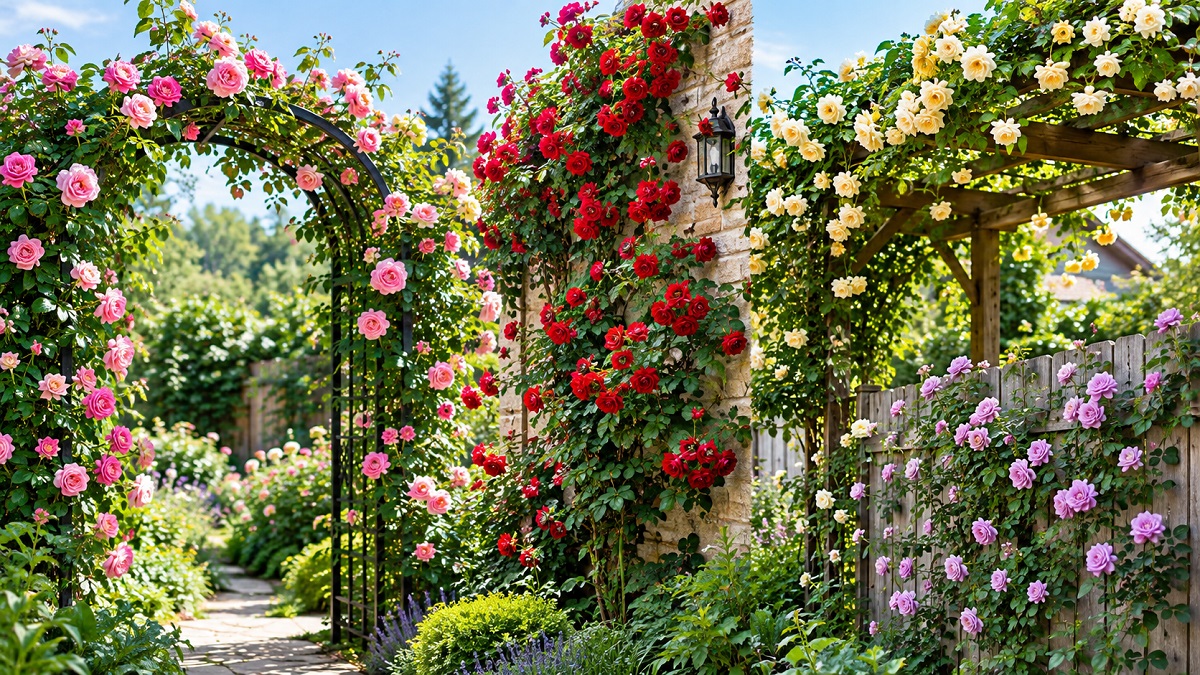
A climbing rose can do much more than cover a bare wall with flowers. When you choose a variety for fragrance as well as growth habit, an ordinary arch, doorway or fence can become one of the most enjoyable places in the garden. The scent is especially noticeable when the rose is planted beside a path, seating area or entrance where you naturally pass close to the flowers.
The challenge is that climbing roses are not all alike. Some make compact climbers that suit a small arch, while others produce long, vigorous stems better suited to a large wall or pergola. Flowering habits also vary. Some repeat throughout the growing season, whereas others produce one spectacular flush and then concentrate on foliage and hips.
This guide looks at ten fragrant climbing roses that are particularly useful for vertical growing. The selection includes classic roses with strong old-rose perfume, softer myrrh and musk fragrances, and varieties valued for their combination of scent, flowering and architectural growth.
Choose for the space first: the right rose should fit the height, aspect and structure of your arch or wall as well as providing flowers you enjoy.
Before choosing a rose from a catalogue, look at the structure you want to cover. An arch over a garden path has different requirements from a ten-foot wall. A compact climber may be easier to manage around a doorway, while a vigorous rose can quickly become too large for a lightweight support.
Fragrance is another consideration. Rose scent can range from the deep, classic perfume associated with old roses to lighter musk, myrrh, tea and fruity notes. Scent is also affected by weather, time of day, flower age and the number of open blooms, so a rose described as strongly fragrant will not necessarily smell identical in every garden.
Check the expected height and spread before planting. A rose that can reach several metres may be excellent for a large wall but awkward on a small garden arch.
Repeat-flowering roses are useful when you want colour and scent over a long season. Once-flowering varieties can still be outstanding choices where one major display is more important than continuous bloom.
Gertrude Jekyll is one of the standout choices when fragrance is the main reason for growing a climbing rose. It produces rich pink, fully double flowers with a classic old-rose scent. The rose can be grown as a shrub, but it can also be trained as a short climber, making it useful where you want strong perfume without an enormous plant.
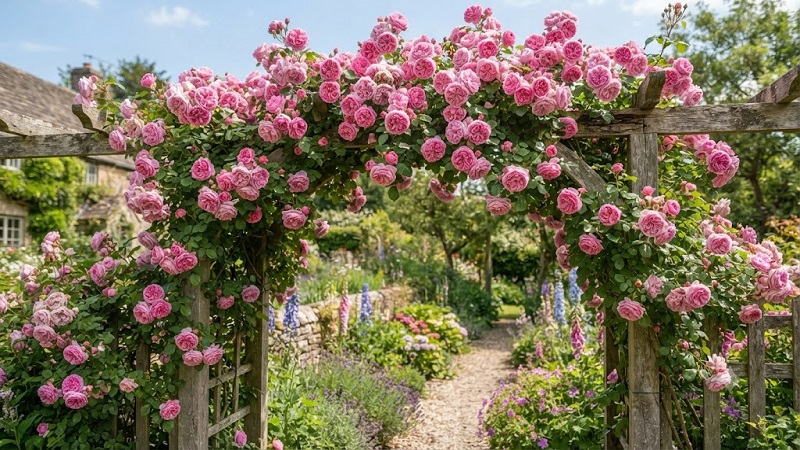
Its rich colour works particularly well against pale walls, timber structures and green foliage. The flowers have a traditional appearance, so Gertrude Jekyll fits naturally into cottage-style gardens as well as more formal planting schemes.
Give it fertile, well-drained soil and a position with good light. If space is limited, regular tying and thoughtful pruning are important because the plant still needs to be shaped rather than simply allowed to grow wherever it chooses.
Zéphirine Drouhin is a particularly interesting climbing Bourbon rose because its stems are thornless. That makes it worth considering for an arch over a path or beside a seating area where people may brush against the plant.
The cerise-pink flowers are strongly fragrant and appear over a long flowering period. Its vigorous climbing habit can make a substantial vertical display, while the lack of thorns gives it a practical advantage in high-traffic parts of the garden.
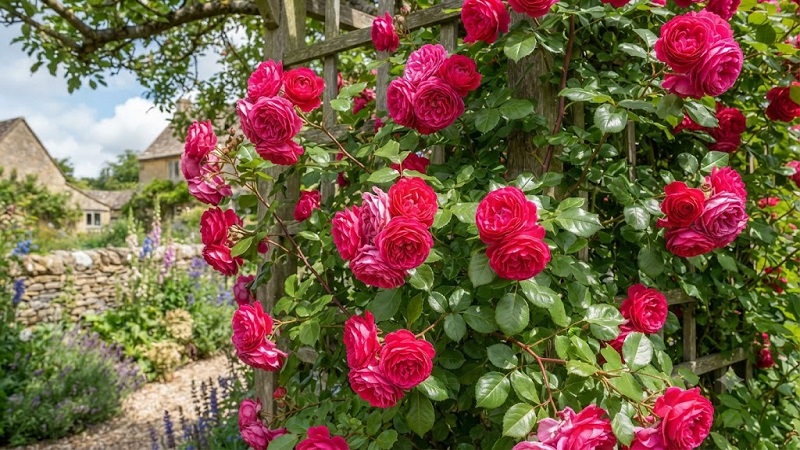
Use Zéphirine Drouhin on a sturdy arch, fence or wall where there is enough room for its mature growth. It is also worth considering for a garden entrance because the combination of colour and perfume is noticeable at close range.
Thornless does not mean maintenance-free. Long stems still need tying, old growth should be managed, and the plant benefits from good air circulation.
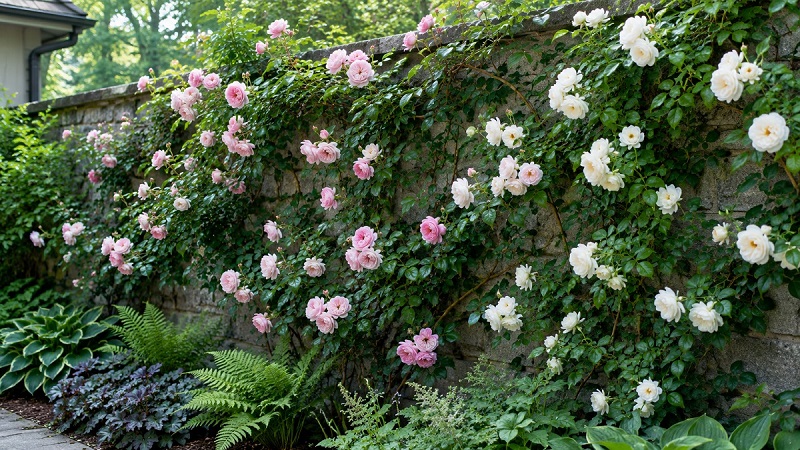
New Dawn is a classic climbing rose with pale blush-pink, semi-double flowers and a noticeable fragrance. It is particularly useful when a gardener wants a rose capable of covering a wall while tolerating conditions that may be less than ideal for many roses.
The RHS describes New Dawn as a large climber with glossy dark-green foliage and fragrant flowers, and notes its suitability for a north-facing wall. That makes it a useful option for gardeners who have a vertical surface that receives less direct sun than an open south-facing border.
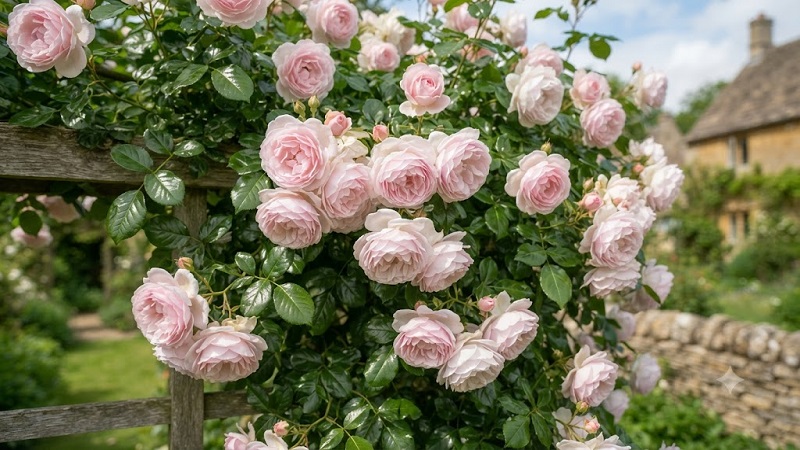
New Dawn has the visual scale needed for a substantial wall or fence. The pale flowers also contrast beautifully with darker foliage, brickwork and painted garden structures. Its flowering can continue from early summer into autumn under suitable conditions.
Although it can tolerate some shade, good light and fertile, moisture-retentive but well-drained soil will help it produce a stronger display.
For gardeners who prefer white or cream roses, Claire Austin is an elegant climbing choice. The flowers have a soft, rounded appearance and carry a fragrance associated with myrrh, with additional sweet and herbal notes.
Its pale colouring makes it especially useful around seating areas and entrances. Rather than creating a strong block of colour, it gives a lighter effect that works beautifully against dark green foliage, old brick and natural timber.
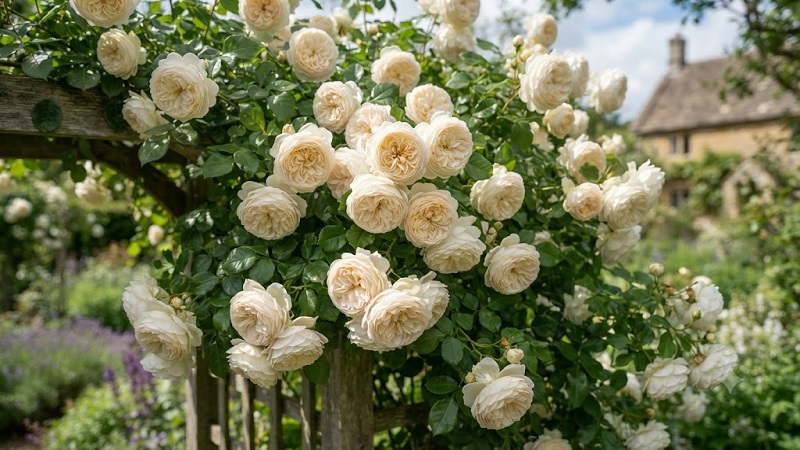
The fragrance is one of the reasons to position this rose somewhere people can walk beneath or alongside it. On a large, distant wall, much of its sensory appeal can be lost.
The Generous Gardener combines a graceful climbing habit with soft pink flowers and a lighter musk fragrance. It is an excellent candidate when you want a rose to soften a wall or pergola rather than create a dense, formal screen.
The flowers have a loose, waterlily-like character, giving the plant a relaxed appearance. The long growth makes it particularly useful on taller supports, where the stems can be spread horizontally to encourage flowering along their length.
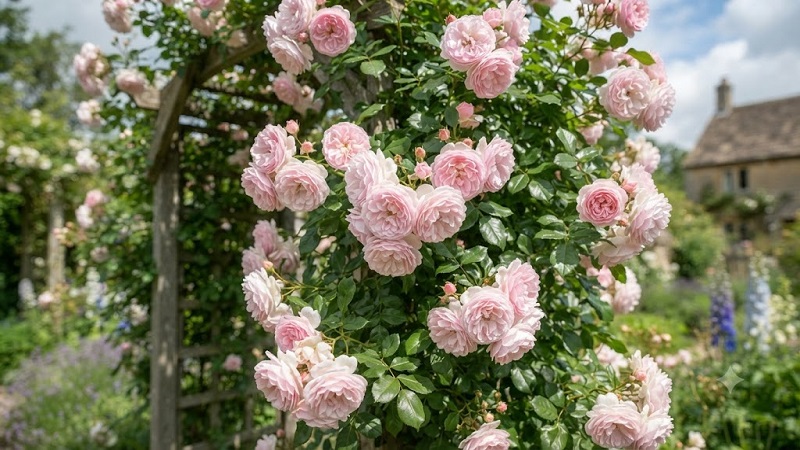
This rose is useful for gardeners who want vertical height without a visually heavy effect. It can be trained across a wall, fence, pergola or large arch, and its pale pink flowers blend easily with other perennial planting.
Consider planting it near plants with blue, white or soft purple flowers. These combinations allow the rose to remain the main vertical feature without making the border feel overly busy.
Wollerton Old Hall is a fragrant English climbing rose known for its warm apricot colouring and sophisticated fragrance. The flowers begin with richer tones and soften as they open, producing a changing display rather than a flat block of colour.
This is a particularly attractive choice for a wall or pergola where flowers can be viewed from several angles. The warm colour works naturally with stone, brick, cream-painted wood and other muted garden materials.
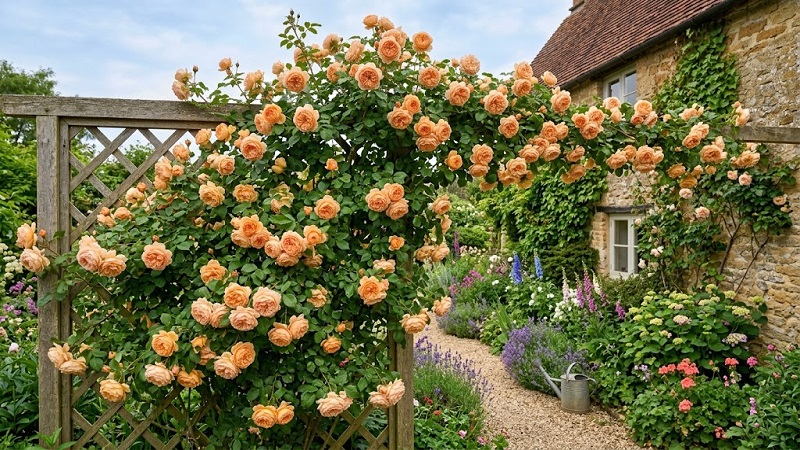
Give it a strong support and enough room for the canes to be trained rather than allowed to pile into a dense mass. A climbing rose generally flowers more generously when its long stems are positioned thoughtfully instead of simply tied vertically.
Its fragrance makes it especially worthwhile beside a terrace, seating area or path where the flowers are close enough to appreciate.
Bathsheba brings warm apricot tones to the vertical garden. Its densely petalled flowers have a romantic, old-fashioned appearance, while the fragrance adds another layer of interest.
The combination of flower form and warm colour makes it particularly effective against neutral backgrounds. A pale wall can make the apricot blooms appear luminous, while dark green foliage provides a strong contrast.
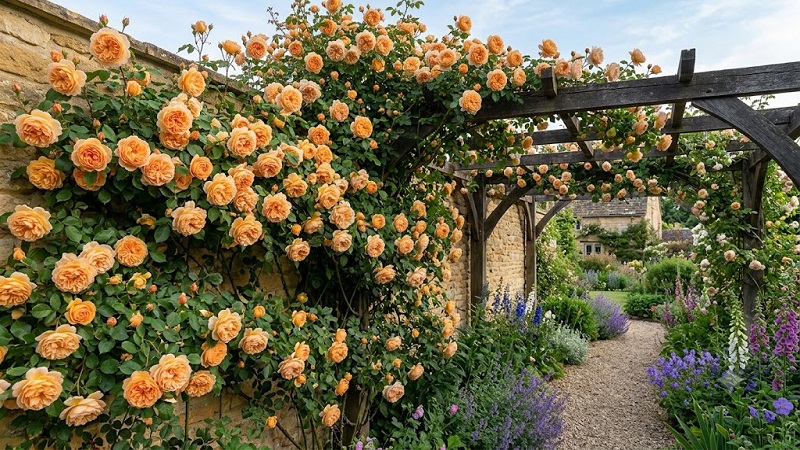
Because the flowers are detailed and full, avoid surrounding them with too many other large, double flowers. Simpler companion plants can make the rose's form easier to appreciate.
Strawberry Hill is a fragrant climbing rose with soft pink flowers and a graceful habit. It is a useful choice when you want a rose that feels romantic without relying on very dark or saturated colours.
The RHS specifically includes Strawberry Hill among roses suitable for a sunny sheltered wall. Its flowers and foliage can give a wall a layered appearance, especially when the stems are trained outward instead of being left in a narrow vertical column.
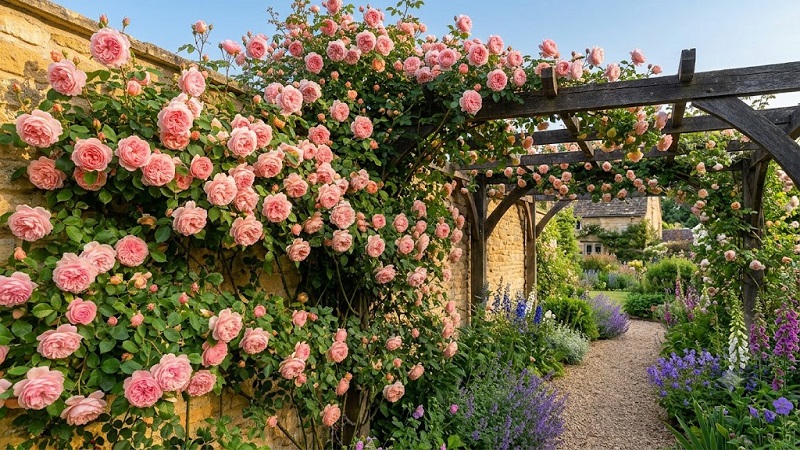
On an arch, place the main stems so they travel toward the top from both sides. Once they reach the upper framework, spread them across the curve. This creates more opportunities for flowering shoots to develop along the structure.
Keep the base of the plant well watered during establishment, but avoid constantly wet soil. Roses perform best when their roots have access to moisture without remaining waterlogged.
Constance Spry is a classic English rose with large, old-fashioned flowers and a rich fragrance. Unlike repeat-flowering roses, it is best appreciated as a spectacular seasonal event rather than as a plant that provides flowers continuously throughout the summer.
That characteristic can actually be an advantage. A large flush of flowers can transform an arch, pergola or wall for several weeks, creating a strong focal point in late spring or early summer.
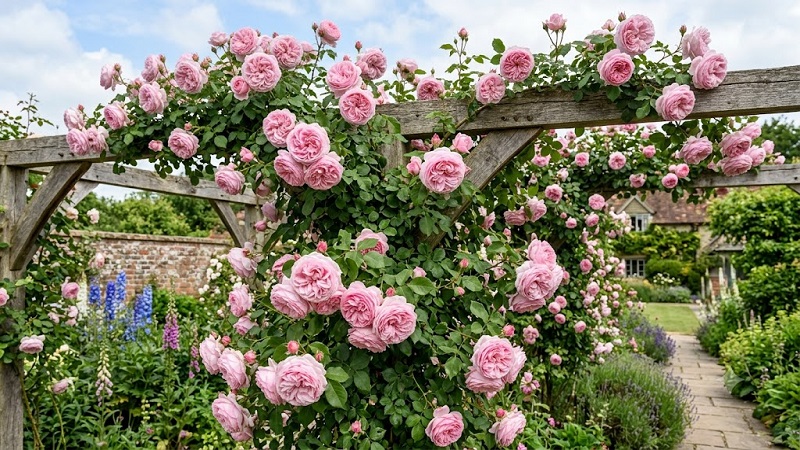
Choose Constance Spry when the main objective is a dramatic traditional rose display and you are happy to accept a more concentrated flowering period. It is particularly attractive in cottage gardens and informal settings.
Allow adequate space around the structure and provide a support capable of handling mature growth. Its long stems should be secured carefully as they develop.
Madame Alfred Carrière is a classic Noisette climbing rose valued for its pale flowers and fragrance. It is especially interesting for gardeners dealing with a wall that receives less direct sunlight.
The RHS lists this rose as a choice for a shady or north-facing wall. That does not mean it will flower equally well in deep shade; rather, it is a useful candidate where the wall receives limited direct sun compared with an open, sunny position.
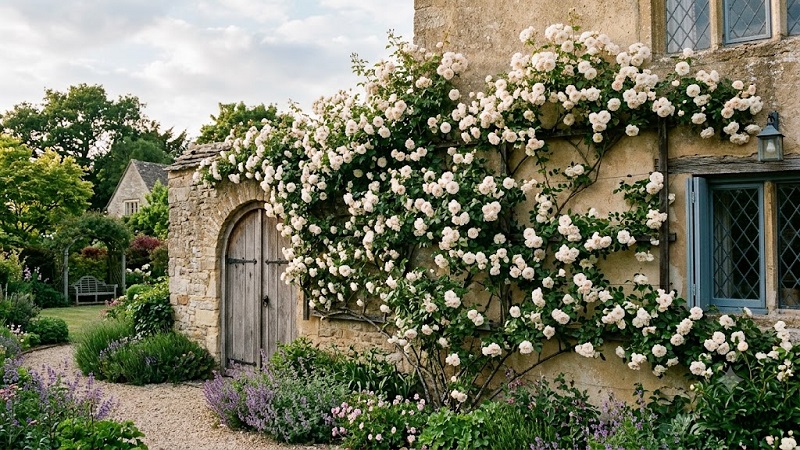
Its pale flowers can brighten a darker wall and make it useful around older buildings, garden boundaries and sheltered structures. Give the plant room to develop and train the stems horizontally where possible.
As with other climbing roses, avoid planting directly against a wall if the ground there is exceptionally dry. Work organic matter into the planting area and water deeply while the rose establishes.
The table below gives a quick way to narrow the list according to flower colour, fragrance character and the type of structure you want to cover.
| Rose | Flower Colour | Fragrance | Best Use | Flowering Character |
|---|---|---|---|---|
| Gertrude Jekyll | Rich pink | Strong old rose | Short climber, arch, wall | Repeat flowering |
| Zéphirine Drouhin | Cerise pink | Strong and sweet | Arch, fence, wall | Long flowering period |
| New Dawn | Blush pink | Fragrant | Wall, fence, large support | Repeat flowering |
| Claire Austin | Creamy white | Myrrh, sweet and herbal notes | Arch, pergola, wall | Repeat flowering |
| The Generous Gardener | Soft pink | Light musk | Tall wall, pergola | Repeat flowering |
| Wollerton Old Hall | Apricot | Rich, warm fragrance | Wall, pergola, arch | Repeat flowering |
| Bathsheba | Apricot-yellow | Fragrant | Arch, pergola, wall | Repeat flowering |
| Strawberry Hill | Soft pink | Fragrant | Sunny wall, arch | Repeat flowering |
| Constance Spry | Soft pink | Rich old-rose style | Large arch, pergola, wall | Single major flush |
| Madame Alfred Carrière | Pale blush | Sweet and musky | Wall, fence, sheltered structure | Repeat flowering |
A rose grown over an arch is experienced at close range. This makes fragrance especially important, but it also means growth habit matters. A rose with extremely long, vigorous canes can quickly become difficult to manage on a narrow arch.
For a small garden arch, look for a rose that can be trained without producing an excessive amount of growth. Gertrude Jekyll is useful in this situation because it can be trained as a shorter climber. Zéphirine Drouhin is another practical choice where thornless stems are desirable.
Larger arches and pergolas can accommodate more vigorous roses such as The Generous Gardener or other substantial climbing varieties. The support should be installed before the rose becomes large enough to put significant weight on the structure.
If the arch crosses a path, position the rose so flowers are close to head height without creating an obstruction. The best scented rose is not necessarily the most useful if its flowers are ten feet above the path where few people can smell them.
Walls create a useful growing environment for climbing roses, but they can also create dry soil close to the base. Rain may be partly excluded by the structure, particularly beneath an overhanging roof or gutter.
When planting beside a wall, improve the soil before planting and make sure water can reach the root zone. Leave enough room between the plant and the wall for healthy root development and airflow.
Consider the direction of the wall as well. Sunny south- and west-facing walls can become hot and dry, while north-facing walls may receive considerably less direct sunlight. New Dawn and Madame Alfred Carrière are useful examples of roses that can cope with less sunny wall conditions better than many sun-loving choices.
Prioritize good soil moisture, adequate irrigation and a support that does not trap excessive heat around the stems.
Choose varieties known to tolerate reduced direct light, but remember that shade tolerance does not mean a rose will perform well in deep, permanent darkness.
A good planting position is one of the most important parts of growing a successful climbing rose. The plant may eventually become the dominant feature on its support, but strong roots are needed before that can happen.
Most climbing roses prefer a position with good light and fertile, well-drained soil. Check the mature dimensions before planting and make sure the structure has enough capacity for the eventual size.
Dig a generous planting hole and improve poor soil with suitable organic matter. Avoid creating a small pocket of rich soil surrounded by compacted ground; roots benefit from an area that allows them to expand naturally.
Follow the nursery's instructions for the particular rose, especially when planting grafted roses. Firm the soil gently around the roots and water thoroughly after planting.
Apply a layer of organic mulch around the plant, keeping it away from direct contact with the main stems. Mulching helps conserve moisture and contributes organic matter as it breaks down.
Do not wait until long stems have become tangled. Secure young canes to the support with soft ties, allowing enough room for natural movement and stem expansion.
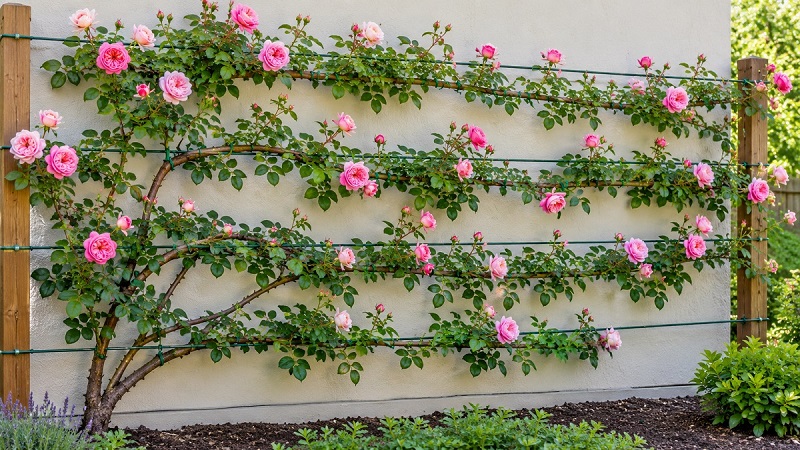
Training is what turns a climbing rose into a convincing architectural feature. The basic principle is simple: use the support to distribute the plant rather than allowing all of the growth to collect at the top.
Many climbing roses produce flowering shoots along stems that have been trained across a support. A purely vertical arrangement can leave the lower portion of a wall relatively bare while the upper section becomes crowded.
Choose ties that will not cut into the stems as they thicken. Check them periodically, particularly after periods of rapid growth.
Give the main canes their own space. A little patience while positioning each stem can make pruning and maintenance much easier later.
For a rose planted at one side of an arch, guide the strongest canes upward and then across the framework. For an arch designed to be covered from both sides, planting one rose on each side can create a more balanced effect, provided the available space and mature size allow it.
Newly planted roses need consistent watering while their root systems establish. Established plants are more resilient, but they still benefit from deep watering during prolonged dry weather, particularly when growing against walls where soil can dry quickly.
Roses produce a substantial amount of growth and flowers, so fertile soil is valuable. Apply a suitable rose fertilizer according to the product label and maintain soil health with well-rotted organic matter or compost where appropriate.
Removing faded flowers can keep repeat-flowering roses looking tidy and may encourage further flowering. The exact approach depends on the rose and whether you want to retain hips later in the season.
Pruning depends heavily on the rose's flowering habit. Repeat-flowering climbers are generally managed differently from once-flowering climbers and ramblers. Always identify the rose before making major cuts rather than applying one pruning method to every plant.
For trained roses, start by removing dead, damaged or weak growth. Then consider whether older stems need replacing with younger, productive canes. Tie suitable new growth into the framework as the season progresses.
Avoid creating an impenetrable tangle of stems. Good spacing around the framework makes the plant easier to inspect and can reduce the conditions that encourage common fungal problems.
Planting a fragrant cultivar is only the beginning. Location can make a major difference to how much of its perfume you actually experience.
A fragrant rose beside a bench, patio, doorway or frequently used path is more rewarding than one hidden at the far end of a border. Arches are naturally useful because visitors pass close to the flowers.
Fragrance can seem more noticeable during cooler, calmer periods. Visit your roses at different times of day before deciding where to plant additional varieties.
Temperature, humidity, flower age and weather can influence scent. A rose may smell different immediately after rain compared with a warm, dry morning.
A garden can become more interesting when roses with different scent profiles are used in separate areas. A classic old-rose fragrance near a doorway can be followed by a softer musk or myrrh-scented rose along a pergola.
Rose foliage can be affected by black spot, rust and powdery mildew. Good airflow, appropriate watering practices and regular removal of badly affected fallen foliage can help reduce problems. Choose planting positions that do not remain excessively damp and crowded.
Aphids often gather around tender shoots and flower buds. Small populations may be controlled naturally by predators such as ladybirds, hoverfly larvae and lacewings. Inspect new growth regularly rather than waiting until an infestation becomes severe.
Poor flowering can have several causes, including inadequate light, excessive shade, insufficient moisture, poor nutrition, overcrowding or unsuitable pruning. Before feeding heavily, check whether the plant is receiving enough light and whether its stems are being trained effectively.
This usually indicates a mismatch between the cultivar and the structure. Strong annual pruning can keep a vigorous rose under some control, but it is better to choose a suitable variety from the beginning.
Gertrude Jekyll is one of the strongest choices for classic old-rose fragrance. It is especially useful when you want a strongly scented pink rose that can be trained as a shorter climber. Fragrance intensity varies with weather and growing conditions, so personal preference is still important.
The best choice depends on the size of the arch. Gertrude Jekyll works well where a shorter climbing rose is appropriate, while Zéphirine Drouhin is useful for larger structures and has the additional advantage of thornless stems.
New Dawn is a notable option because the RHS lists it as suitable for a north-facing wall. Madame Alfred Carrière is another rose worth considering for a wall with reduced direct sunlight. Shade tolerance does not mean a rose should be planted in deep darkness; adequate ambient light remains important.
Yes. Zéphirine Drouhin is a well-known example of a thornless climbing rose. This can be particularly useful around narrow paths, seating areas and entrances where thorny stems may become inconvenient.
Yes. Although Gertrude Jekyll is also grown as a shrub, it can be trained as a short climber and is suitable for walls and similar vertical structures.
Where the structure allows it, spreading the main stems sideways or diagonally can help distribute flowering growth over a larger area. It also creates a more natural covering than tying every stem straight upward.
No. Some climbing roses repeat flower throughout the season, while others produce one major flush. Constance Spry, for example, is valued for its spectacular traditional display but is not a repeat-flowering rose in the same way as many modern climbers.
Leave enough room for roots to establish and for air to circulate around the plant. The exact spacing depends on the structure, soil and rose, so follow the nursery's planting guidance for the particular cultivar rather than using one fixed distance for every rose.
Fragrant climbing roses are at their best when the plant, structure and garden setting work together. Gertrude Jekyll offers an especially strong old-rose perfume, Zéphirine Drouhin brings thornless stems to a vigorous climbing rose, New Dawn is useful for walls including north-facing situations, while Claire Austin and The Generous Gardener provide softer alternatives for arches, pergolas and walls.
The most important decision is not simply which rose has the strongest scent. Consider how large the plant will become, how much sunlight the site receives, whether you want repeat flowers, and how close people will be to the blooms. A well-chosen rose trained carefully over a suitable support can turn a functional structure into one of the most memorable features in the garden.
Explore more practical guides to growing and caring for beautiful flowers and ornamental plants. Discover planting tips, seasonal care, watering, pruning, propagation, and garden design ideas to help you create a healthier and more attractive landscape.