Best Shade-Tolerant Climbing Roses for North-Facing Walls
Discover the best shade-tolerant climbing roses for north-facing walls, including New Dawn and Madame Alfred Carrière, with planting and care tips.
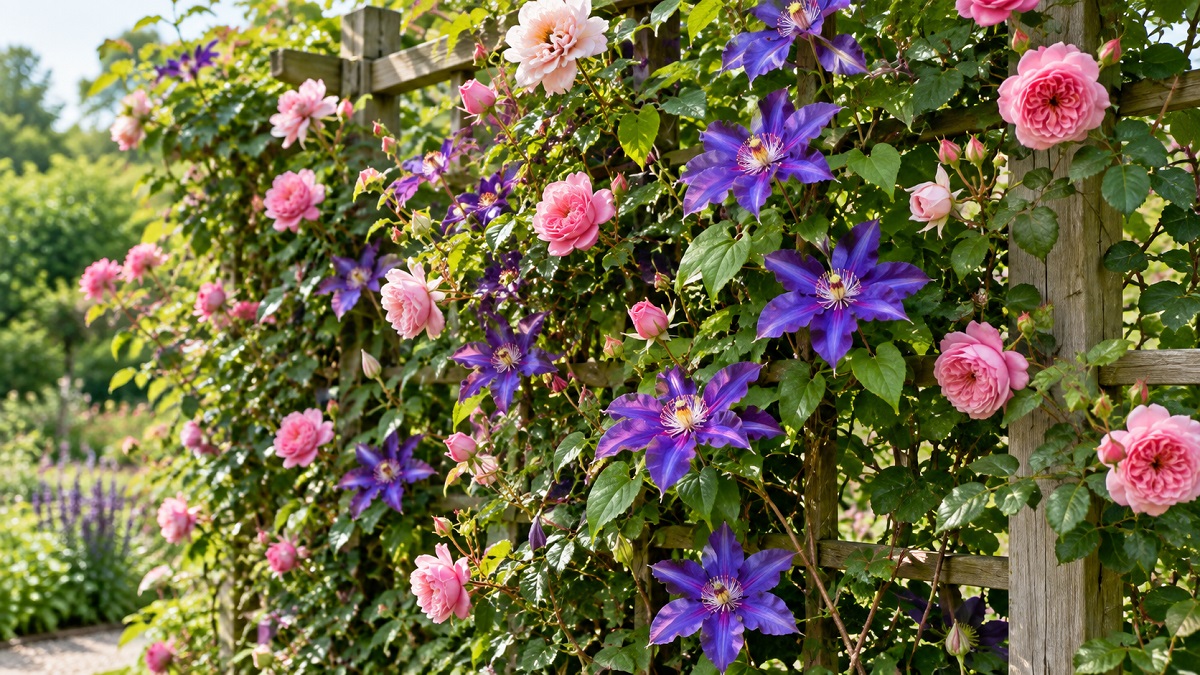
Pairing clematis with climbing roses is one of the easiest ways to turn a plain wall, arch, fence, or sturdy trellis into a living display of flowers. The combination works particularly well because the two plants can occupy the same vertical space while contributing very different textures and flowering habits. A rose supplies strong stems, glossy foliage, and large blooms, while clematis can thread through the framework with lighter foliage and flowers that appear in a different shape and color.
The trick is not simply to plant one of each and let them grow together. Successful combinations depend on matching their flowering periods, mature size, pruning requirements, color, and growing conditions. You also need a support strong enough for a mature climbing rose and enough room around the roots for both plants to establish without competing excessively.
For the best result, match the clematis to the rose's size, bloom timing, and pruning routine.
Roses and clematis complement one another naturally because they bring different forms to the same vertical garden. A climbing rose usually provides the structural framework, with long canes trained across a wall, arch, pergola, or trellis. Clematis can then weave among those canes and add flowers in spaces where the rose foliage may be relatively open.
This layered effect is especially useful in smaller gardens. Instead of needing separate beds for each plant, you can use one vertical support to create a more complex planting. The rose becomes the backbone of the display, while clematis acts almost like a flowering companion threaded through it.
Climbing roses offer strong architectural stems, substantial foliage, fragrance in many cultivars, and large flowers. They can form the dominant framework of an arch, fence, or wall.
Clematis generally has a lighter visual presence. Its twining leaf stems can move through the rose's framework, creating additional flowers without completely hiding the rose.
Rather than choosing two plants simply because their flowers look attractive together, consider the entire planting from a distance. Look at stem structure, foliage density, flower size, bloom position, and the amount of bare support that will remain visible.
Start with the rose rather than the clematis if the rose is going to be the permanent structural plant. Climbing roses vary considerably in mature size, growth habit, flowering pattern, and flexibility of their canes.
On a small arch or narrow fence, an excessively vigorous rose can quickly overwhelm its companion. For a larger pergola or substantial arbor, however, a more vigorous climbing rose may provide the height and coverage needed for the design.
Check the expected height and spread of the rose before purchasing a clematis. The goal is to leave enough vertical space for the clematis to develop without having to fight through a dense mass of rose stems.
Repeat-flowering climbing roses can provide color over a long period, making them useful companions for clematis with different flowering seasons. A rose that has a strong flush at one time of year can also be paired with a clematis that peaks before or after it, creating a succession rather than a single burst of flowers.
Flexible rose canes that can be trained horizontally or diagonally are particularly useful on trellises and arches. Training canes outward rather than keeping them all upright often encourages flowering along more of the available framework.
Clematis is not one uniform type of plant. Different cultivars vary in mature size, flower size, flowering season, and pruning requirements. Those differences matter when the plant will share a support with a rose.
For a mixed planting, avoid choosing a clematis solely because it has a beautiful flower. Its mature growth habit needs to fit the rose and the available support.
| Characteristic | What to Look For | Why It Matters |
|---|---|---|
| Mature size | Fits the height and width of the support | Prevents one plant from overwhelming the other |
| Flowering period | Complements or overlaps the rose's bloom season | Creates a longer-lasting display |
| Flower color | Contrasts with or harmonizes with the rose | Keeps the planting visually balanced |
| Pruning group | Fits the amount of maintenance you can provide | Makes annual pruning easier to coordinate |
| Growth density | Moderate growth for smaller supports | Reduces crowding and shading |
Large-flowered cultivars can create a dramatic contrast with roses. Their individual blooms are often easy to notice among rose foliage, particularly when the two plants have contrasting flower colors.
Viticella-type clematis are often useful in mixed plantings because many have a vigorous, freely flowering habit. Their smaller flowers can create a softer effect than very large blooms and can weave attractively through a rose framework.
Clematis that flowers later in the growing season can extend the visual interest after an earlier rose flush has faded. This is particularly useful when the goal is succession rather than simultaneous peak bloom.
One of the most useful ways to design a rose-and-clematis combination is to think about when each plant flowers. Two plants that bloom at exactly the same time can produce a spectacular peak, but they can also compete for attention. Plants with staggered flowering periods can keep the support interesting for longer.
Before buying the pair, check the typical flowering period of the specific cultivars in your climate. Flowering dates can shift with temperature, winter conditions, pruning, and local growing conditions.
Choose cultivars whose flowering periods overlap. This approach works well when you want the trellis to become a strong focal point during a particular season.
Combine plants whose main flowering periods follow one another. The rose can provide the first major flush, followed by a clematis that comes into its own later.
A little overlap is often desirable. Completely separate flowering seasons may leave one plant looking like an afterthought when the other is in bloom.
Color is where this pairing becomes especially personal. There is no single correct combination, but a few simple principles can prevent the planting from becoming visually busy.
A purple or violet clematis can stand out strongly against a pale pink, white, cream, or soft yellow rose. Similarly, a pale clematis can brighten a darker rose.
For a quieter planting, choose colors that sit close together. Pink roses with mauve, lavender, or soft rose-colored clematis can produce a romantic effect without a sharp color break.
Flowers are not the only color element. Dark green rose foliage, lighter clematis leaves, bark, painted trelliswork, and the background wall all influence how the flowers appear.
A climbing rose can become a substantial plant, so the support should be installed before the planting becomes established. The trellis, arbor, pergola, or wires need to be securely attached to something capable of carrying the mature plant.
Clematis climbs differently from a climbing rose. Many clematis use leaf stems to grasp relatively narrow supports, while roses generally need their canes to be guided and tied. A support that works for a rose may therefore need additional fine lines, netting, or narrow trellis elements for the clematis.
Do not expect the clematis to automatically cover the entire rose. Guide young clematis shoots toward suitable sections of the support and loosely secure rose canes where necessary.
Dense growth can trap moisture and make maintenance more difficult. Avoid packing multiple vigorous plants into a very narrow structure. Good spacing and sensible training allow leaves to dry more quickly and make it easier to inspect both plants.
Prepare the planting area before either plant goes into the ground. Both need fertile, well-drained soil and consistent moisture during establishment, but neither should sit in permanently waterlogged soil.
Avoid planting the two crowns directly on top of each other. Giving each plant its own root space makes watering, feeding, pruning, and troubleshooting much easier.
The flowers may share the same vertical space, but the roots still need room below ground. Competition becomes more noticeable when the planting area is small, dry, or crowded with other perennials.
A layer of organic mulch can help keep the root zone cooler and reduce rapid moisture loss. Keep mulch slightly away from the base of the plants to avoid creating persistently damp conditions around the crowns and stems.
During hot or dry weather, check the soil rather than relying solely on a fixed watering schedule. Plants growing beside walls and paving can dry out faster than those in an open border.
Pruning is one of the most important considerations when combining these plants. Climbing roses and clematis do not necessarily follow the same pruning schedule, and clematis pruning varies according to type.
Clematis are commonly divided into pruning groups based on when they flower and where their flower buds develop. Before cutting back a clematis, identify its pruning group rather than treating every cultivar the same way.
The appropriate pruning approach depends on whether the rose is a climber, rambler, repeat-flowering cultivar, or another growth type. Follow the requirements of the particular rose rather than applying a generic pruning routine.
During pruning, remove weak, damaged, crossing, or poorly positioned growth as appropriate for the plant. The objective is not to create a perfectly bare framework, but to maintain enough space for both plants to receive light and remain accessible.
Identify the clematis pruning group before making major cuts. A mistake in timing can remove flower-producing wood and reduce the following season's display.
Once established, the planting is relatively straightforward if the support, spacing, and plant choices were right from the beginning. Regular observation is more useful than constant intervention.
Water deeply when the soil is becoming dry, especially during establishment and periods of hot weather. The exact frequency depends on soil type, rainfall, temperature, container versus in-ground planting, and exposure.
Feed according to the needs of the individual plants and the fertility of the soil. Avoid excessive nitrogen, which can encourage lush leafy growth at the expense of the balanced flowering display you are trying to create.
Check the support throughout the growing season. Rose canes may need tying, while young clematis shoots can be guided toward suitable parts of the trellis before they become tangled.
Remove spent flowers according to the needs of the particular rose and clematis cultivar. Deadheading can keep the display tidy and, for plants that respond to it, encourage additional flowering.
Inspect leaves, stems, and developing buds regularly. Dense plantings should be checked from both the front and back because problems can develop unseen inside the framework.
Remove weeds and excessive volunteer growth around the planting. A clean root-zone area makes it easier to water correctly and spot early signs of stress.
| Mistake | What Can Happen | Better Approach |
|---|---|---|
| Choosing plants only by flower color | The mature plants may be incompatible in size or growth habit. | Compare mature size, pruning, and flowering season first. |
| Using a weak support | The structure can sag or become difficult to maintain. | Install a strong support before planting. |
| Planting both crowns too closely | Root competition and maintenance problems can increase. | Give each plant its own root space. |
| Ignoring pruning groups | Clematis flowering wood may be removed accidentally. | Identify the clematis pruning group first. |
| Allowing unchecked growth | The clematis may disappear inside the rose or become tangled. | Guide and train new growth throughout the season. |
| Overcrowding the support | Air circulation and access for maintenance can suffer. | Choose plants whose mature sizes fit the structure. |
The following approaches can help when planning a new vertical planting. Use them as design concepts rather than fixed recipes, since cultivar availability and performance vary by climate.
This is a classic contrast. The pale rose creates a soft background while deep purple or violet clematis flowers provide definition among the foliage.
White flowers keep the composition light, while blue-violet clematis adds cool color without making the display feel overly warm or saturated.
For a gentler combination, choose related pink, lavender, and mauve tones. The result can feel cohesive even when the plants are flowering heavily at the same time.
A warm yellow rose against a cooler purple clematis creates a noticeable contrast. Keep the surrounding planting restrained so the two climbers remain the visual focus.
Instead of prioritizing matching colors, choose a rose and clematis with flowering periods that complement one another. This approach is useful when your main goal is to keep the structure colorful for as much of the growing season as practical.
A successful combination should look as though the two plants belong together rather than appearing as two separate specimens forced onto the same trellis. Allow some stems to overlap, but retain enough visual separation that each plant can still be recognized.
Repeating the same clematis color elsewhere in the garden can also help connect the planting to nearby beds. Likewise, echoing the rose color with smaller flowering plants can make the vertical display feel integrated into the wider landscape.
Think about the view from several angles. A combination that looks beautiful from directly in front may appear crowded from the side. This is particularly important on arches and pergolas where people walk underneath or beside the planting.
| Season | Main Tasks |
|---|---|
| Late winter | Check the support, identify clematis pruning requirements, and complete appropriate pruning. |
| Spring | Guide new growth, mulch the root zone, monitor moisture, and watch for early pest or disease symptoms. |
| Summer | Water during dry periods, train shoots, remove damaged growth, and enjoy the main floral display. |
| Autumn | Remove fallen or diseased foliage where appropriate and check ties and supports before winter weather. |
Clematis and climbing roses can turn an ordinary vertical structure into a layered garden feature, but the best combinations are planned around more than flower color. Start with the size of the support, choose plants with compatible growth habits, consider when each one flowers, and make sure their pruning requirements can be managed together.
Once planted, guide young stems instead of waiting for them to become tangled, keep the root zones adequately watered, and leave enough room for air and light to move through the foliage. With thoughtful plant selection and regular training, the rose can provide the framework while clematis threads through it with an additional season of color and texture.
Explore more practical guides to growing and caring for beautiful flowers and ornamental plants. Discover planting tips, seasonal care, watering, pruning, propagation, and garden design ideas to help you create a healthier and more attractive landscape.