How to Train Climbing Roses: Horizontal Training, Ties & Support
Learn how to train climbing roses on walls, fences and trellises. Discover horizontal and diagonal training, tie-back techniques, spacing, pruning and maintenance.
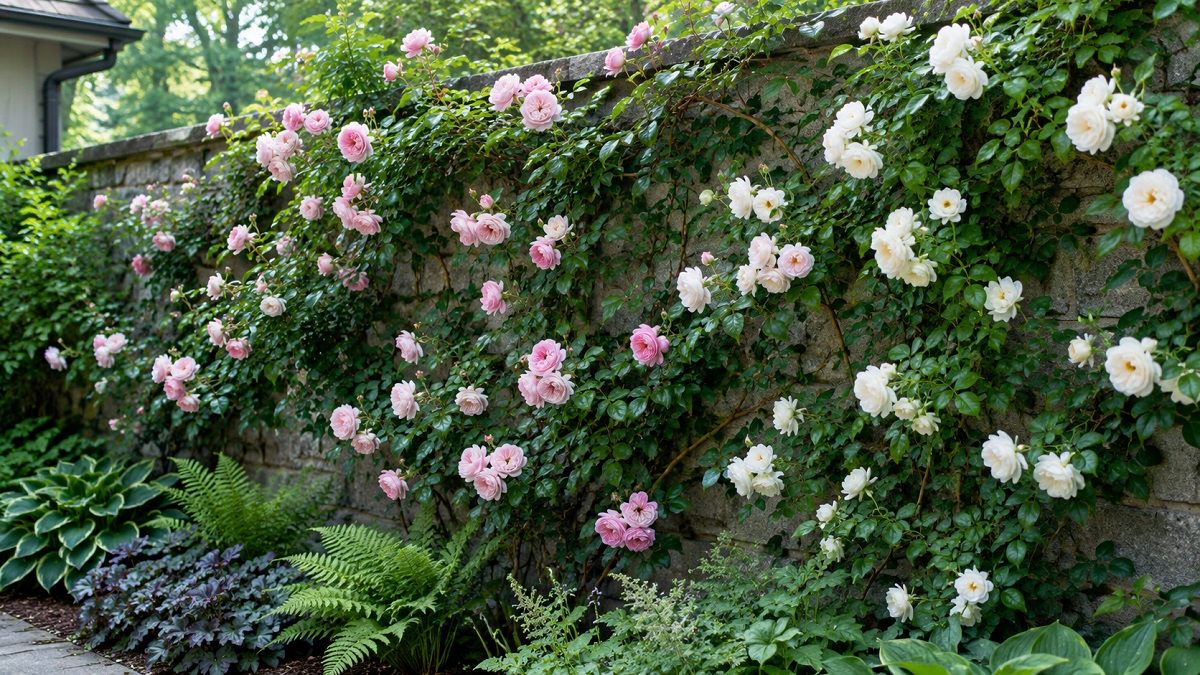
A north-facing wall can be one of the trickier places to grow a rose. In the Northern Hemisphere, it usually receives less direct sunlight than a south- or west-facing wall, and the area immediately beside the wall can also become dry because rainfall is partly blocked by the structure. That does not mean you have to give up on roses, though.
Several climbing and rambling roses are surprisingly adaptable to light shade. The key is to choose a variety that can flower with fewer hours of direct sun, give its roots reasonably fertile soil, and train the stems across the support instead of allowing them to grow as a few upright shoots.
For a north-facing wall, some of the most useful choices include 'Madame Alfred Carrière', 'New Dawn', 'Zéphirine Drouhin', 'Gertrude Jekyll' when grown as a climber, and several other roses traditionally recommended for shady walls. The best choice depends on how much light the wall actually receives, the space available, and whether fragrance, flower colour, repeat flowering, or low-thorn growth matters most to you.
North-facing walls are not completely sunless. A few hours of useful light can make a significant difference to flowering.
It is important to set realistic expectations before choosing a rose for a shady wall. Shade tolerance does not mean that a rose will flower just as heavily as it would in full sun. Most roses still perform best when they receive several hours of good light.
A north-facing wall can nevertheless provide a useful growing position if it is open to the sky and receives some reflected or indirect light. A wall that gets a little morning or afternoon brightness can be very different from a site that remains dark beneath trees or between tall buildings all day.
Flowering may be lighter in deep shade, and growth can become more stretched as the plant searches for light. Good air circulation is also important because leaves that stay damp for long periods can encourage fungal problems.
Another consideration is the soil. The narrow strip immediately beside a wall is often overlooked during watering. Roof overhangs, gutters and the wall itself can leave the planting area considerably drier than the rest of the garden. Check the soil rather than assuming that rainfall is reaching the roots.
If the wall is bright during the day and receives several hours of usable light, you have many more options than you would in deep, permanent shade. Choose the brightest part of the wall for the rose and avoid placing it directly underneath dense tree cover.
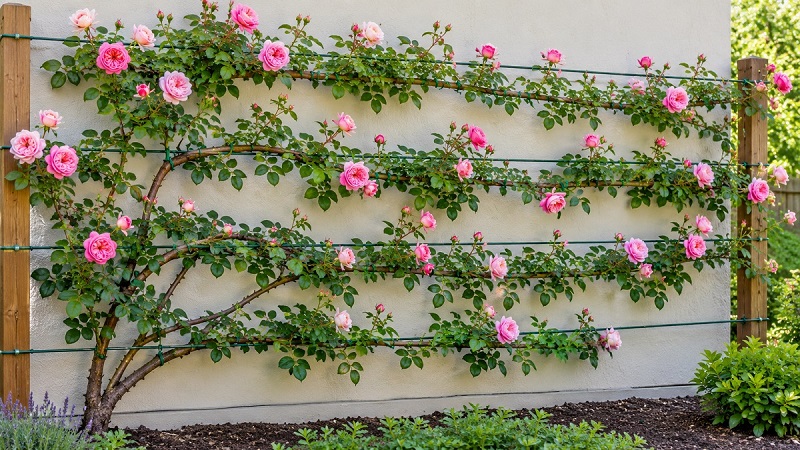
A climbing rose does not naturally behave like a vine that automatically covers a wall evenly. Its long stems need to be tied to a suitable support. Spreading the main stems sideways or diagonally encourages flowering shoots along their length instead of concentrating growth at the top.
The following roses are useful candidates for north-facing walls and other partially shaded positions. They are not identical in habit. Some are vigorous climbers, some are shrub roses that can be trained as climbers, and some are ramblers that need considerably more room.
| Rose | Flower Colour | Fragrance | Typical Use | Shade Suitability |
|---|---|---|---|---|
| 'Madame Alfred Carrière' | Creamy white with blush-pink tones | Strong | North wall, fence, large support | Very good |
| 'New Dawn' | Soft blush pink | Fragrant | Wall, fence, arch | Very good |
| 'Zéphirine Drouhin' | Pink | Strong | Wall, fence, arch | Good |
| 'Gertrude Jekyll' | Rich pink | Very strong | Climber or trained shrub | Good |
| 'Climbing Iceberg' | White | Light fragrance | Wall or fence | Good |
| 'Félicité Perpétue' | Creamy white with pink-tinged buds | Fragrant | Large wall or arch | Good |
| 'The Generous Gardener' | Soft pink | Fragrant | Wall, arch or large support | Good |
If fragrance is high on your list, 'Madame Alfred Carrière' is one of the first roses worth investigating for a north-facing wall. It is a vigorous climber with flexible, relatively thorn-light stems and creamy-white flowers carrying soft pink colouring.
One of its useful characteristics is its ability to cope with a north-facing position. The flowers also work well against a darker background because the pale colouring remains easy to notice in subdued light.
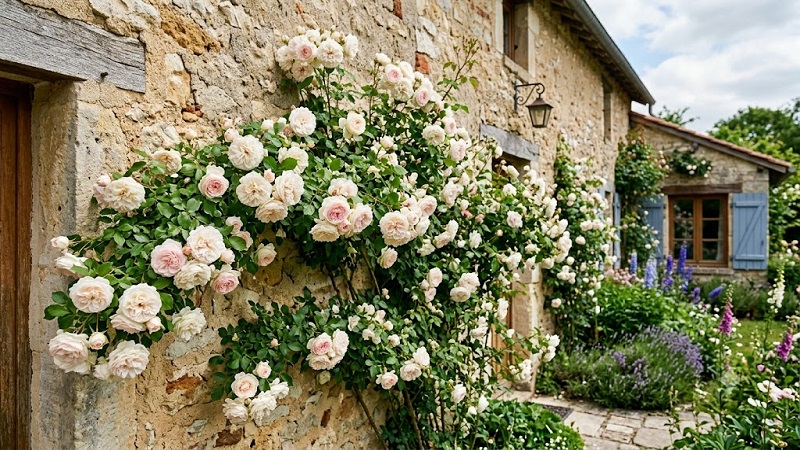
This is not a rose for a tiny trellis. It can become a substantial plant, so give it a strong support and enough room to develop. If you have a tall wall, fence or large pergola, its size becomes an advantage rather than a problem.
'New Dawn' is another particularly useful choice for a north-facing wall. It produces soft blush-pink flowers and dark green foliage, creating a gentle colour combination rather than the dramatic contrast of a deep red rose.
The RHS specifically describes 'New Dawn' as suitable for a north-facing wall and lists it for full sun or partial shade. It can make a substantial climber, so provide a sturdy framework from the beginning rather than relying on a lightweight garden trellis.
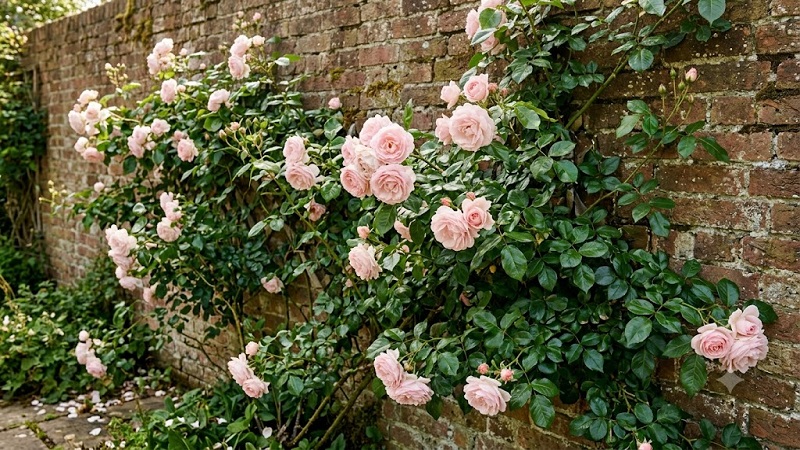
Its repeat-flowering habit is useful when you want more than one short flush of flowers. In a shady site, however, flowering will still depend on the amount of available light. A bright north-facing wall is much more promising than a deeply enclosed corner.
Use 'New Dawn' where you want a classic climbing rose to cover a wall, fence or large support without requiring a completely sunny position. Its pink flowers are especially attractive against brick, stone and dark-painted backgrounds.
'Zéphirine Drouhin' is well known for its fragrant pink flowers and relatively thornless stems. That last feature can be particularly useful when the rose is being trained close to a path, doorway or seating area.
Although it is commonly associated with sunny rose gardens, the RHS lists it as tolerant of shade and a north aspect. It therefore deserves consideration where you want a fragrant pink climber but would rather avoid a heavily thorny plant.
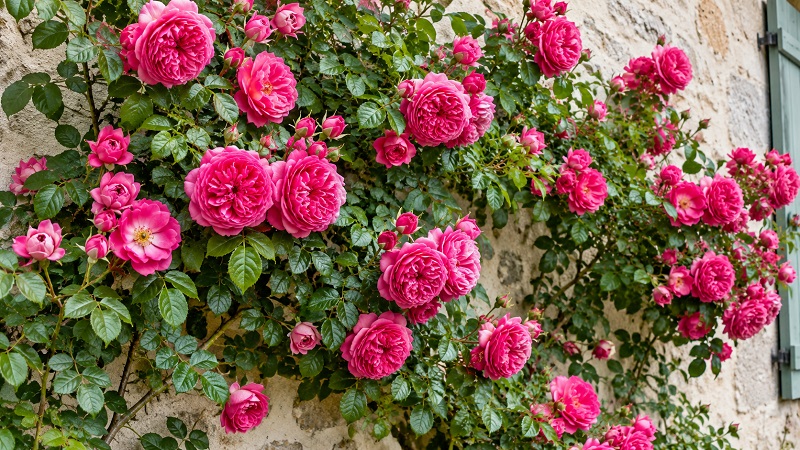
Give it fertile, well-drained soil and a support that allows the stems to be spread out. Avoid planting it in a permanently wet corner simply because the location is shaded. Shade and poor drainage are two separate problems, and combining them can make rose growing considerably harder.
Its comparatively low-thorn character makes 'Zéphirine Drouhin' worth considering where people regularly walk close to the rose. You still need to train and secure the stems properly, but there are fewer sharp thorns to contend with than on many traditional climbing roses.
Even a shade-tolerant rose benefits from the brightest available section of the wall. If another building, dense hedge or tree blocks the sky above the plant, flowering may be noticeably reduced.
'Gertrude Jekyll' is especially appealing if fragrance is more important to you than having an unusually large climber. It produces strongly scented, rich pink flowers and can be grown either as a shrub or trained as a climber.
Its flexibility makes it useful for gardens where you do not want a huge rambler taking over the wall. When grown as a climber, it can provide vertical interest while remaining easier to integrate into a mixed border.
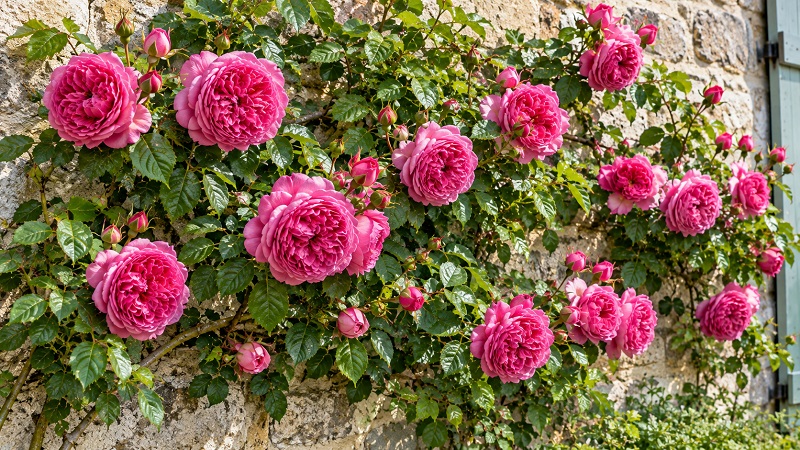
As with any rose in shade, do not expect exactly the same flowering performance you would see in an open, sunny position. Choose the brightest part of the wall and keep surrounding vegetation from creating additional competition for light.
If white flowers are your preference, 'Climbing Iceberg' is a useful option for a shady wall. White flowers can be particularly effective in low-light gardens because they catch available light and remain visible against darker foliage or masonry.
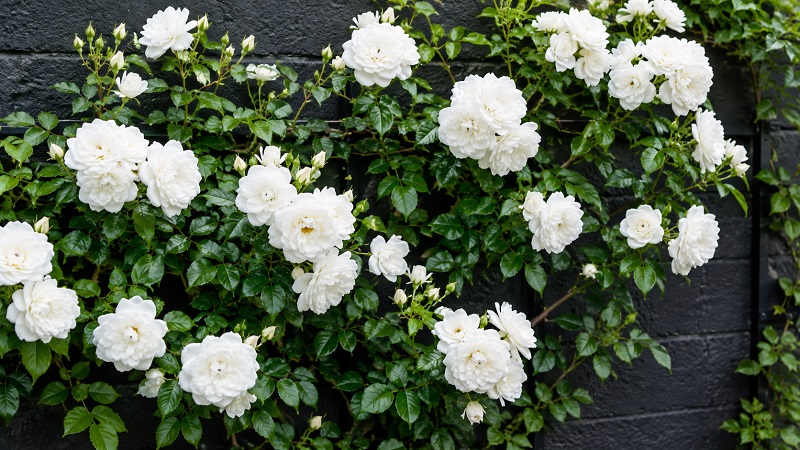
It is included by the RHS among climbing roses suitable for north-facing or shady walls. Allow enough room for the mature plant and provide a proper support system rather than attaching the stems directly to a fragile fence.
'Félicité Perpétue' is a rambling rose with creamy-white flowers and pink-tinged buds. It is a better fit for a generous wall, arch or other large structure than for a compact garden fence.
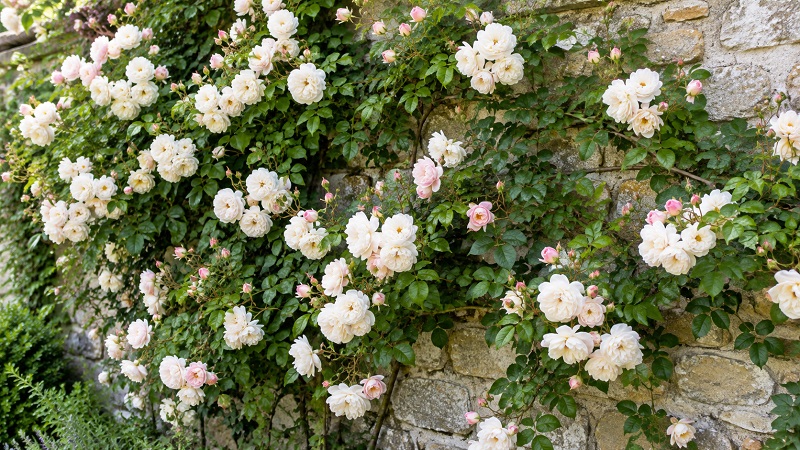
Its size is worth considering before planting. A vigorous rambler can look wonderful when given enough space but become difficult to manage if squeezed into a narrow planting area.
'The Generous Gardener' is another option for a partially shaded wall. Its soft pink flowers have a lighter appearance that can brighten a darker part of the garden.
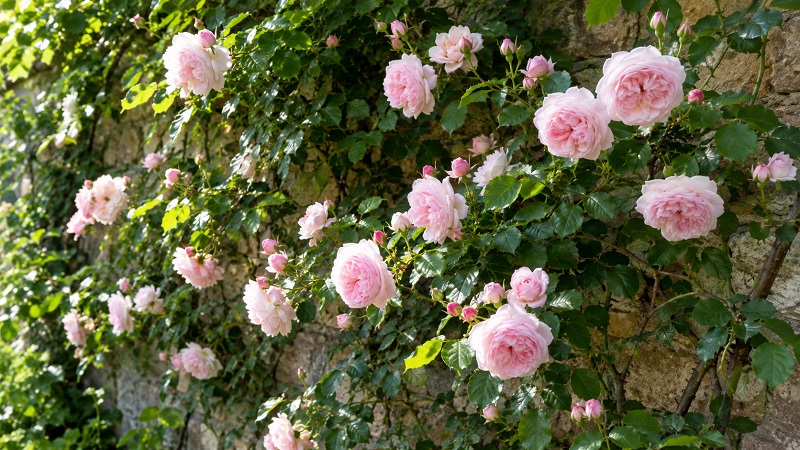
It can be grown as a shrub or trained as a climber, making it useful when you want some flexibility in how the plant eventually fills the space.
Planting position matters almost as much as variety. A shade-tolerant rose still needs a healthy root system, and the soil beside a wall is often less favourable than it appears from the surface.
Observe the wall at different times of day before planting. Look for reflected light from nearby paving, open sky above the wall and any brief periods when direct sunlight reaches the planting area.
Work organic matter into poor or compacted soil before planting, while maintaining good drainage. Roses dislike both waterlogged soil and very dry, impoverished ground.
Leave enough space between the rose and the wall to allow the roots to establish and to make watering easier. The exact distance depends on the structure and soil, but the important point is to avoid trapping the plant in a narrow, dry pocket immediately beside the masonry.
Fix strong wires, a trellis or another suitable framework to the wall before the rose becomes large. Climbing roses can become surprisingly heavy, particularly after rain.
Water slowly so moisture reaches the root zone rather than running away along the surface. Continue monitoring the soil during dry weather because a wall can create a rain shadow.
Training is one of the most overlooked parts of growing a climbing rose. Simply allowing every long stem to grow vertically can leave the lower portion of the wall relatively bare while most of the flowers appear near the top.
Instead, gradually spread the main stems sideways or diagonally across the support. Tie them loosely so they have room to expand. Flowering side shoots can then develop along more of the plant.
On a wall, think of the main stems as the framework and the smaller flowering shoots as the branches that fill it. A little attention during the growing season can make the finished plant look much fuller.
Roses beside walls can dry out faster than expected. Check the soil around the roots before watering. When the soil is dry several centimetres below the surface, give the plant a thorough watering rather than frequent shallow splashes.
A layer of organic mulch can help conserve moisture and improve soil condition. Keep mulch slightly away from the base of the rose rather than piling it against the stems.
Avoid surrounding the rose with dense vegetation that blocks the little light available. Good spacing also helps leaves dry after rain or watering.
A fertile soil supports stronger growth and flowering. Follow the directions of the rose fertiliser you use rather than applying large quantities in the hope of compensating for low light.
Black spot, rust and powdery mildew can affect roses. Shade alone does not automatically cause disease, but poor air movement, wet foliage and unsuitable watering practices can create favourable conditions for fungal problems.
| Mistake | What Can Happen | Better Approach |
|---|---|---|
| Choosing a rose for a completely dark corner | Weak growth and disappointing flowering | Choose the brightest available section of the wall |
| Planting directly against the wall | Dry soil and restricted root development | Leave workable space between plant and wall |
| Using a weak trellis | Support can bend or fail as the rose matures | Use a strong framework fixed securely to the wall |
| Letting every stem grow straight upward | Flowers become concentrated near the top | Train major stems sideways or diagonally |
| Watering only the surface | Roots remain relatively dry | Water deeply enough to wet the root zone |
| Ignoring mature size | A vigorous climber can overwhelm a small support | Match the rose to the available wall or fence |
| Expecting full-sun flowering in deep shade | Flower production may remain disappointing | Use the most shade-tolerant varieties and maximize available light |
There is no single climbing rose that suits every north-facing wall. Start with the conditions you actually have rather than choosing solely by flower colour.
For a large wall where fragrance and shade tolerance are priorities, 'Madame Alfred Carrière' is particularly interesting. If you want soft pink flowers on a classic climber, 'New Dawn' is another strong candidate. For a fragrant rose with relatively thornless stems, 'Zéphirine Drouhin' is worth considering.
If your space is more limited and you want a rose that can also be managed as a shrub, 'Gertrude Jekyll' offers more flexibility. For a lighter visual effect, white-flowering choices such as 'Climbing Iceberg' can work beautifully against a darker wall.
Whichever variety you choose, remember that a north-facing wall is still a challenging rose-growing site. A suitable cultivar, fertile soil, consistent watering, strong support and thoughtful training can make the difference between a sparse plant and a healthy climber that gradually turns the wall into a feature of the garden.
Yes. Some climbing and rambling roses tolerate partial shade and are specifically recommended for north-facing walls. They still need useful daylight, however, so a bright north-facing wall is more suitable than a permanently dark location.
'Madame Alfred Carrière' is a particularly useful choice because it is a vigorous, fragrant climber that is tolerant of shade and north-facing aspects. 'New Dawn' is another well-known option for this type of position.
Flowering is usually reduced when light levels are very low. Shade-tolerant roses are better described as adaptable to partial shade rather than plants that require no sunlight. If the site is extremely dark, a different shade-loving climber may be more appropriate.
Avoid placing the rose directly against the masonry. Leave enough working space for the roots and for watering, with the exact distance depending on the wall, soil and support arrangement. The important issue is preventing the root zone from becoming a dry, restricted pocket.
Spreading the main stems sideways or diagonally can encourage flowering shoots along a larger section of the plant. This is especially useful when the goal is to cover a wall evenly rather than create a tall column of growth.
Yes. 'New Dawn' is listed by the RHS as suitable for a north-facing aspect and partial shade. It produces soft blush-pink flowers and can make a substantial climbing plant.
'Madame Alfred Carrière' has relatively few thorns and 'Zéphirine Drouhin' is also noted for its thornless character. These qualities can be useful when a rose is being trained near paths or frequently used areas.
Note: Rose performance varies with climate, soil, available daylight and local growing conditions. A rose described as shade-tolerant can still produce fewer flowers in a deeply shaded position than it would in brighter light.
Explore more practical guides to growing and caring for beautiful flowers and ornamental plants. Discover planting tips, seasonal care, watering, pruning, propagation, and garden design ideas to help you create a healthier and more attractive landscape.