Best Shade-Tolerant Climbing Roses for North-Facing Walls
Discover the best shade-tolerant climbing roses for north-facing walls, including New Dawn and Madame Alfred Carrière, with planting and care tips.
Climbing roses often have plenty of vigorous growth but still fail to cover a wall, arch, fence, or trellis evenly. The problem is not always the rose itself. Long canes left to grow straight upward tend to concentrate flowering near their upper portions, while lower sections can remain surprisingly bare.
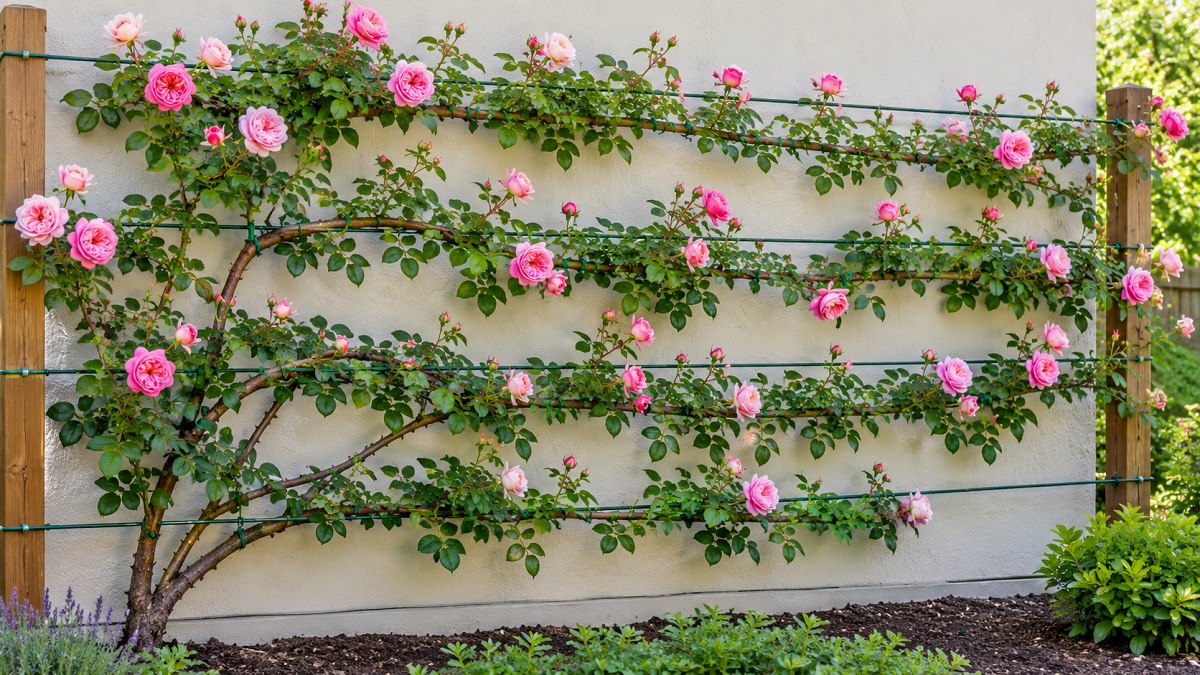
Training changes that pattern. By guiding the main canes sideways, diagonally, or in broad curves and securing them with flexible ties, you can spread the plant across its support instead of allowing a few stems to dominate. Horizontal training is particularly useful because it encourages flowering growth along more of the length of the trained cane.
The technique is simple, but the details matter. Canes should be positioned gradually, ties should leave room for expansion, and the plant should be checked regularly as new growth develops. With a little patience, training can turn a tangled climber into a much more balanced feature in the garden.
The basic idea: spread the main canes across the support rather than letting them grow as a tight upright bundle.
A climbing rose does not automatically know how to cover a support evenly. Left alone, many varieties send strong shoots upward toward available light. Those upright stems can become crowded at the top while the lower part of the support receives comparatively little flowering growth.
Training gives you control over where the main framework grows. Instead of allowing several dominant canes to occupy the same space, you can distribute them across the structure and create a more deliberate shape.
The main canes form the framework of the plant. Smaller flowering shoots develop from them. If the framework is arranged across the support, those secondary shoots have more room to fill the space.
Horizontal training is one of the most useful techniques for climbing roses. When a vigorous main cane is trained upward without interruption, the plant tends to put strong growth toward its tip. By bending the cane sideways and securing it along a support, you create a longer framework from which flowering shoots can develop.
The cane does not have to be perfectly horizontal. A shallow diagonal can work just as well, particularly when the support is narrow or the stem is not flexible enough to make a sharp change in direction.
The important point is distribution. Instead of stacking the main canes vertically in one area, spread them through the available space.
Avoid bending a cane sharply against its natural growth direction. Older woody stems may be stiff, and trying to make a sudden 90-degree turn can cause cracking or splitting.
A broad, gradual curve is usually safer. If a cane resists the position you want, train it over several stages rather than forcing it into place in one session.
Young, flexible canes are generally easier to train than thick, mature wood. New growth can often be guided while it is still pliable, whereas an established cane may require a much more gradual approach.
Training is also easier when you can clearly see the plant's framework. Before tying anything, remove dead, damaged or obviously unwanted growth according to the pruning needs of the particular rose.
Avoid doing extensive bending during periods when the stems are especially brittle. Weather, variety and the age of the cane all influence how flexible it will be.
A climbing rose needs a support that can handle both the plant's weight and the additional load created by rain, wind and mature foliage. A lightweight structure that seems adequate when the rose is small may become unstable as the plant develops.
Leave enough space between the rose and a wall when the support system requires airflow behind the plant. The exact arrangement depends on the structure and the rose, but the goal is to make tying, pruning and inspection practical.
Before you start tying, identify the strongest healthy canes that will form the plant's permanent framework. These are not necessarily the longest stems. A useful framework consists of well-positioned canes that can be spread through the available space.
Try to avoid building the entire plant around one or two dominant stems. If several healthy canes emerge from the base, consider how each can contribute to the final shape.
Choose canes that are free from obvious damage and have enough flexibility to reach the support without excessive bending. Young canes are particularly valuable because they can often be directed before they become rigid.
It can be tempting to prune a rose into a neat shape immediately. Give the plant enough time to establish a useful framework first. A cane that looks awkward when upright may become an important horizontal branch once it is redirected.
The process is straightforward: select a suitable cane, guide it toward an open section of the support, and secure it at several points without constricting the stem.
Look at the entire support before moving the cane. Decide where the stem should finish and how its position will leave room for other canes.
Start the bend close to the base of the cane, but do not make a sudden turn. Use a broad curve and work along the stem gradually.
Attach the cane to the support with soft ties. Make the first tie near the beginning of the trained section and add additional ties farther along the cane.
The tie should hold the cane in position without digging into the bark. Stems expand as they mature, and rigid or overly tight ties can cause damage.
Step back and look at the plant from a distance. The best arrangement is not necessarily the one that looks perfect up close. Aim for a framework that fills empty areas without creating unnecessary congestion.
Tie-backs are used to secure rose canes to their support while allowing some natural movement. The choice of tie matters almost as much as the position of the cane.
Soft garden ties, stretchable plant ties or other suitable flexible materials are preferable to thin wire or hard string directly against the stem. The tie should not behave like a cutting edge as the cane moves in the wind.
A loose loop around the cane gives the stem room to expand. Avoid tying the cane tightly against the support simply because it looks tidy on the day you finish the job.
One tie at the end of a long cane usually leaves the middle unsupported. Several attachment points distribute the weight and reduce the chance of the cane swinging or rubbing against the support.
When tying a cane to a wire or narrow support, a figure-eight arrangement can keep the stem from rubbing directly against the support. The crossing point creates a small buffer between the plant and the structure.
Even spacing is more useful than forcing every cane into exactly the same pattern. Think about the support as a three-dimensional growing area rather than a flat grid.
If several canes are trained at the same height, flowering shoots may become crowded. Staggering the framework vertically can create a more natural spread and help different sections of the plant occupy unused space.
| Training Pattern | Useful For | What to Watch |
|---|---|---|
| Horizontal | Wide walls and trellises | Avoid overcrowding at the same height |
| Diagonal | Narrow or angled supports | Keep the angle gradual |
| Broad curve | Arches and decorative structures | Do not force stiff canes |
| Fan-shaped | Walls and broad trellises | Spread the main canes evenly |
Training and pruning work together, but they are not the same job. Training determines where the main framework grows; pruning controls unwanted, damaged, congested or aging growth.
Once the framework is established, inspect the smaller shoots developing along the trained canes. These shoots can eventually become part of the flowering structure, so avoid removing healthy growth simply because it does not point in exactly the direction you expected.
Dead, damaged or badly positioned stems should be dealt with according to the needs of the particular rose. Also watch for growth that crosses and repeatedly rubs against another stem.
A little irregularity is usually better than a dense knot of stems. An open framework makes it easier to inspect the plant, reach the support and carry out future pruning.
This often creates a tall, narrow plant with limited coverage lower down. Redirecting suitable canes sideways gives the plant more room to occupy the support.
A sudden bend can split or damage a stiff cane. Work with the natural flexibility of the stem and use gradual curves.
A tie that looks harmless at first can become restrictive as the cane thickens. Leave space and inspect older ties regularly.
Thin wire or rough material can rub against moving stems. Choose a tie designed for supporting plants and replace anything that begins to damage the cane.
A single long cane may dominate the structure while other healthy stems remain unused. Consider the whole framework before deciding where each cane should go.
A rose can become surprisingly heavy. Check the trellis, wires, fixings and other supporting structures periodically, particularly as the plant becomes larger.
Training is not a one-time task. Climbing roses continue producing new shoots, and those shoots need to be incorporated into the framework as the plant develops.
During the growing season, look over the plant periodically. Guide suitable new canes while they are still flexible, remove or redirect growth that is becoming awkward, and check existing ties.
After strong winds or heavy weather, inspect the plant for loose ties and damaged canes. A stem that has been knocked against a support repeatedly can suffer damage even if it initially appears healthy.
The same basic principles work across different supports, but the way you arrange the canes changes with the available space.
A wall can provide a broad surface for horizontal or fan-shaped training. Use a suitable support system rather than attaching stems directly where doing so could damage the plant or make maintenance difficult.
Fences are useful when the rose needs to provide a living screen. Spread the main canes across the available sections and avoid allowing all the strongest growth to collect at the top.
Trellises make it easy to establish a deliberate pattern. Horizontal wires or openings can provide convenient attachment points, while diagonal training can help fill gaps between fixed points.
On an arch or pergola, guide canes along the structure rather than simply allowing them to grow straight upward. Broad curves can follow the shape of the support while maintaining a manageable framework.
Look at the rose from several steps away. Empty sections are often easier to identify from a distance than while you are standing beside the plant.
If one side is becoming crowded, direct new flexible growth toward the open side. If the upper section is filling too quickly, avoid automatically adding more upright stems there. Instead, consider whether an existing cane can be guided across an underused area.
Over time, the framework becomes easier to manage because the plant begins to grow within the structure you have established.
Climbing roses can have substantial thorns, particularly on mature canes. Wear suitable gloves and protective clothing when reaching into dense growth.
Work slowly when bending older canes. If a stem begins to resist strongly, stop rather than trying to force it into position. A damaged main cane can take time to recover and may leave a noticeable gap in the framework.
Horizontal or gently diagonal training is useful for spreading the main framework across a support and encouraging flowering growth to develop along a larger portion of the plant. The exact arrangement should suit the rose and the available structure.
Ties should hold the cane securely without squeezing it. Use flexible material, leave room for the stem to expand, and inspect ties periodically as the plant grows.
Older canes can be more difficult to bend because they become woody and less flexible. Instead of forcing them, work gradually and use younger canes where possible.
Soft, flexible garden ties are generally preferable to thin or abrasive materials that can cut into or rub against the stem. The tie should accommodate growth and some movement.
Check them regularly during periods of active growth and after strong weather. Any tie that becomes tight, damaged or abrasive should be loosened or replaced.
No. Training depends on the rose's growth habit, the support available and the look you want to achieve. Horizontal, diagonal and fan-shaped arrangements can all be useful.
Training a climbing rose is mostly a matter of guiding growth rather than fighting it. The strongest results come from establishing a useful framework, spreading the main canes through the available space and securing them with ties that support without restricting.
Horizontal and gently diagonal canes can make a large difference when a rose needs to cover a wall, fence or trellis evenly. Add new growth to the framework while it is flexible, keep the ties under observation, and resist the temptation to force mature stems into sharp bends.
With regular attention, the rose gradually becomes easier to manage. Instead of a handful of upright stems competing for space, you can develop a broad, balanced framework that makes better use of the support and creates a more natural flowering display.
Explore more practical guides to growing and caring for beautiful flowers and ornamental plants. Discover planting tips, seasonal care, watering, pruning, propagation, and garden design ideas to help you create a healthier and more attractive landscape.