Growing & Caring for 'Blue Princess' Holly
Learn how to grow and care for 'Blue Princess' Holly, including sunlight, soil, watering, pruning, winter care, pollination, berries, and common problems.
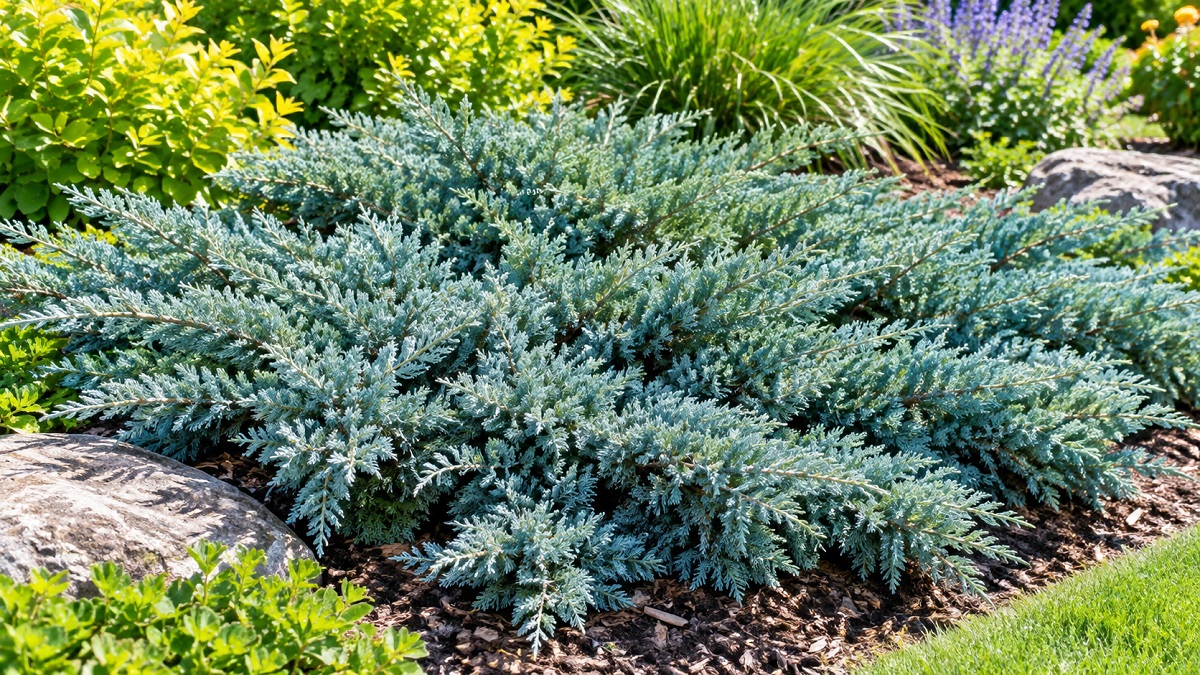
Blue Rug Juniper is one of those plants that can quietly solve several landscape problems at once. It stays close to the ground, spreads outward rather than upward, and keeps its blue-green to silver-blue foliage through the seasons. Instead of competing with taller shrubs and perennials, it fills the spaces beneath them, softens hard edges, and can flow naturally over rocks, retaining walls, slopes, and garden borders.
Usually sold as Juniperus horizontalis ‘Blue Rug’, this plant is also closely associated with the cultivar name ‘Wiltonii’. It is a low-growing form of creeping juniper with a dense, trailing habit. Mature plants are commonly only about 4 to 6 inches tall while spreading several feet wide, making the horizontal growth habit far more important than height when choosing a planting location.
Once established, Blue Rug Juniper is relatively undemanding. The most important conditions are abundant sunlight, sharply draining soil, and sensible watering during establishment. It is much less forgiving of constantly wet ground than it is of dry conditions. With the right site, it can provide year-round structure without the regular pruning, mowing, or seasonal replacement required by many other ground covers.
Blue Rug Juniper is a low-maintenance evergreen ground cover best suited to sunny, well-drained locations.
Blue Rug Juniper is a prostrate, spreading evergreen shrub in the cypress family, Cupressaceae. Rather than forming an upright mound, its flexible branches travel laterally and gradually create a dense mat. The foliage has a distinctive silver-blue appearance that gives the plant its appeal even when it is not being used as a flowering accent.
The plant is particularly useful where a gardener wants a low-maintenance evergreen layer. It can cover bare soil beneath larger landscape plants, run along a sunny walkway, spill over a low wall, or stabilize the visual appearance of a slope. Its low profile also makes it useful where a taller shrub would block a view or overwhelm a narrow planting bed.
One of its most useful characteristics is its tolerance of dry conditions after establishment. This does not mean a newly planted juniper should be neglected. Young plants need consistent moisture while their roots establish, but mature specimens generally cope well with periods of reduced rainfall when planted in an appropriate site.
Its growth pattern is the key. Blue Rug Juniper invests much of its growth in horizontal branches instead of vertical shoots. A healthy specimen can remain only a few inches tall while gradually covering several feet of ground.
The foliage is evergreen and strongly blue-silver, giving the plant visual interest throughout the year. In colder weather, the foliage can develop purple or bronze tones without necessarily indicating a problem.
Sunny banks, rocky beds, dry borders, and the edges of retaining walls can be awkward places for conventional ground covers. Blue Rug Juniper is well suited to these conditions because it prefers full sun and does not demand constantly moist soil.
The following table brings together the main characteristics to consider when choosing and caring for Blue Rug Juniper. Exact size can vary with cultivar naming, climate, soil, and growing conditions, so allow generous horizontal space rather than treating the mature dimensions as a rigid measurement.
| Characteristic | Blue Rug Juniper |
|---|---|
| Botanical name | Juniperus horizontalis ‘Blue Rug’; commonly associated with ‘Wiltonii’ |
| Family | Cupressaceae |
| Plant type | Woody evergreen shrub and ground cover |
| Growth habit | Prostrate, creeping, trailing and spreading |
| Mature height | Approximately 4–6 inches |
| Mature spread | Approximately 4–8 feet, depending on conditions and source |
| Foliage | Dense, fine-textured, silver-blue to blue-gray evergreen foliage |
| Winter color | May develop purple or bronze tones |
| Flowers | Does not produce showy flowers |
| Cones | Small bluish to blue-black, berry-like female cones may develop |
| Sunlight | Full sun; about 6 or more hours of direct light is ideal |
| Soil | Adaptable, provided the soil drains well |
| Preferred drainage | Well-drained to dry conditions |
| Water requirement | Moderate during establishment; relatively drought tolerant once established |
| Pruning | Usually minimal; trim only when necessary for shape or damaged growth |
| Landscape role | Ground cover, slope planting, rock garden, border, retaining wall and erosion-control planting |
| Maintenance level | Low when planted in a suitable site |
| Classification | Details |
|---|---|
| Kingdom | Plantae |
| Division | Pinophyta |
| Class | Pinopsida |
| Order | Pinales |
| Family | Cupressaceae |
| Genus | Juniperus |
| Species | Juniperus horizontalis |
| Cultivar | ‘Blue Rug’, commonly listed with or associated with ‘Wiltonii’ |
| Common names | Blue Rug Juniper, Blue Rug Creeping Juniper |
Full sun is one of the most important requirements for Blue Rug Juniper. Aim for a location receiving at least six hours of direct sunlight each day. More sun generally helps the plant maintain its dense habit and characteristic blue-silver foliage.
Avoid placing it beneath dense tree canopies or beside structures that shade the planting bed for most of the day. A young plant may survive in less light for a period, but insufficient sunlight can result in weaker growth and a less impressive ground-covering habit.
Sunny slopes are particularly suitable. The combination of strong light, good air movement, and rapid drainage creates conditions that suit this juniper much better than a shaded, waterlogged corner.
Blue Rug Juniper is adaptable to several soil textures, including sandy, loamy, rocky, and some clay soils. Drainage matters more than having a particular soil texture. The roots should not remain saturated for long periods.
If your garden soil is heavy clay, improve the planting site by addressing drainage rather than simply adding a small amount of organic material around the planting hole. On very wet sites, raising the planting area or choosing another location may be more effective than repeatedly trying to correct standing water.
The cultivar can tolerate a fairly broad soil-pH range, but gardeners should concentrate first on drainage, sunlight, and overall soil condition rather than attempting to create an artificially precise pH.
Blue Rug Juniper handles dryness considerably better than prolonged saturation. Soil that stays wet can reduce root health and increase the likelihood of root and fungal problems. If water collects around the crown after rainfall, the planting location needs attention.
Plant Blue Rug Juniper during a period when the weather is reasonably mild and the soil can be worked easily. In climates with cold winters, planting in spring gives the roots a full growing season to establish before severe cold arrives. In areas with mild winters, fall can also be a useful planting period.
Start with sunlight and drainage. Look for an open location that receives several hours of direct sun and does not collect water. Remember that the plant will spread much farther than it grows tall.
Remove competing weeds and loosen compacted soil. If the existing ground drains poorly, correct the drainage problem before planting. Do not create a bowl-shaped planting hole that holds water around the root ball.
Set the root ball so that its top is level with, or only slightly above, the surrounding soil. Avoid burying the stem or crown beneath a thick layer of soil.
Give the plant a deep watering immediately after planting so that the soil settles around the roots. Continue monitoring moisture during the establishment period rather than relying on a fixed schedule.
This is one of the easiest steps to overlook. Blue Rug Juniper is not a small upright shrub. Give neighboring plants enough room for its branches to travel outward. Crowding it too closely can reduce air circulation and create unnecessary maintenance later.
Newly planted Blue Rug Juniper needs more attention to watering than an established specimen. During the first growing season, check the soil regularly and water deeply when the upper soil begins to dry rather than giving the plant frequent shallow sprinkles.
Once the root system is established, watering can usually be reduced substantially. The plant is drought tolerant and is particularly well suited to dry, sunny locations. However, drought tolerance does not mean zero water under every circumstance. Extended heat, unusually dry weather, newly disturbed roots, or extremely sandy soil can still create water stress.
Check the soil beneath the surface rather than judging moisture from the foliage alone. If the soil is dry well below the surface and the plant is exposed to prolonged heat, a thorough watering may be appropriate.
More water is not necessarily better. Frequent irrigation in poorly draining soil can be more damaging than a moderate dry period. Always consider drainage before increasing watering frequency.
Blue Rug Juniper generally does not require heavy feeding. If the plant is growing well in reasonably fertile soil, routine fertilization may be unnecessary.
If growth is weak and a soil test indicates a nutrient deficiency, address the specific deficiency rather than automatically applying large amounts of fertilizer. Excessive fertilization can encourage growth that the plant does not need and may contribute to nutrient runoff.
A thin layer of mature compost around the planting area can be useful where soil organic matter is low, but keep mulch and compost away from direct contact with the plant's crown and main stems.
One of the advantages of Blue Rug Juniper is that it generally needs very little pruning. Its natural growth habit is already low and spreading, so there is rarely a reason to shear it into a formal shape.
Remove dead, broken, diseased, or badly misplaced branches when necessary. If a branch has extended beyond the intended planting area, selective trimming can help maintain the desired outline.
Be conservative when shortening older branches. Junipers may have limited ability to regenerate new foliage from completely bare interior wood. Removing too much of the green growth can leave permanent gaps.
For this reason, selective pruning is usually preferable to severe shearing. If the plant has substantially outgrown its location, relocating or replacing it may be more practical than repeatedly cutting it back hard.
A moderate layer of organic mulch can help reduce weed competition while young plants establish. Keep the mulch a short distance away from the crown and stems to maintain good air circulation.
Weed control becomes especially important around low-growing junipers because weeds can emerge above and through the spreading branches. Remove weeds while they are small rather than waiting until their roots become tangled with the juniper.
Avoid burying the entire plant under mulch. Blue Rug Juniper is naturally adapted to spreading across the soil surface, not being covered by a deep layer of organic material.
Blue Rug Juniper is a cold-hardy evergreen and is capable of handling substantial winter exposure. Its foliage can take on purple or bronze coloration during colder weather, which is a characteristic seasonal change rather than automatically a sign of damage.
In regions with freezing winters, make sure newly planted specimens enter winter adequately hydrated. Evergreen foliage continues to lose moisture during cold and windy weather, while frozen soil can limit the plant's ability to replace that moisture.
Mature plants usually require little special winter protection when planted in an appropriate climate. Avoid wrapping healthy established plants unnecessarily; good site selection and proper drainage are generally more valuable than elaborate winter protection.
Blue Rug Juniper can be propagated from cuttings, although propagation is usually more useful for gardeners who want to produce additional plants than for someone who simply wants one or two specimens.
Semi-hardwood cuttings are a commonly recommended method for juniper propagation. Because rooting can take patience and conditions need to be controlled carefully, purchasing a healthy nursery plant is often the simpler option for a home landscape.
When propagating named cultivars, vegetative propagation is important because seed does not necessarily reproduce the exact characteristics of the parent cultivar.
The plant's greatest strength is its horizontal form. Instead of using it as a conventional shrub, think of Blue Rug Juniper as a living evergreen carpet.
Silver-blue foliage contrasts beautifully with gray, tan, or dark rocks. Allowing branches to weave between stones creates a natural transition between hardscape and planting.
Its spreading growth makes Blue Rug Juniper useful on slopes where a low evergreen ground cover is desired. The plant can also help visually tie a bank into the surrounding landscape.
Planting it near the top of a retaining wall allows the branches to cascade over the edge. This is one of the most attractive ways to display the plant's natural form.
Blue Rug Juniper can form a low evergreen edge in a sunny border. Use it where its eventual spread can be accommodated without constantly trimming the plant away from paths.
Once established, its drought tolerance makes it suitable for water-conscious landscapes. Pair it with other plants that enjoy similar sunny, well-drained conditions rather than combining it with moisture-loving species.
Its dense, spreading habit can be useful as part of a planting strategy for slopes and banks. It should not be treated as a substitute for engineered erosion control on unstable slopes, but it can contribute useful vegetative cover in an appropriate landscape.
Blue Rug Juniper is generally considered a low-maintenance plant, but it is not completely immune to pests and diseases. Problems are more likely when plants are stressed, overcrowded, poorly ventilated, or growing in persistently wet conditions.
Spider mites can become troublesome during hot, dry periods. Fine webbing and stippled or dull-looking foliage can be warning signs. Regularly inspecting plants during periods of heat and drought can help identify a problem before it becomes severe.
Scale insects and aphids can occasionally affect junipers. Inspect stems and foliage when growth appears unusually weak or discolored. Early detection makes management easier.
Creeping junipers can also encounter bagworms, caterpillars, mites, and other insect pests. Remove manageable infestations promptly and identify the pest before selecting a treatment.
Poor drainage is one of the most important conditions to avoid. Soil that remains saturated can contribute to root problems and fungal diseases. If a plant repeatedly declines despite adequate sunlight, examine the soil and drainage before assuming it needs more fertilizer or water.
| Problem | Likely Cause | What to Check |
|---|---|---|
| Weak or sparse growth | Insufficient sunlight or unsuitable site | Check daily direct sunlight and surrounding competition. |
| Yellowing or declining foliage | Root stress, poor drainage, watering problems, or another underlying issue | Check soil moisture and drainage before adding fertilizer. |
| Brown or dry patches | Drought stress, winter injury, pests, or disease | Inspect branches and foliage and examine recent weather and watering. |
| Plant remains too small | Normal slow establishment, competition, or poor growing conditions | Check roots, sunlight, moisture, and soil compaction. |
| Plant spreading into walkway | Normal horizontal growth | Trim selected branches rather than shearing the entire plant. |
| Branches die back | Root problems, disease, severe environmental stress, or physical damage | Trace the affected branch back toward the crown and inspect the site. |
| Purple winter foliage | Normal seasonal color response | Monitor the plant as temperatures moderate in spring. |
Continue exploring our gardening guides with more plant profiles, growing tips, and practical advice for creating a healthy, productive garden.