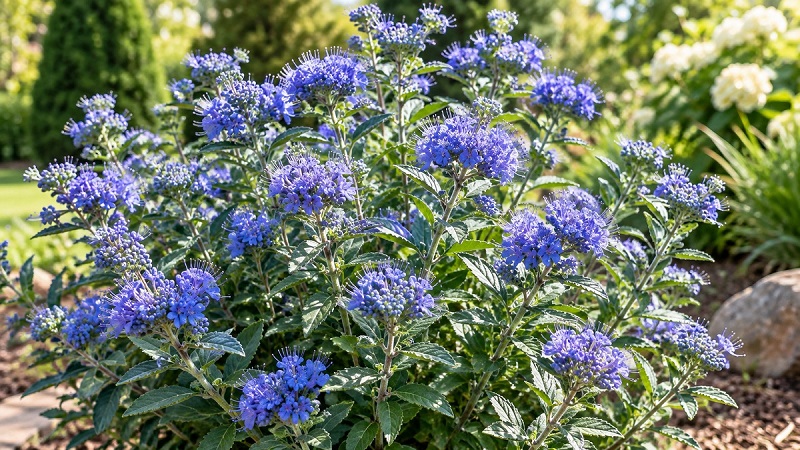
Growing & Caring for Bluebeard (Caryopteris × clandonensis)
Learn how to grow and care for Bluebeard, including sunlight, soil, watering, planting, pruning, winter care, propagation, pests, and pollinator benefits.
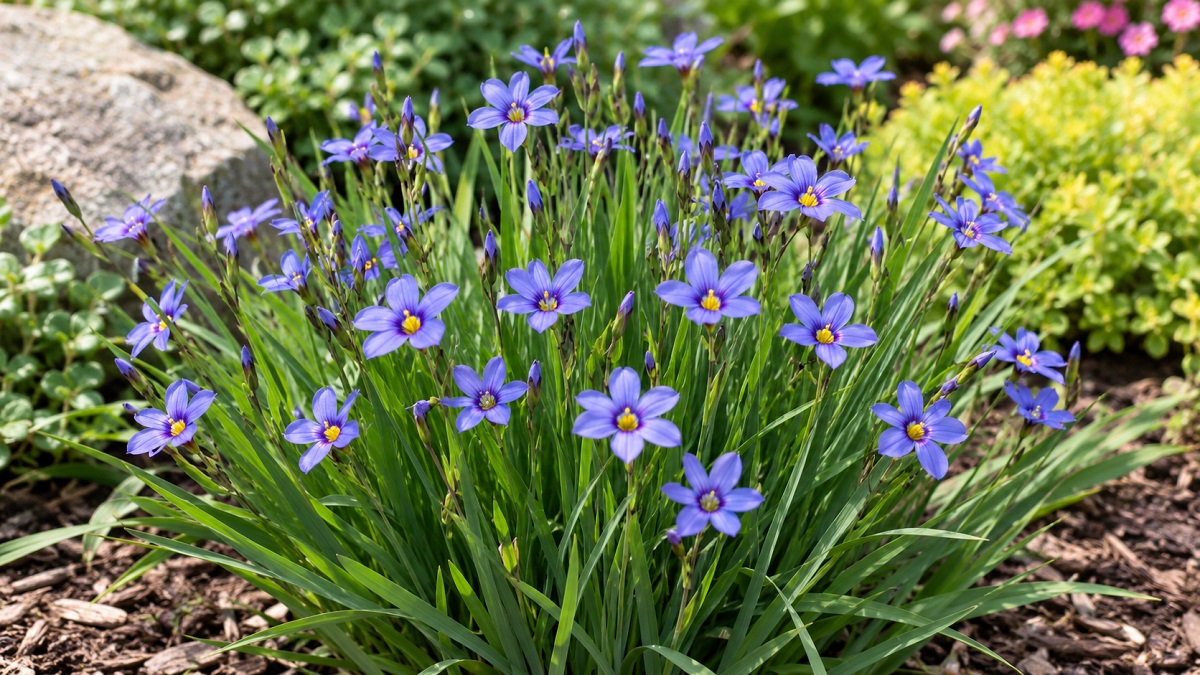
Blue-Eyed Grass is one of those plants that can be easy to overlook before it flowers. Its narrow, upright leaves resemble miniature grass, but when the blossoms appear, the plant becomes much more distinctive. The blue to violet flowers, usually marked with yellow centers, rise above tidy clumps of foliage and bring a delicate splash of color to perennial borders, rock gardens, cottage gardens, meadow-style plantings, and naturalized areas.
Despite its common name, Blue-Eyed Grass is not a true grass. Sisyrinchium angustifolium belongs to the iris family, Iridaceae. Missouri Botanical Garden describes it as a herbaceous perennial and recommends a moderately moist location with little maintenance beyond occasional division and seasonal cleanup.
The key to growing it well is fairly simple: give it reasonable light, soil that holds moisture without remaining soggy, and enough room for the clump to develop. Once established in a suitable location, Blue-Eyed Grass generally does not demand constant attention.
Best results: grow Blue-Eyed Grass in a sunny to lightly shaded site with moderately moist, reasonably well-drained soil.
Blue-Eyed Grass is a small perennial valued more for its flowers and fine texture than for imposing size. Sisyrinchium angustifolium forms clumps of narrow, upright leaves that can initially look much like grass. In late spring, slender flowering stems carry small blue or violet-blue flowers that stand clearly above the foliage.
The resemblance to grass explains the common name, but botanically this plant belongs to the iris family. That distinction is useful when planning a garden because Blue-Eyed Grass behaves more like a compact flowering perennial than a lawn grass. It is better suited to borders, rock gardens, native-style plantings, paths, meadow edges, and other ornamental spaces than to areas intended for mowing.
Missouri Botanical Garden lists Sisyrinchium angustifolium at approximately 1.5 to 2 feet tall and 0.5 to 1 foot wide, with full sun to part shade and medium water requirements. Its listed bloom period is May through June.
Its narrow foliage provides a fine vertical texture, while the flowers add a surprisingly bright accent for such a compact plant. The contrast between grassy leaves and iris-like flowers gives it an unusual appearance in a mixed planting.
No. Blue-Eyed Grass is a member of the iris family, Iridaceae. The common name refers to its grass-like foliage rather than its botanical classification.
The following table summarizes the principal characteristics and growing requirements for Sisyrinchium angustifolium. Growing conditions can vary with climate, soil, cultivar, and local selection, so use these figures as a practical guide rather than an absolute limit.
| Characteristic | Blue-Eyed Grass Details |
|---|---|
| Botanical name | Sisyrinchium angustifolium |
| Common name | Blue-Eyed Grass |
| Plant family | Iridaceae |
| Plant type | Herbaceous perennial |
| Typical height | About 1.5–2 feet |
| Typical spread | About 0.5–1 foot |
| Sun exposure | Full sun to part shade |
| Water requirement | Medium moisture |
| Flowering period | May–June |
| Flower color | Violet-blue to blue, commonly with a contrasting center |
| Foliage | Narrow, upright, grass-like leaves |
| Soil preference | Moisture-retentive but well-drained garden soil |
| Best garden locations | Perennial borders, rock gardens, meadow-style plantings, edging and naturalistic gardens |
| Maintenance | Generally low once established; periodic division and seasonal cleanup may be useful |
Missouri Botanical Garden's plant listing specifically gives Sisyrinchium angustifolium a height of 1.5–2 feet, spread of 0.5–1 foot, full sun to part shade exposure, medium water needs, and a May–June bloom period.
Location has a major influence on the appearance and flowering of Blue-Eyed Grass. A site receiving full sun is a good choice when you want compact growth and abundant flowering, while part shade can also be suitable. Missouri Botanical Garden places this perennial in the full-sun-to-part-shade range.
In a garden with adequate soil moisture, a sunny position can produce strong flowering and sturdy growth. Morning and midday light are especially useful in areas where afternoon heat becomes intense.
Blue-Eyed Grass can also be grown in part shade. This can be helpful in warmer climates where a little protection from harsh afternoon sunlight prevents the soil from drying too quickly. Avoid assuming that deep shade will produce the same flowering performance as a brighter location.
Avoid placing plants in a permanently stagnant, overcrowded pocket. Air movement helps foliage dry after rain or irrigation and makes the planting easier to maintain.
Blue-Eyed Grass appreciates soil that can retain some moisture while still allowing excess water to drain away. The goal is not a dry, gritty planting bed and not a permanently saturated one. A loose garden soil with reasonable organic matter is a practical starting point.
Before planting, remove persistent weeds and break up heavily compacted ground. If the existing soil is poor, incorporating mature organic matter can improve its structure and water-holding capacity. Soil preparation is particularly useful when establishing a new perennial bed because it gives developing roots a better environment from the beginning.
Not necessarily. Its documented water requirement is medium, so the plant should not be treated as an aquatic or bog plant. It benefits from consistent moisture, especially while establishing, but the root zone should not remain saturated for long periods.
Heavy, poorly drained soil can create problems for many perennials. If water routinely stands around the crown after rain, consider improving the bed structure or choosing a better-drained location rather than simply increasing irrigation.
Nursery-grown plants are generally the simplest way to establish Blue-Eyed Grass in a home garden. Spring is a convenient planting period because plants have the growing season ahead of them, although planting timing should be adapted to the local climate.
Clear weeds, roots and competing vegetation from the planting area. Loosen the soil deeply enough to provide a comfortable root zone and mix in organic matter if the soil structure needs improvement.
Before planting, inspect the roots. If they are tightly circling the outside of the container, gently loosen the outer roots so they can move into the surrounding soil.
Set the plant so the crown sits at approximately the same level at which it was growing in its container. Avoid burying the crown deeply beneath additional soil or mulch.
Water immediately after planting. This settles the soil around the roots and removes large air pockets. Continue checking moisture regularly while the plant establishes.
A modest layer of organic mulch can help slow moisture loss and reduce weed competition. Keep mulch away from direct contact with the crown and stems.
Blue-Eyed Grass performs best when moisture is reasonably consistent. The plant is listed as having medium water requirements, so the aim is to avoid both prolonged drought and constantly saturated soil.
Newly planted specimens need closer attention than established clumps. Check the soil rather than watering automatically every day. If the upper layer is beginning to dry and there has been little rainfall, water deeply enough to moisten the root zone.
Once established, Blue-Eyed Grass can usually rely more heavily on rainfall, depending on local conditions. During extended dry weather, water when the soil becomes noticeably dry rather than allowing the plant to remain stressed for long periods.
More water is not always better. Poor drainage combined with frequent irrigation can create an unhealthy root environment. Water the soil around the plant and allow excess moisture to drain naturally.
Blue-Eyed Grass generally does not need an aggressive fertilizer program. In a reasonably fertile garden bed, excessive feeding can encourage soft foliage without necessarily improving the overall appearance of the plant.
If the soil is poor, begin with a soil test rather than applying fertilizer simply because the plant is growing slowly. This helps determine whether a nutrient deficiency is actually present.
A light application of a balanced, slow-release fertilizer in spring may be appropriate in nutrient-poor garden soil, but follow the product label and avoid repeated heavy applications. Organic matter added to the soil can also support long-term soil structure and fertility.
Blue-Eyed Grass does not require elaborate pruning. The main reason to trim it is to tidy the clump, remove damaged foliage, or refresh the planting after flowering and the main growing period.
Allowing some flowers to remain can provide an opportunity for seed development and natural reseeding. If you prefer a tidier appearance, spent flowering stems can be removed.
Old or damaged foliage can be cleaned up as new growth begins. Missouri Botanical Garden specifically notes spring cutback as part of the low-maintenance care routine for this plant.
Use clean, sharp scissors or pruners and avoid cutting healthy new shoots. A gentle cleanup is usually preferable to repeatedly shearing the entire plant during active growth.
Blue-Eyed Grass can be increased by dividing established clumps, and plants can also be grown from seed. Division is usually the more straightforward option when you already have a healthy mature plant and want another specimen with similar characteristics.
Missouri Botanical Garden specifically recommends division every few years as part of routine maintenance for Sisyrinchium angustifolium.
Division is useful when an established clump becomes crowded or when you want to create several smaller plants for another section of the garden.
Dividing in spring, around the beginning of active growth, is a practical approach because the plants have the growing season available to recover.
Growing Blue-Eyed Grass from seed requires more patience than planting established divisions. Seeds are small, and young seedlings can be easily confused with surrounding weeds, especially in a mixed garden bed.
Start with a weed-free area containing fine, loose soil. Because seedlings are delicate, avoid creating a thick layer of mulch directly over the germination area.
Spread the seed evenly over prepared soil and press it gently into contact with the surface. Avoid burying small seed deeply. Keep the growing medium evenly moist while waiting for germination.
Young plants need adequate light and moisture while their root systems develop. Weed carefully because unwanted plants can compete with seedlings before the Blue-Eyed Grass becomes established.
Seed-grown plants may take longer to reach a flowering size than nursery-grown divisions. For gardeners who enjoy the process of raising perennials from seed, however, the slower start can be worthwhile.
Blue-Eyed Grass can be used in containers when the pot provides adequate drainage and enough room for the roots. A container can also be useful if you want to place the plant along a patio, entrance, balcony, or small garden where planting directly in the ground is not possible.
The pot should have drainage holes at the bottom. Do not rely on a layer of gravel to compensate for a container without proper drainage.
Use a well-structured container mix rather than heavy garden soil. The growing medium should retain enough moisture for the plant without becoming permanently waterlogged.
Containers dry out faster than garden beds, particularly during hot weather. Check the pot regularly and adjust watering according to temperature, wind, rainfall, container size, and the plant's growth.
Spring is an important period for cleanup and fresh growth. Remove old damaged foliage, check for winter damage, refresh the mulch if needed, and begin monitoring soil moisture as temperatures rise.
This is also a suitable time to divide established plants if the clump has become crowded.
Flowering generally occurs around May and June according to the Missouri Botanical Garden listing. Keep newly planted specimens adequately watered during flowering and remove spent flowers if a tidier appearance is desired.
Pay attention to prolonged heat and drought. Blue-Eyed Grass has medium moisture requirements, so extended periods without rain may require supplemental irrigation.
In hot climates, a location receiving morning sun and some afternoon protection can reduce moisture stress, particularly when the soil dries quickly.
Allow the plant to finish its natural seasonal cycle. Remove obviously damaged material and keep competing weeds under control. If you want natural reseeding, avoid removing every flower head immediately after bloom.
Winter care depends heavily on the local climate. Avoid excessive winter watering where natural rainfall already keeps the soil wet. In colder areas, a light layer of organic mulch can help moderate soil temperature, but do not bury the crown.
Blue-Eyed Grass is generally a relatively simple perennial when planted in conditions that suit it. Many problems can be traced back to unsuitable moisture, poor drainage, excessive competition, or insufficient light rather than a need for complicated treatments.
Yellow or weak-looking foliage can have several causes. Check the soil moisture first. Constantly wet soil, drought stress, poor light, root disturbance, and nutrient deficiencies can all affect foliage appearance.
If a plant produces plenty of leaves but very few flowers, examine its light exposure and overall growing conditions. A move from a brighter position to heavy shade can reduce flowering performance.
Sandy soil, containers, exposed locations, and hot weather can increase water loss. Mulching the surrounding soil and improving organic matter can help maintain more consistent moisture.
Soil that remains saturated for extended periods creates an unfavorable root environment. If water repeatedly pools around the plants, improving drainage is more useful than simply adjusting the fertilizer.
A mature clump can eventually become congested. If flowering declines or the center of the plant becomes untidy, division can rejuvenate the planting and provide additional plants for other locations.
Its compact size, narrow foliage and blue-violet flowers make Blue-Eyed Grass especially useful where a gardener wants a fine-textured perennial rather than a large specimen. Its listed size of roughly 1.5–2 feet tall and 0.5–1 foot wide makes it suitable for the front or middle portion of many perennial combinations.
Use it near the front of a border where its fine foliage will not be hidden by taller plants. The flowers can provide a small but noticeable burst of color in late spring.
The relatively small stature of Blue-Eyed Grass works naturally with stones, low-growing perennials and other plants that appreciate good drainage.
Its grass-like appearance allows it to blend easily with meadow-style plantings and informal perennial combinations. Repeating several clumps through a planting can create a more natural visual rhythm.
Blue-Eyed Grass can be used near paths and the front edge of planting beds where its flowers can be seen without requiring a large amount of space.
Combine Blue-Eyed Grass with other perennials that prefer similar light and moisture conditions. Plants with contrasting leaf shapes can make its narrow foliage more noticeable.
Rather than planting one isolated specimen, consider using several clumps in a loose grouping. Repetition helps the small flowers have greater visual impact.
The easiest way to maintain Blue-Eyed Grass is to avoid making the job harder than necessary. Start with an appropriate planting location, prepare the soil properly, and pay attention to moisture during establishment.
Missouri Botanical Garden characterizes Sisyrinchium angustifolium as a low-maintenance perennial and specifically mentions spring cutback and division every few years as useful maintenance practices.
Blue-Eyed Grass is a good example of a plant whose appearance can be misleading. The fine leaves look like grass, but the violet-blue flowers reveal its relationship to irises. Give it a suitable sunny or partly shaded location, moderate moisture, and soil with reasonable drainage, and it can become a dependable part of a mixed perennial planting.
The most important maintenance tasks are straightforward: keep young plants watered while they establish, control competing weeds, tidy old foliage when appropriate, and divide crowded clumps every few years. With those basics covered, there is little reason to overwork the plant.
For gardeners who enjoy small flowering perennials with a natural, slightly informal character, Blue-Eyed Grass offers an appealing combination of delicate flowers and grass-like texture without requiring the space or maintenance associated with larger ornamental plants.
Continue exploring our gardening guides with more plant profiles, growing tips, and practical advice for creating a healthy, productive garden.