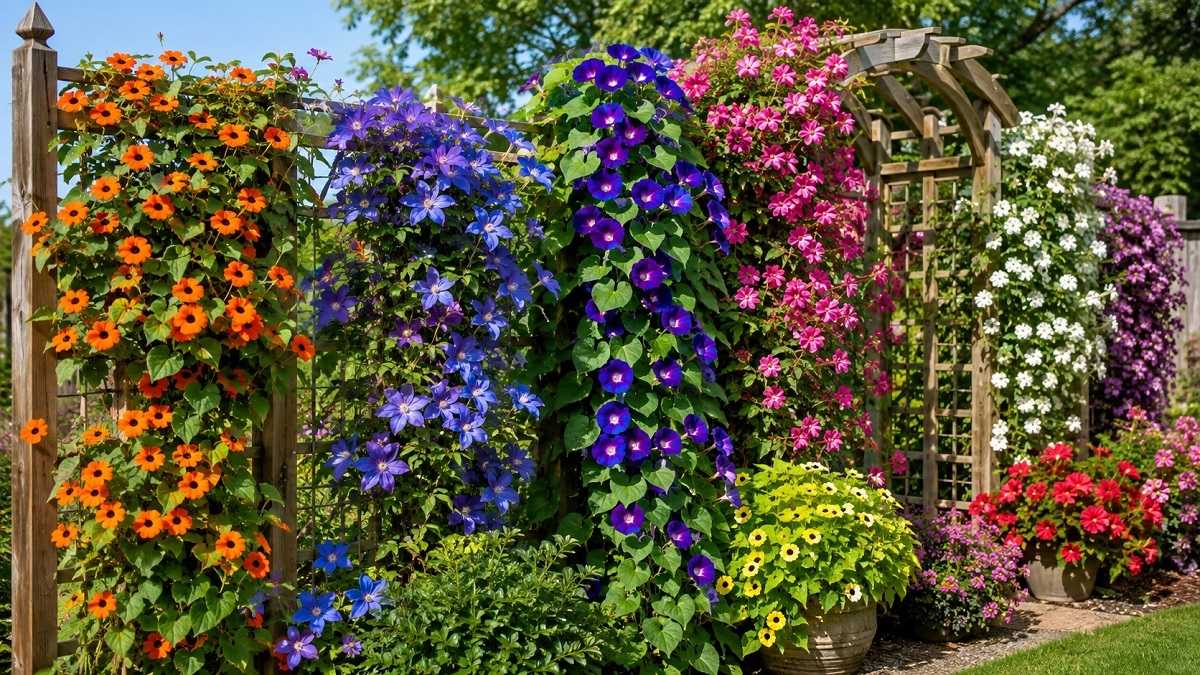
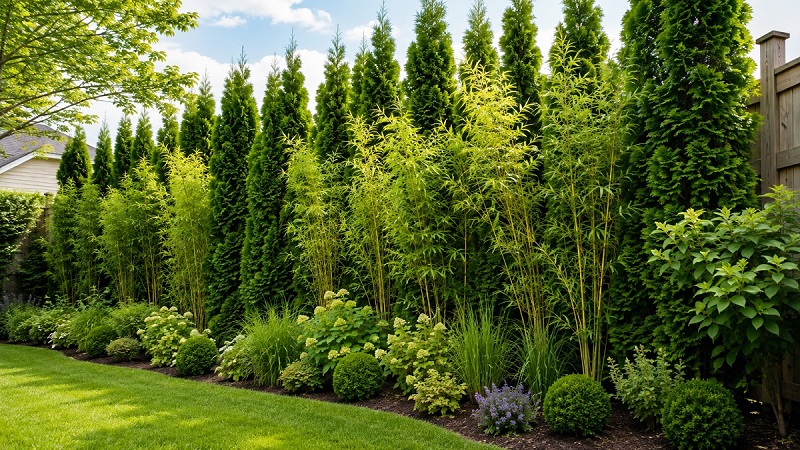
Fast-growing annual vines add colorful flowers, lush foliage, vertical interest, and temporary privacy to summer gardens.
If a garden bed, fence, trellis, balcony, or bare wall looks a little too empty at the beginning of summer, fast-growing annual vines can change the scene surprisingly quickly. Unlike slow-growing woody climbers, annual vines put much of their energy into producing stems, leaves, and flowers during a single growing season. With warmth, sunlight, water, and something to climb, many can cover an ordinary support with fresh foliage and colorful blooms in just a few weeks.
Annual vines are especially useful when you want quick summer color without committing to a permanent planting. They can soften fences, disguise unattractive structures, create temporary privacy, decorate entrances, and add height to otherwise flat-looking flower beds. Many also work beautifully in containers, making them practical for patios, balconies, decks, and small gardens.
This guide looks at 10 fast-growing annual vines that combine vigorous growth with attractive summer flowers or foliage. The best choice depends on the amount of sunlight available, the size of the support, your climate, and whether you want flowers, edible pods, fragrance, or simply a lush green screen.
There is something particularly useful about an annual vine: it does not need to be a long-term commitment. A permanent climbing plant can eventually become too large for a small structure, require regular pruning, or become difficult to remove. Annual vines give you much more flexibility. You can grow one against a trellis this year, try another along a fence next year, and change the color scheme whenever you want.
Most of the vines featured here are vigorous warm-season plants. Once nighttime temperatures become reliably warm, their growth can accelerate dramatically. A small seedling that looks insignificant in May may have several feet of new growth by midsummer when conditions are favorable.
Why gardeners love annual vines
Fast seasonal growth
Strong vertical interest
Bright summer flowers
Useful for temporary screening
Excellent for fences and trellises
Many can be grown from seed
Easy to replace or change each year
Another advantage is vertical gardening. Instead of using valuable ground space for every plant, a vine uses a support to grow upward. This can make a small garden feel much larger. A narrow trellis beside a patio, for example, can become a wall of foliage without taking up the space required by a large shrub.
Fast growth does come with a responsibility, however. A vigorous annual vine needs somewhere to go. If you plant one beside a weak support and walk away for a month, you may return to find stems sprawling across nearby plants or wrapping around anything within reach. Good planning is therefore just as important as choosing a colorful variety.
Quick Care Guide
Fast-growing vines reward preparation: give them sunlight, moisture, fertile soil, and a sturdy structure before growth takes off.
LightUsually full sun; some tolerate partial shade
SoilFertile, well-drained soil
WaterKeep evenly moist during active growth
SupportProvide a trellis, netting, arch, or fence
1. Morning Glory (Ipomoea purpurea)
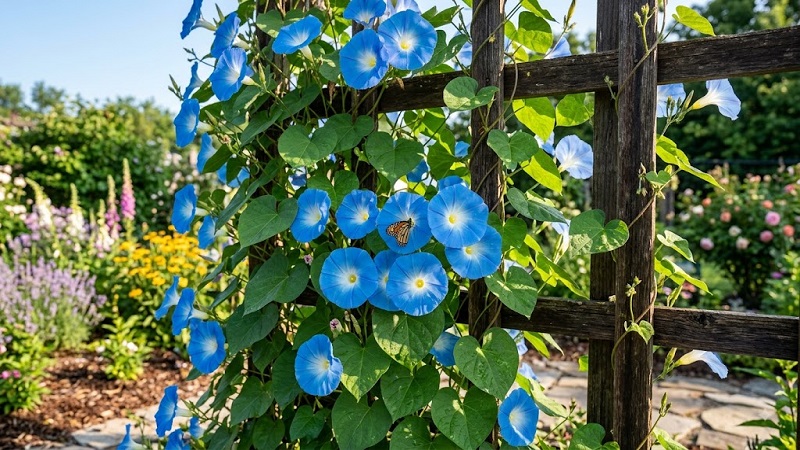
Morning glory is one of the classic choices when gardeners want a fast-growing annual vine with a big visual payoff. Its heart-shaped leaves quickly create a dense green backdrop, while trumpet-shaped flowers appear in shades that can include blue, purple, pink, red, and white depending on the variety.
Morning glory flowers open early in the day, showcasing bright trumpet-shaped blooms against dense green foliage.
The flowers are especially attractive in the morning, opening fresh as the day begins. In hot afternoon weather they may close, so morning glory is particularly rewarding when planted where you can enjoy it early in the day.
Growing morning glory
Choose a sunny location with fertile soil and good drainage. Morning glory can grow vigorously once established, so install its support before or at planting time. A fence, trellis, arch, or strong netting works well.
Seeds are commonly started directly in the garden after the danger of frost has passed and the soil has warmed. The hard seed coat can benefit from soaking before planting, which may encourage more uniform germination. Once seedlings emerge, give them something to climb toward.
Avoid excessive nitrogen fertilizer. Very rich feeding can encourage lush leaves and stems at the expense of flowers. Regular moisture and plenty of sunlight usually produce better flowering than constant heavy fertilization.
Best use: fences, trellises, arches, screens, and vertical summer displays.
2. Moonflower (Ipomoea alba)
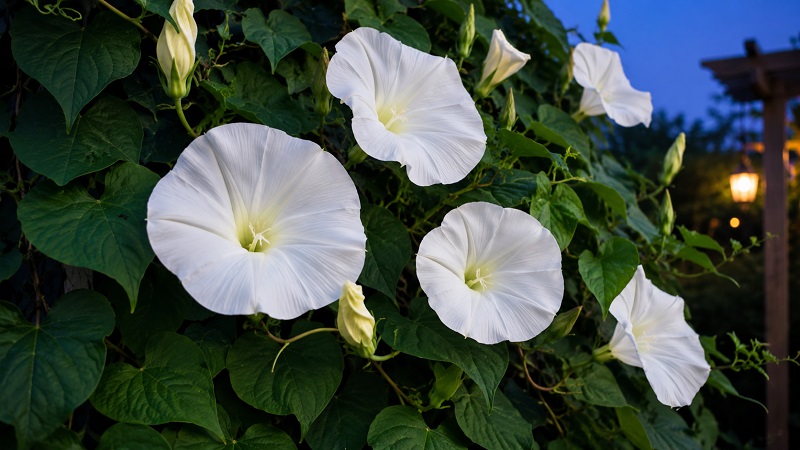
Moonflower is a close relative of morning glory, but its personality is quite different. Instead of opening in the morning, its large white flowers generally open toward evening and can remain attractive into the night. The blooms are especially striking against the dark green foliage.
Opening at dusk, moonflower's large white blooms create a luminous look perfect for evening gardens.
For a patio, porch, or evening entertaining area, moonflower can be an excellent seasonal climber. Its large flowers create a luminous appearance at dusk, and the plant can develop substantial vine growth during a warm summer.
How to grow moonflower
Give moonflower a warm, sunny site and a strong climbing structure. The vine appreciates consistent moisture during active growth but does not like sitting in poorly drained soil.
The seeds have a hard coating and may germinate more readily after appropriate preparation. Plant them after temperatures have warmed. Young plants can be somewhat slow to start, but growth often accelerates once warm weather arrives.
Because moonflower can become a substantial vine, do not underestimate the support required. A lightweight decorative stake may not be enough once the plant becomes covered with foliage.
Best use: evening gardens, pergolas, porches, patios, and moonlit planting areas.
3. Cypress Vine (Ipomoea quamoclit)
Cypress vine combines delicate-looking foliage with colorful tubular flowers. Its finely divided leaves give it a softer texture than many broad-leaved climbers, while its flowers are attractive to hummingbirds and other pollinators.
Cypress vine features star-shaped red blooms nestled in light, feathery foliage that draws in hummingbirds.
Despite its delicate appearance, this is a vigorous warm-season vine when given enough sunlight and moisture. Red flowers are particularly common, although other colors may be available depending on the cultivar.
Growing cypress vine
Plant cypress vine in full sun and provide a narrow trellis, netting, or other support. Its stems can weave through relatively open structures, making it useful where you want a light, airy screen rather than a heavy wall of foliage.
Direct sowing after the soil warms is often the simplest approach. Keep the seedbed evenly moist during germination. Once plants begin climbing, guide young stems toward the support instead of allowing them to trail along the ground.
Cypress vine can become vigorous in favorable climates, so check the plant periodically and redirect stems when necessary.
Best use: pollinator gardens, small trellises, fences, and delicate vertical displays.
4. Cardinal Climber (Ipomoea × multifida)
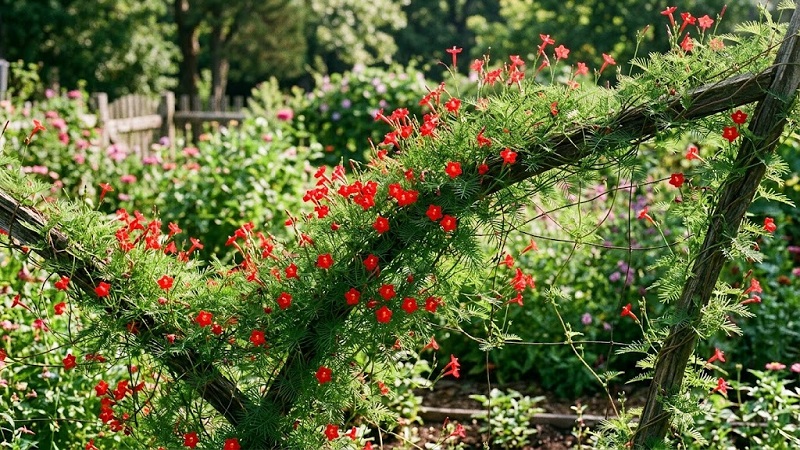
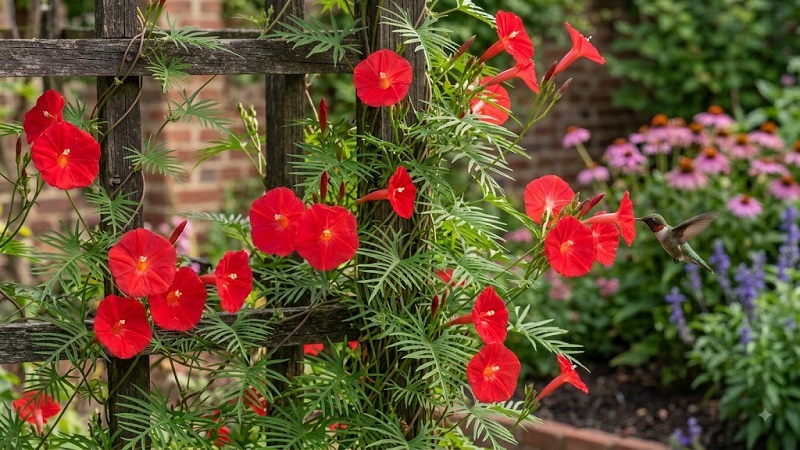
Cardinal climber is another excellent choice when you want a fast annual vine with bright flowers and interesting foliage. Its small scarlet-red tubular flowers stand out strongly against deeply divided green leaves.
Cardinal climber displays striking scarlet blooms set against delicate, palmately divided green leaves.
The combination of fern-like foliage and red flowers gives this vine a lighter visual character than some of the larger-leaved climbers. It can be especially attractive around garden entrances, low fences, arches, and trellises.
Care and training
Grow cardinal climber in a sunny location with fertile, well-drained soil. Keep young plants consistently watered while they establish. Once active growth begins, guide the stems onto the support.
Like other annual climbers, it performs best when the structure is already in place. Trying to add a trellis after a vigorous vine has begun sprawling can be frustrating and may damage tender stems.
Moderate feeding is usually sufficient. Excessively rich nitrogen conditions can produce plenty of foliage without necessarily improving the floral display.
Best use: trellises, arches, fences, and hummingbird-friendly summer gardens.
5. Black-Eyed Susan Vine (Thunbergia alata)
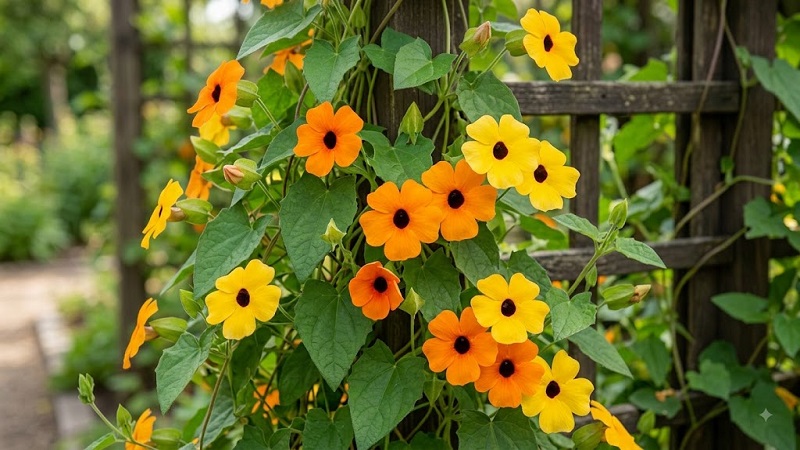
Black-eyed Susan vine is one of the most recognizable flowering annual climbers. Its cheerful flowers have a dark central eye surrounded by brightly colored petals, with common shades including yellow, orange, and white.
Black-eyed Susan vine offers vibrant blooms with distinctive dark eyes, perfect for brightening trellises and balconies.
It is an especially useful choice when you want a vine that feels ornamental rather than merely functional. The flowers can soften a trellis, brighten a balcony, or create a colorful backdrop for a seating area.
Light and watering
Provide bright light, preferably several hours of direct sun, although some afternoon shade can be beneficial in very hot climates. Keep the soil evenly moist but well drained. Plants that experience repeated severe drying may stop flowering or look stressed.
A trellis, obelisk, or other narrow support gives the stems something to wrap around. The vine is also well suited to large containers where its stems can climb upward while the base remains compact.
Regular removal of faded flowers can help maintain a tidy appearance and encourage continued blooming during the growing season.
Best use: containers, balconies, trellises, arches, and colorful pollinator displays.
6. Hyacinth Bean (Lablab purpureus)
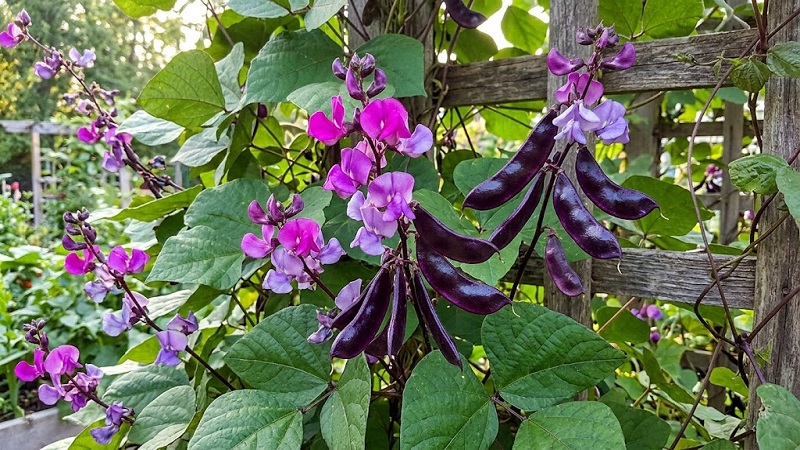
Hyacinth bean is an excellent option when foliage is just as important as flowers. It can produce large leaves, attractive flowers, and ornamental seed pods, giving the plant several seasons of visual interest within one summer.
Hyacinth bean delivers rich color with colorful blooms, dark purple pods, and lush leafy growth.
Purple-tinged stems and pods can add another layer of color, while the vigorous growth makes hyacinth bean useful for covering substantial structures quickly.
Growing hyacinth bean
Choose a warm, sunny site with fertile soil and dependable moisture. Because the plant can become large, provide a sturdy trellis, fence, arbor, or other support before growth accelerates.
Seeds can be started directly outdoors once the soil has warmed. Germination and early growth are generally strongest under warm conditions. Give plants enough space to develop without competing heavily with neighboring flowers.
Water deeply when the soil begins to dry rather than providing frequent shallow sprinkles. Mulching around the root zone can help moderate soil temperature and reduce moisture loss.
Best use: large trellises, screens, arbors, fences, and dramatic foliage displays.
7. Annual Sweet Pea (Lathyrus odoratus)
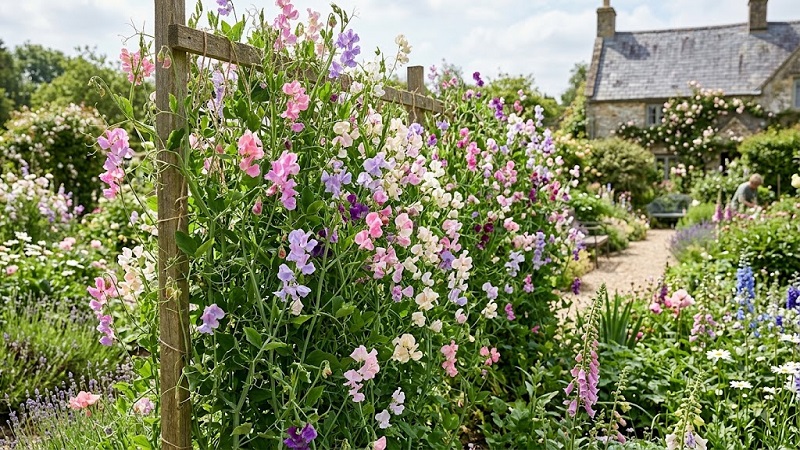
Annual sweet pea is the choice to consider when fragrance is high on your wish list. Its delicate-looking flowers can be intensely scented, and the blooms are available in a wide range of attractive colors.
Cherished for their sweet perfume, sweet pea vines bear ruffled, pastel blooms during cool spring months.
Unlike several heat-loving vines in this list, sweet pea generally prefers cooler growing conditions. In regions with hot summers, it is often best treated as a spring or early-season vine rather than a midsummer plant.
Getting the best flowers
Plant sweet peas early enough to take advantage of cool weather. Give them fertile, well-drained soil and a support with plenty of thin surfaces for their tendrils to grip.
Regular harvesting of flowers can encourage the plant to continue producing blooms. Allowing large numbers of seed pods to develop signals the plant that its reproductive job is nearly complete, so removing spent flowers is useful when the goal is an extended floral display.
In suitable climates, sweet peas can be grown near a walkway, window, or seating area where their fragrance is easy to appreciate.
Best use: fragrant trellises, cutting gardens, fences, and cool-season displays.
8. Nasturtium (Tropaeolum majus)
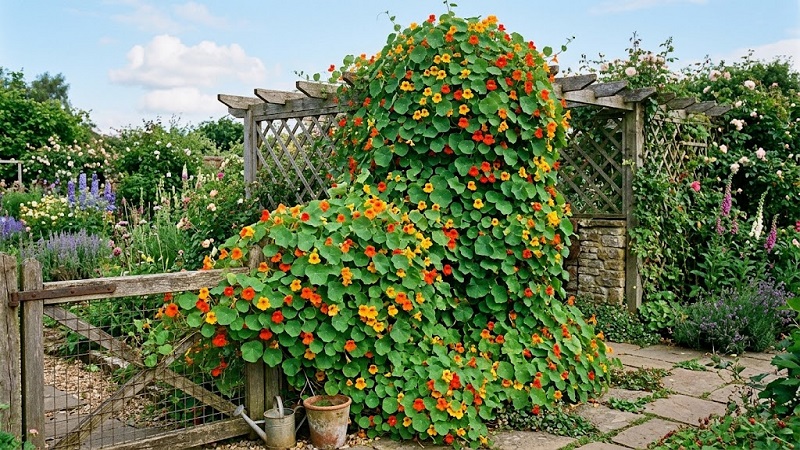
Nasturtium is a wonderfully flexible annual. Depending on the variety, it may grow as a compact mound, trail from a container, or climb several feet. Climbing types are particularly useful when you want colorful flowers without an extremely heavy vine.
Climbing nasturtium displays vivid, edible blooms against distinctive umbrella-like foliage for a casual cottage-garden look.
The rounded leaves and bright flowers create a relaxed, cottage-garden appearance. Flowers commonly appear in shades of yellow, orange, and red, and the plant can flower generously when conditions suit it.
Growing climbing nasturtiums
Nasturtiums prefer well-drained soil and generally do not need heavy fertilization. In fact, overly fertile soil can produce lots of leaves and fewer flowers. Full sun usually provides the strongest flowering, although some afternoon shade can be welcome in hot climates.
Water newly planted vines regularly until established, then adjust irrigation according to weather and soil conditions. Avoid keeping the root zone constantly saturated.
Climbing varieties can be trained onto a small trellis or allowed to spill over a raised bed or container. Their relatively manageable size makes them useful in smaller gardens.
Best use: containers, small trellises, raised beds, cottage gardens, and edible landscapes.
9. Scarlet Runner Bean (Phaseolus coccineus)
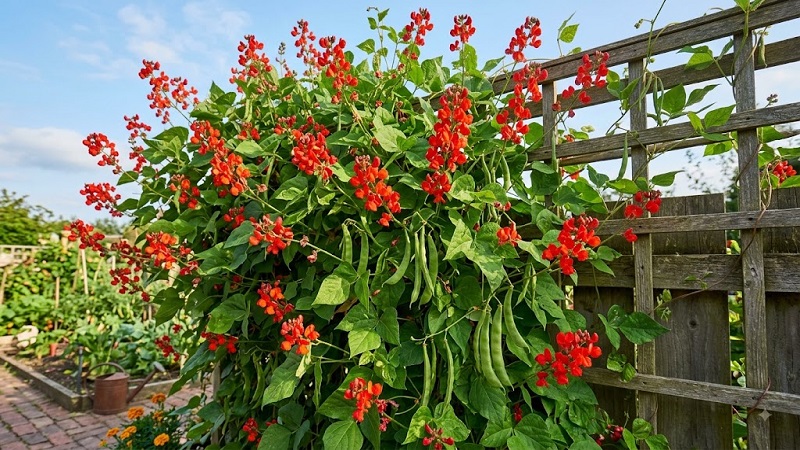
Scarlet runner bean combines ornamental value with a potential edible harvest. The vigorous vines can climb quickly, while clusters of red flowers provide a strong burst of summer color.
Scarlet runner bean blends beauty and purpose, pairing vivid red blooms with vigorous growth and edible pods.
It is a particularly useful plant for gardeners who want their vertical garden to do more than look attractive. A productive bean trellis can provide flowers, foliage, and edible pods in the same space.
Planting and support
Wait until the soil has warmed before sowing. Beans dislike cold, wet soil, and early planting can result in poor establishment. Choose a sunny location and install a sturdy trellis or bean frame.
Keep plants watered consistently during flowering and pod production. A lack of moisture at this stage can reduce productivity. Harvest pods while they are young and tender if you plan to eat them, following the preparation recommendations appropriate for the variety.
Do not assume that a lightweight decorative trellis will handle a mature bean vine. The combination of stems, leaves, pods, and wind can place considerable weight on a support.
Best use: edible gardens, vegetable trellises, fences, and productive summer screens.
10. Cup-and-Saucer Vine (Cobaea scandens)
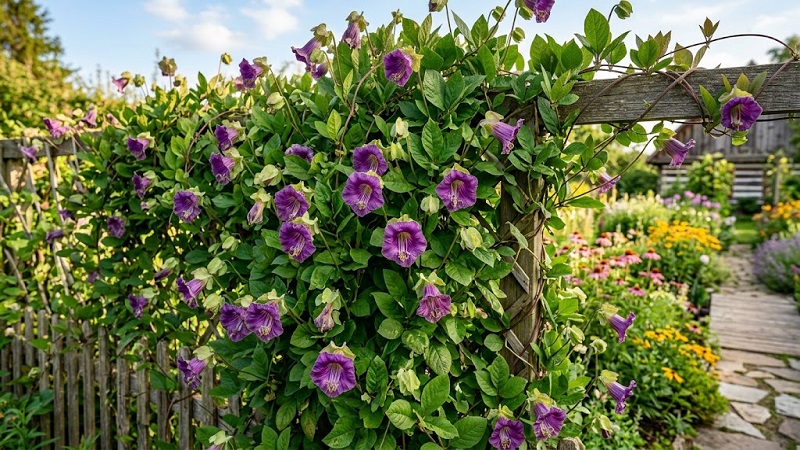
Cup-and-saucer vine is a dramatic climber for gardeners who want something different. Its large bell-shaped flowers are surrounded by green structures that give the blooms a distinctive cup-and-saucer appearance. The foliage is also attractive, making the plant useful even before it reaches peak bloom.
Cup-and-saucer vine features dramatic bell-shaped blooms nestled in saucer-like calyxes that flourish in warm weather.
This vine can become impressively vigorous in a long, warm growing season. It is therefore best suited to a substantial support rather than a tiny decorative trellis.
Growing cup-and-saucer vine
Provide full sun and fertile, well-drained soil. Warm temperatures encourage strong growth, and regular moisture is important while the plant is actively producing stems and foliage.
Start plants early enough to give them a long growing season where summers are short. In colder regions, gardeners may start them indoors before moving them outside after the risk of frost has passed.
Young stems may need initial guidance toward the trellis. Once established, the plant can climb efficiently on its own support structures.
Best use: large arbors, pergolas, fences, and statement vertical plantings.
Annual Vine Comparison
The 10 vines differ considerably in flower style, growth habit, and preferred conditions. Use the table below as a starting point when deciding which plant fits your garden.
Vine
Main Attraction
Light
Growth Character
Best Support
Morning glory
Trumpet flowers and heart-shaped leaves
Full sun
Vigorous
Fence or trellis
Moonflower
Large evening-opening white flowers
Full sun
Vigorous
Strong trellis or arbor
Cypress vine
Fine foliage and bright flowers
Full sun
Fast
Netting or trellis
Cardinal climber
Red flowers and finely divided leaves
Full sun
Fast
Trellis or fence
Black-eyed Susan vine
Colorful flowers with dark centers
Sun to partial shade
Moderately vigorous
Trellis or container support
Hyacinth bean
Large foliage, flowers, and pods
Full sun
Very vigorous
Large trellis or arbor
Annual sweet pea
Fragrant flowers
Sun
Moderate
Fine trellis or netting
Nasturtium
Bright flowers and rounded leaves
Sun to partial shade
Moderate to fast
Small trellis or container
Scarlet runner bean
Flowers and edible pods
Full sun
Vigorous
Strong bean trellis
Cup-and-saucer vine
Large unusual flowers
Full sun
Very vigorous
Arbor or large trellis
How to Choose the Right Fast-Growing Vine
The fastest-growing vine is not automatically the best vine for every garden. A plant that can cover a large fence in a short time may be completely unsuitable for a small balcony. Start by looking at the growing space rather than the flower color.
Consider the amount of sunlight
Most flowering annual vines perform best with abundant sunlight. If a location receives only a few hours of light, choose a vine that tolerates partial shade rather than expecting a full-sun plant to flower heavily.
Observe the location at different times of day before planting. A spot that looks sunny in the morning may become shaded by a building or tree later. Understanding the actual light pattern can prevent disappointing growth.
Match the vine to the support
Think about mature size, not the size of the young plant at the garden center. Hyacinth bean, moonflower, cup-and-saucer vine, and other vigorous climbers can produce considerable top growth. They need a support capable of carrying that weight.
Decide whether you want flowers or food
If the goal is pure ornament, flowering vines such as black-eyed Susan vine and morning glory are obvious choices. If you want a combination of flowers and harvests, climbing beans can make more sense.
Think about the season
Not all annual vines prefer the same temperatures. Heat-loving species thrive when summer arrives, while annual sweet pea performs better in cooler conditions. Choosing a plant that matches your seasonal climate is one of the simplest ways to improve results.
Planting and Growing Tips for Fast Results
Fast growth begins with good establishment. Even the most vigorous annual vine cannot compensate for poor soil, inadequate moisture, or a lack of support.
Prepare the soil first
Loosen the planting area and remove competing weeds. Work in organic matter if the soil is poor or compacted. The goal is not to create an excessively rich bed but to provide a healthy root environment that drains well while holding enough moisture for active growth.
Plant at the right time
Warm-season vines should not be rushed into cold soil. Waiting until the danger of frost has passed and temperatures are suitable can result in faster establishment than planting too early and leaving seedlings struggling in unfavorable conditions.
Water consistently after planting
Young vines need reliable moisture while their roots develop. Check the soil regularly rather than watering according to a rigid calendar. Weather, soil type, container size, and plant maturity all affect how quickly the root zone dries.
Mulch around the roots
A layer of organic mulch can help reduce evaporation and moderate soil temperatures. Keep mulch slightly away from the base of the stems to reduce the chance of prolonged wetness around the crown.
Feed moderately
Vigorous vines need nutrients, but more fertilizer is not always better. Excess nitrogen can produce an impressive wall of leaves with surprisingly few flowers. Use a balanced feeding approach and follow the fertilizer label for application rates.
Guide young stems early
Training is easiest while the stems are young and flexible. Once vines become tangled together, separating them can cause unnecessary breakage. A few minutes of guidance every several days can keep a climbing plant headed in the direction you want.
Providing the Right Support
Support is one of the most important parts of growing annual vines successfully. The structure should be installed before the plant needs it, not after the vine has already begun crawling across the ground.
Good support options
Wood or metal trellises
Garden arches
Arbors and pergolas
Strong wire or garden netting
Fences with suitable openings
Obelisks and climbing towers
Bean frames for edible vines
The best structure depends on the climbing method. Some vines twine around narrow supports, some use tendrils, and others need their stems guided through a trellis. Choose a structure that provides enough surface area for the plant to grip.
Also consider wind. A support that feels solid when empty may become unstable once covered by dense foliage. Anchor tall structures securely, particularly when they are placed in exposed areas.
Common Problems With Annual Vines
Lots of leaves but few flowers
This is often related to insufficient light, excessive nitrogen, or environmental stress. Move container-grown vines to a brighter location if possible, avoid unnecessary high-nitrogen feeding, and maintain consistent moisture.
Vines are sprawling instead of climbing
The support may have been installed too late, or the plant may need a little guidance. Gently position young stems against the trellis. Do not force brittle mature stems into tight bends.
Leaves are wilting
Check the soil before assuming the plant needs water. Wilting can result from dry soil, extreme heat, root problems, or other stress. If the soil is dry several centimeters below the surface, water thoroughly and monitor the plant's recovery.
Yellow leaves
Yellowing can have several causes, including overwatering, poor drainage, nutrient problems, or natural aging of older leaves. Examine the entire plant and its growing conditions rather than treating yellow leaves as a single problem.
Pests
Annual vines can attract aphids, spider mites, caterpillars, and other garden pests. Inspect stems and the undersides of leaves regularly. Catching a problem early is much easier than trying to control a large infestation after the vine has become dense.
Diseases
Good air circulation, appropriate watering, healthy soil, and adequate spacing can reduce many disease problems. Avoid repeatedly wetting foliage when conditions are humid, and remove badly damaged plant material when appropriate.
Summer Garden Design Ideas
Fast-growing annual vines are useful because they can solve several design problems at once. Instead of simply planting one against a fence, think about how vertical growth can change the way a garden feels.
Create a temporary privacy screen
Install a trellis or wire frame along a patio edge and grow a vigorous annual vine across it. During the growing season, the foliage can create a softer, greener boundary without the long-term commitment of a hedge.
Frame an entrance
An arch covered with a flowering vine can turn an ordinary garden entrance into a focal point. Morning glory, black-eyed Susan vine, cardinal climber, or another manageable climber can add height and color around the doorway.
Hide an unattractive fence
A temporary vine is an easy way to soften chain-link fencing or a weathered garden structure. Choose a vigorous plant for a large surface, but make sure you can remove the old stems at the end of the season.
Grow vertically in a small garden
Containers with climbing vines can add substantial height without requiring a large planting bed. Place a trellis behind a container and let the vine provide a living backdrop.
Combine different flowering times
Use vines with different bloom characteristics to create interest throughout the season. A morning-opening vine can complement plants that look best in the evening, while foliage-focused vines can provide structure between periods of peak flowering.
Use vines around outdoor seating
A pergola or small arbor covered with a seasonal vine can make a seating area feel more enclosed and inviting. Fragrant choices are particularly enjoyable when planted close to areas where people spend time.
Frequently Asked Questions
What is the fastest-growing annual vine?
Several annual vines can grow extremely quickly in warm, favorable conditions. Morning glory, hyacinth bean, moonflower, and climbing beans are among the stronger choices when rapid seasonal coverage is the main goal. Actual growth speed depends on temperature, sunlight, soil, water, and the length of the growing season.
Can annual vines grow in containers?
Yes. Many annual vines grow well in large containers when provided with adequate sunlight, consistent moisture, and a suitable climbing structure. Black-eyed Susan vine and nasturtium are particularly adaptable to container growing, while very vigorous vines need large containers and substantial support.
Do fast-growing vines need fertilizer?
They may benefit from moderate feeding, particularly when grown in containers or poor soil. However, excessive nitrogen can encourage foliage at the expense of flowers. Start with healthy soil and follow the fertilizer label rather than assuming more fertilizer will produce faster flowering.
How often should annual vines be watered?
Watering frequency depends on temperature, rainfall, soil, and whether the vine is growing in the ground or a container. Keep newly planted vines consistently moist while they establish, then water deeply when the root zone begins to dry. Containers generally need more frequent attention than garden beds.
Which annual vine is best for a small trellis?
Nasturtium and black-eyed Susan vine can work well on smaller structures, provided the selected variety and container or planting area are appropriate. Very vigorous vines may quickly outgrow a small trellis and are better matched with larger supports.
Can annual vines provide privacy?
Yes. Vigorous vines can create seasonal screening when grown across a properly supported fence, trellis, or frame. The amount of privacy depends on the vine's mature foliage density and the size of the structure.
Should I remove annual vines after summer?
In climates where the plants are not hardy, annual vines naturally decline as temperatures change. Removing dead stems at the end of the season keeps the support tidy and makes it easier to prepare the area for the following year. Follow local guidance for handling any plant that has produced abundant seed.
Which annual vine has fragrant flowers?
Annual sweet pea is one of the best-known fragrant annual climbers. It performs best during cooler conditions, so it may be more useful as a spring or early-season vine in areas with very hot summers.
Final Thoughts
Fast-growing annual vines are one of the easiest ways to add height, movement, flowers, and temporary screening to a summer garden. They are especially valuable when you want a dramatic result without waiting years for a permanent climber to mature.
For classic colorful flowers, morning glory is hard to overlook. Moonflower adds evening interest, while cypress vine and cardinal climber offer bright flowers with finer-textured foliage. Black-eyed Susan vine brings a cheerful ornamental display, and hyacinth bean can transform a large support with foliage, flowers, and colorful pods.
If fragrance matters most, annual sweet pea deserves a place on the list where the climate is suitable. Nasturtium offers flexibility for containers and smaller spaces, while scarlet runner bean combines ornamental flowers with a productive garden crop. For a truly dramatic structure, cup-and-saucer vine can make an impressive seasonal statement.
The key to success is simple: match the vine to the space, prepare the support before planting, provide enough sunlight and moisture, and guide young growth early. With those basics in place, a modest trellis or bare fence can become a lively vertical garden filled with summer color in surprisingly little time.
Continue exploring our gardening guides with more plant profiles, growing tips, gardening design ideas and practical advice for creating a healthy, productive garden.