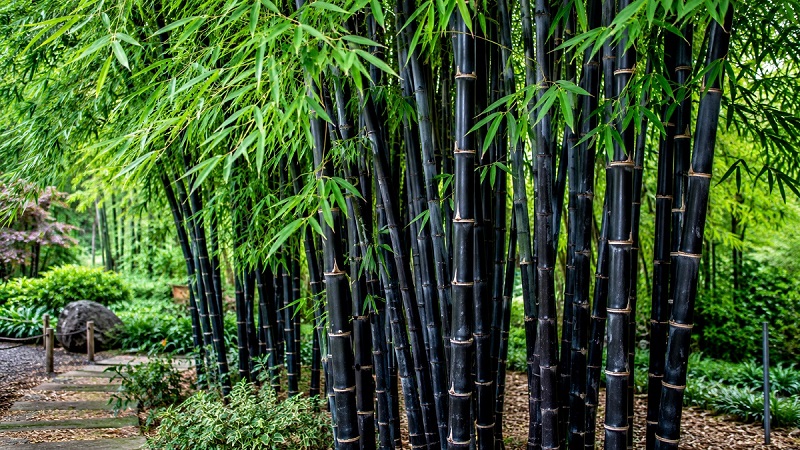
Growing & Caring for Black Bamboo (Phyllostachys nigra)
Learn how to grow and care for Black Bamboo (Phyllostachys nigra). Discover sunlight, watering, soil, planting, pruning, feeding, propagation, winter care, and common problems.
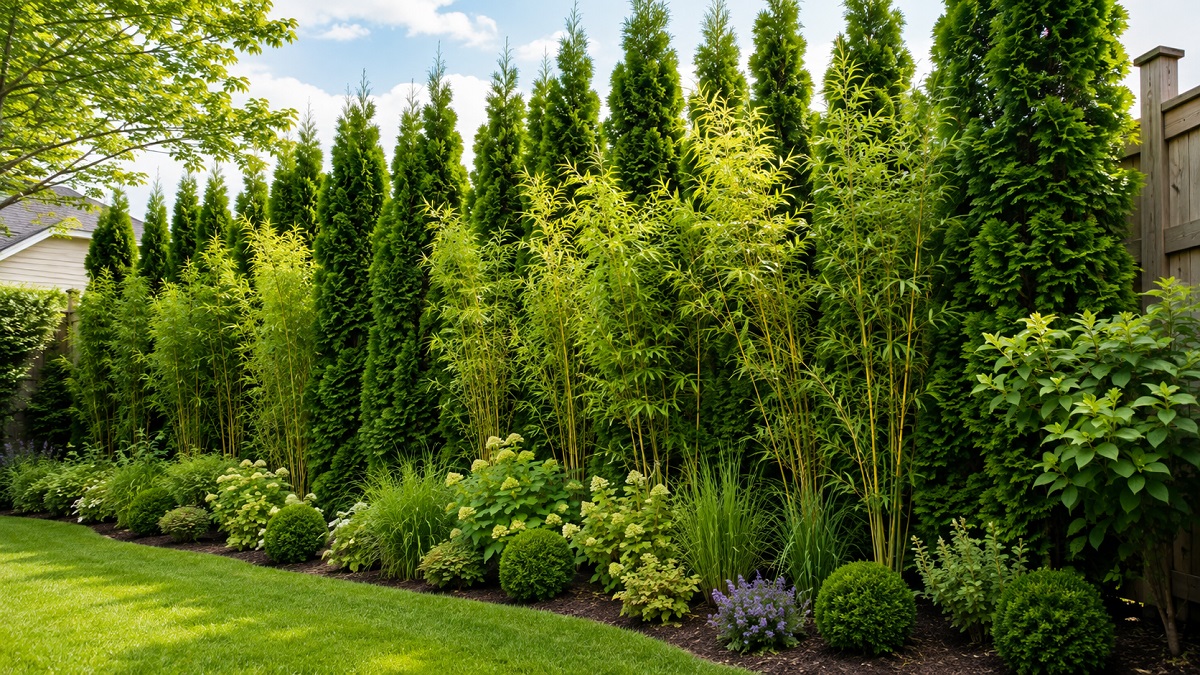
Creating privacy in a garden does not always mean building a tall fence or wall. Plants can make a living screen that looks softer, greener, and more natural. The right privacy plant can block unwanted views, reduce wind, add wildlife habitat, and make an outdoor space feel more comfortable.
The challenge is finding plants that grow quickly without becoming difficult to manage. Some plants can put on several feet of growth in a good season, while others take longer but offer better long-term control. Your climate, soil, sunlight, available space, and pruning habits all matter when choosing a privacy screen.
In this guide, we look at 10 fast-growing privacy screen plants that can be useful for gardens, backyards, patios, property boundaries, and other outdoor spaces. We will also cover spacing, maintenance, evergreen versus deciduous screens, and common mistakes to avoid.
Choose according to your climate, available space, desired height, and maintenance level.
Before buying privacy plants, think about what you actually need the screen to do. A plant that grows quickly is not automatically the best choice. Some fast-growing species become very large, need regular pruning, or develop aggressive roots. Others may not remain attractive if they are planted too closely together.
Start by measuring the area you want to screen. Note the length of the boundary and the maximum height and width that the plants can occupy. Also check how much sunlight the planting area receives during the day. A plant that needs full sun may perform poorly in a deeply shaded corner.
Next, consider whether you need privacy throughout the entire year. If the answer is yes, an evergreen plant is usually the better choice. Deciduous plants can still make excellent screens, but they lose their leaves during part of the year.
Finally, check your local growing conditions. A plant that grows rapidly in one region may grow much more slowly in another. Hardiness, rainfall, summer heat, winter temperatures, soil drainage, and watering can all change the result.
Bamboo is one of the first plants people think about when they want a fast privacy screen. Its tall canes and dense foliage can create a green wall relatively quickly when conditions are suitable. Bamboo can be particularly useful when you want a narrow screen that grows upward rather than taking up a large amount of ground space.
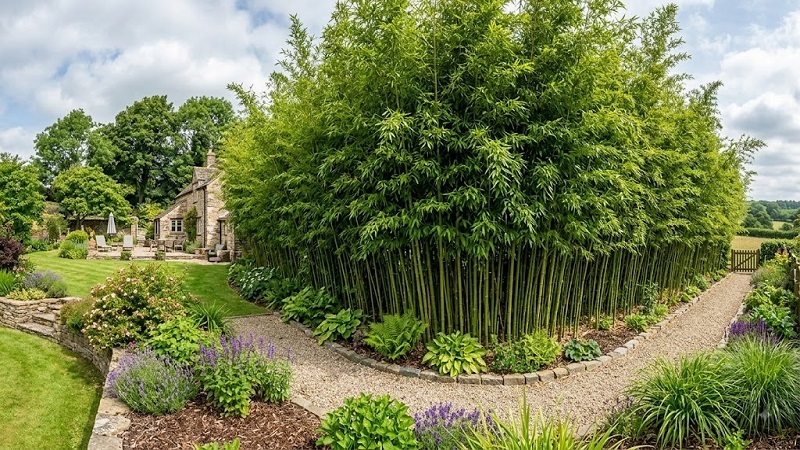
However, bamboo is not one single type of plant. Some bamboo spreads through underground rhizomes and can become difficult to control if it is planted without planning. Clumping types spread more slowly from the base and are generally easier to manage in a residential garden.
The biggest advantage is speed. Bamboo can produce tall new shoots during its growing season, and established plants can develop a thick appearance. The evergreen foliage of many commonly grown bamboos also means the screen can remain useful through much of the year.
Plant bamboo in fertile, well-drained soil and provide regular water while it establishes. Mulching around the base can help keep the root zone evenly moist.
For a smaller garden, consider a clumping bamboo rather than a running bamboo. If a running type is used, research its spreading behavior and install appropriate containment before planting.
Leyland cypress is a popular choice for people who want a tall evergreen screen. It has a narrow, upright shape and can grow rapidly when planted in a suitable location. A row of these trees can eventually form a substantial visual barrier.
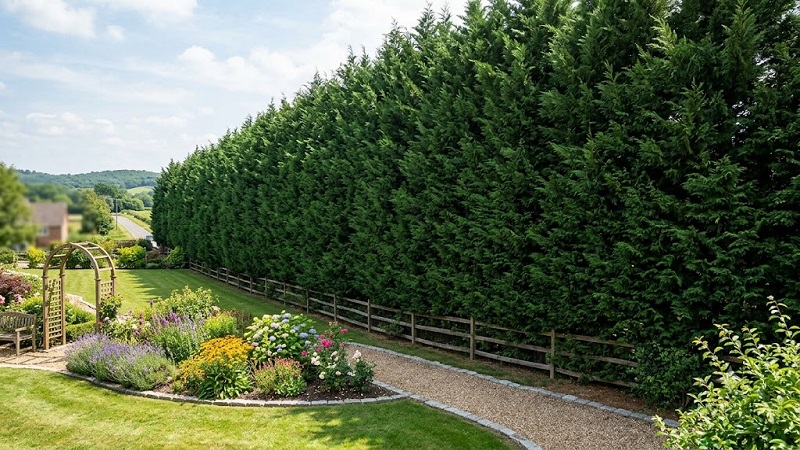
This plant is best suited to areas where there is enough room for mature trees. Although it can be kept narrower through pruning, planting large trees in an extremely small space can create maintenance problems.
Young trees benefit from consistent watering, especially during dry weather. Once established, they are more tolerant of normal garden conditions, but good drainage is still important.
Pruning is easier when it begins early. Rather than allowing young trees to grow without any shaping and then cutting them back heavily years later, maintain a sensible form from the beginning. Avoid removing excessive green growth at once.
Because Leyland cypress can become very tall, think about the eventual height before planting. It is a good option for large boundaries but may be unsuitable for a small courtyard.
Green Giant arborvitae is another strong choice for a tall evergreen privacy screen. It develops a naturally pyramidal shape and has dense green foliage that can provide excellent visual coverage when trees are planted in a suitable row.
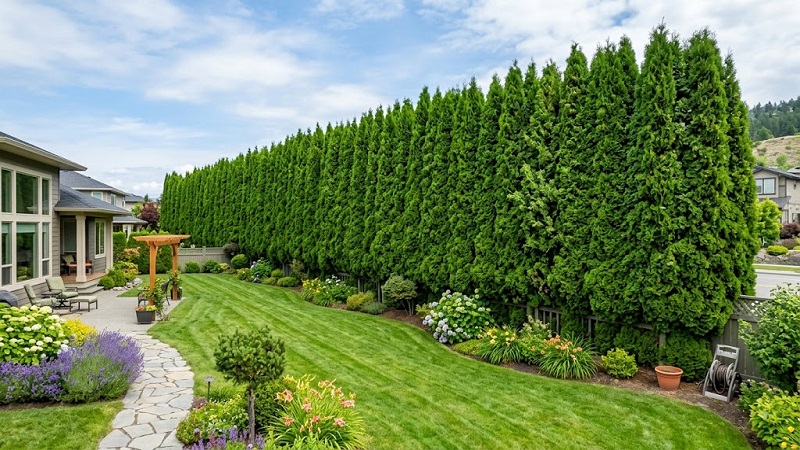
One advantage of this type of arborvitae is that it can produce substantial growth without requiring the same level of shaping as some formal hedge plants. Its naturally upright habit makes it useful along property lines and larger garden boundaries.
Give each plant enough space to develop. Planting trees too close together may provide a dense appearance quickly, but overcrowding can create competition for water and nutrients and make long-term maintenance more difficult.
Water new plants regularly during their establishment period. A layer of organic mulch can help reduce moisture loss, but keep mulch away from direct contact with the trunk.
Privet is widely used for hedges because it responds well to pruning and can produce dense growth. It is particularly useful when you want a formal-looking hedge rather than a row of large trees.
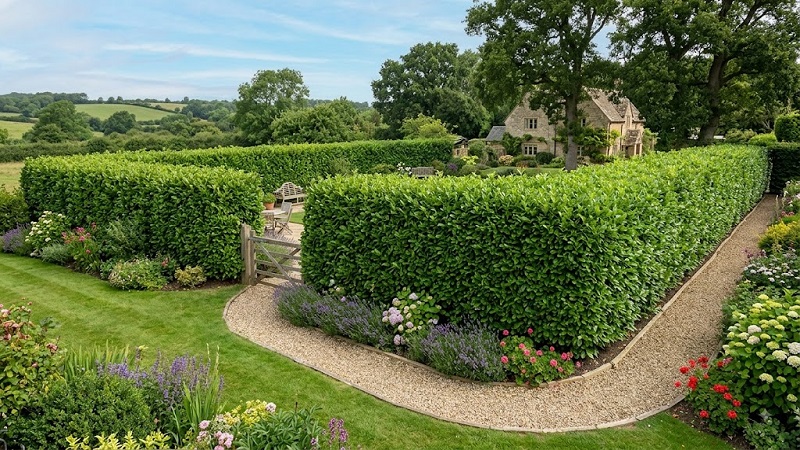
With regular trimming, privet can be shaped into a neat wall of foliage. If allowed to grow naturally, it can become much larger and less formal. This makes it a flexible choice for gardeners who want to control the final appearance.
Privet generally performs best with adequate sunlight and reasonable soil moisture. After planting, consistent watering helps the hedge establish a strong root system.
Before planting privet, check whether the particular species is considered invasive in your region. Different privet species behave differently, so local guidance is useful.
Elaeagnus is a strong choice for gardeners who want a fast-growing, dense privacy screen with attractive foliage and good tolerance of challenging conditions. Depending on the species or cultivar, these shrubs can develop into substantial evergreen or semi-evergreen plants that provide useful year-round screening.
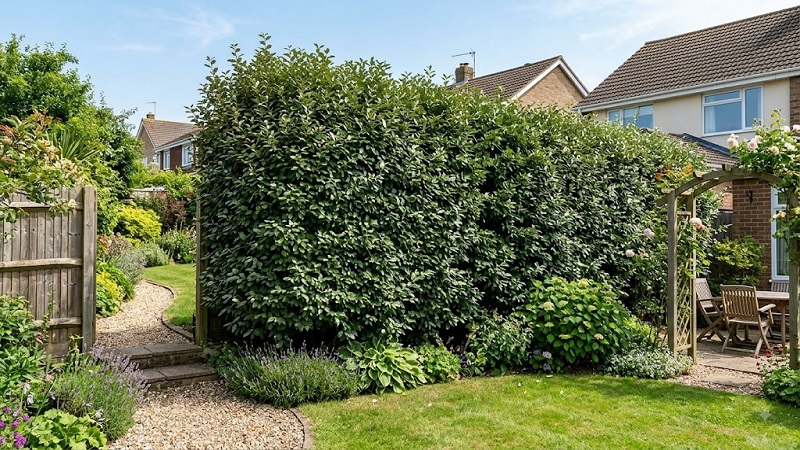
One of the main advantages of Elaeagnus is its ability to grow in conditions where some other screening shrubs may struggle. Many types tolerate wind, salt exposure, poor soil, and periods of dry weather once established, making them particularly useful for exposed gardens and coastal landscapes.
The exact appearance and growth rate depend on the species and cultivar. Some Elaeagnus develop into large, spreading shrubs, while others can be maintained as a more compact hedge with regular pruning. Check the mature height and width before planting, especially when using it near property boundaries or buildings.
Elaeagnus works well along property boundaries, beside fences, around patios, and in exposed areas where a tough privacy screen is needed. Its dense branching can create an effective visual barrier, while the silvery or green foliage adds texture and interest to the landscape.
Willow trees are known for vigorous growth, which makes them useful when a fast-growing screen is needed in a suitable location. Some willow species can develop rapidly when they have adequate water and room for their roots.
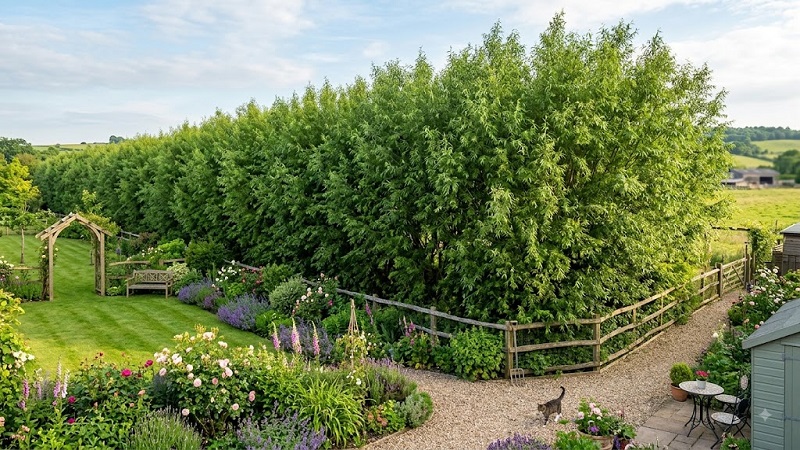
Willows are particularly worth considering for damp areas where other privacy plants may struggle. They are not ideal for every garden, however. Their mature size and root system mean they should not be squeezed into a tiny planting strip beside buildings, pipes, or other sensitive structures.
For a smaller screening project, investigate shrub-form willows or suitable living-willow techniques rather than automatically choosing a large tree.
Regular pruning can help keep vigorous willow growth under control. If you have a very small garden, another privacy plant may be a better long-term choice.
Photinia is popular as a privacy shrub because it combines dense growth with attractive new foliage. Many gardeners particularly like the bright red color that appears on fresh growth before the leaves mature to green.
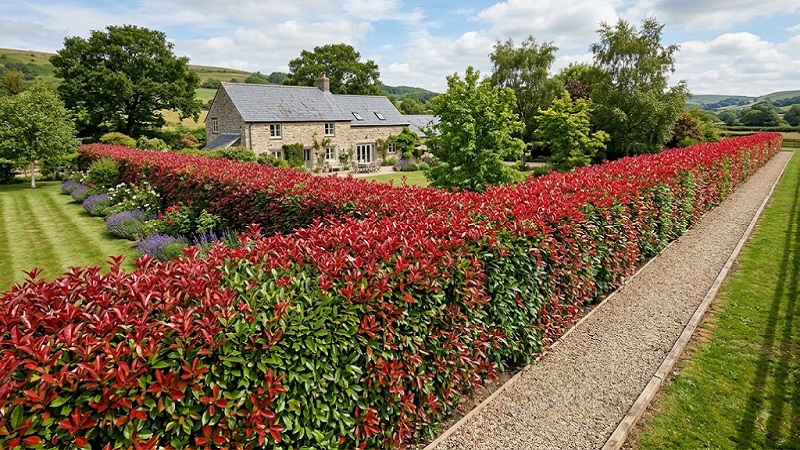
This gives a Photinia hedge more visual interest than a completely green screen. With regular pruning, plants can develop a thick branching structure suitable for boundary hedges and garden divisions.
Photinia generally prefers a sunny to partly shaded position and well-drained soil. Good air circulation is useful in dense hedges because overcrowded, poorly ventilated foliage can create favorable conditions for leaf problems.
Pruning encourages branching. Instead of allowing a young plant to become tall and thin, occasional shaping can encourage growth lower down. The result is a fuller screen rather than a hedge with bare areas near the base.
Cherry laurel is a broadleaf evergreen shrub that can make a thick privacy screen. Its large, glossy leaves give it a different appearance from narrow-leaved conifers and can create a lush background in a garden.
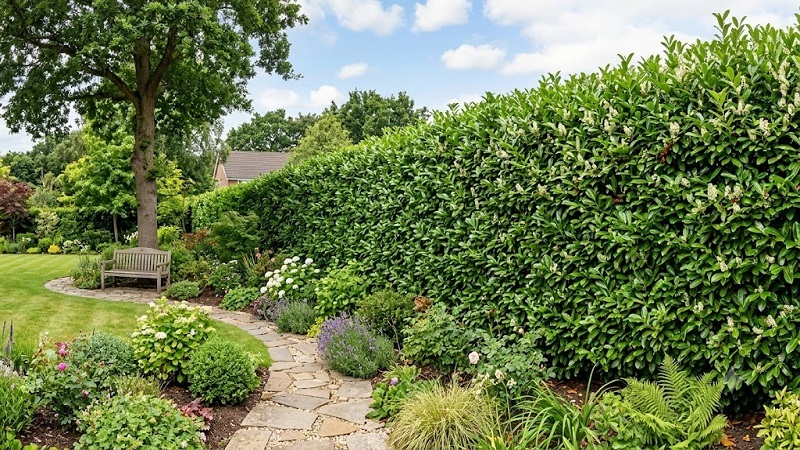
It is useful when you want a hedge that looks substantial rather than delicate. Plants can be maintained as a formal hedge through regular trimming, or they can be allowed to grow more naturally.
Cherry laurel prefers reasonably fertile, well-drained soil and performs best when it receives suitable light for the particular variety and climate.
Because it can become large, give it enough room to develop. Do not choose it for a narrow space simply because you intend to prune it heavily every year.
Not every privacy screen needs to be a row of trees. Star jasmine can be trained against a fence, trellis, pergola, or other support to create a living vertical screen.
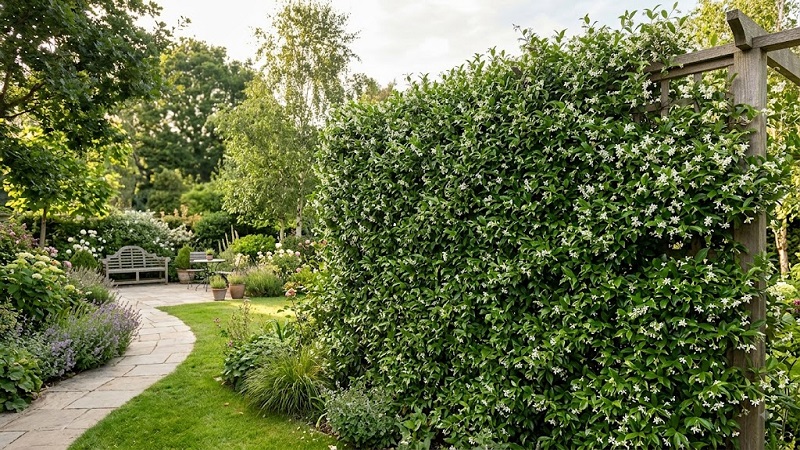
This makes climbing plants particularly useful for patios and small gardens where horizontal space is limited. Once established in a suitable warm climate, star jasmine can produce vigorous growth and a dense layer of foliage.
Its fragrant flowers are another reason gardeners choose it. The combination of green foliage and white flowers can make a privacy screen feel more like part of the garden rather than a simple barrier.
Provide a sturdy support because mature vines can become quite substantial. Guide young stems across the support so the plant fills the available space instead of forming a dense mass in only one area.
In colder regions, winter conditions may limit its usefulness as a year-round privacy screen. Check local climate suitability before planting.
Honeysuckle includes many different species, so it is important to identify the exact plant before adding one to your garden. Some honeysuckles are vigorous climbers that can quickly cover fences, trellises, and other structures.
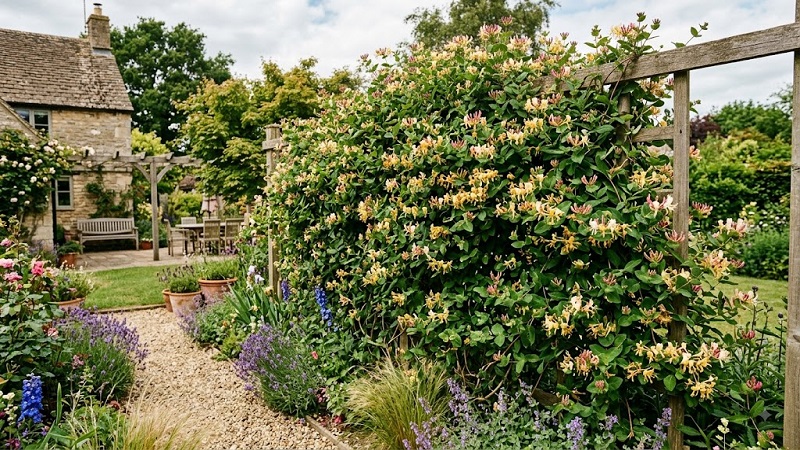
As a privacy screen, a suitable non-invasive honeysuckle can provide vertical coverage and flowers that attract pollinators. It is especially useful when you already have a fence or trellis and need foliage to soften the structure.
The main concern is vigor. Some honeysuckles can become difficult to control, and certain species are invasive in particular regions. Choose a species recommended for your local area rather than selecting solely on growth speed.
Prune after flowering when appropriate for the species, and remove unwanted growth before it becomes tangled. A climbing screen looks much better when it is trained instead of simply left to grow wherever it can.
There is no single spacing rule that works for every privacy plant. The correct distance depends on the plant's mature width, growth rate, desired hedge density, and how quickly you want the screen to fill in.
A common mistake is planting everything extremely close together because the gardener wants instant privacy. Although close planting can produce a full screen sooner, it also increases competition for water, nutrients, light, and root space.
A better approach is to consider the mature width of each plant. For example, large trees need considerably more room than small hedge shrubs. Climbers are different again because their main limitation may be the size of the supporting structure rather than ground space.
| Privacy Plant | Typical Use | Growth Character | Maintenance |
|---|---|---|---|
| Bamboo | Tall narrow screen | Very vigorous | Moderate |
| Leyland Cypress | Tall evergreen boundary | Fast | Moderate |
| Green Giant Arborvitae | Large evergreen screen | Fast | Low to moderate |
| Privet | Formal hedge | Fast | High if kept formal |
| Elaeagnus | Dense evergreen hedge | Fast | Moderate |
| Willow | Large screen or damp area | Very vigorous | Moderate to high |
| Photinia | Colorful hedge | Fast | Moderate |
| Cherry Laurel | Dense evergreen hedge | Moderate to fast | Moderate |
| Star Jasmine | Fence or trellis | Vigorous in suitable climates | Moderate |
| Honeysuckle | Climbing screen | Vigorous | Moderate to high |
If privacy is your main goal, evergreen plants are often the first choice because they retain foliage for most or all of the year. This is particularly important if the screen is being used to hide a neighboring property, road, outdoor equipment, or another view that you do not want to see during winter.
Deciduous plants have their own advantages. They can provide rapid summer growth, flowers, attractive seasonal color, and habitat for wildlife. They may also allow more sunlight into the garden during winter after the leaves fall.
Think about when you actually need privacy. If your outdoor space is used mainly during warm weather, a deciduous or semi-evergreen screen may be perfectly suitable.
For year-round screening, consider evergreen trees, evergreen shrubs, bamboo species that retain foliage, or suitable evergreen climbing plants.
Good planting preparation can make a major difference in how quickly a privacy screen becomes established. Start by removing competing weeds and grass from the planting area. If the soil is compacted, loosen it before planting.
Dig a planting hole that is wide enough for the root system. Avoid making the hole unnecessarily deep. The plant should normally sit at a similar depth to the level at which it was growing in its container or nursery soil.
After planting, water thoroughly so the soil settles around the roots. Continue watering as needed while the plants establish. Newly planted screens should not be expected to survive on rainfall alone during extended dry periods.
Mulch can help conserve soil moisture and reduce competition from weeds. Keep a small gap around trunks and stems rather than piling mulch directly against them.
It can be tempting to use a large amount of fertilizer to force faster growth. This is not always helpful. Healthy roots and suitable soil moisture are more important during establishment. Excess fertilizer can damage roots and create weak, overly soft growth.
Fast growth sounds attractive, but mature size matters more in the long run. A plant that grows several feet each year can quickly become too large for a small garden.
Crowding plants may produce quick coverage, but it can increase competition and make pruning harder. Follow spacing recommendations for the particular species and your desired final appearance.
A privacy plant that performs well in one climate may struggle in another. Winter cold, summer heat, humidity, rainfall, and soil type all influence growth.
Large, vigorous plants need room for their root systems. Before planting trees or aggressive species near buildings, drainage systems, paving, or underground utilities, consider their mature size and root behavior.
Young plants are easier to shape than mature, overgrown hedges. Light, regular pruning can help create a dense screen while keeping the plant within its intended boundaries.
Some vigorous plants can become invasive outside their natural range. Always check local recommendations before planting bamboo, honeysuckle, privet, or other plants known for vigorous spread in some regions.
There is no shortcut that can replace a suitable plant and good growing conditions. However, several simple practices can help a new screen establish more effectively.
The goal should be healthy growth rather than maximum growth at any cost. A plant that grows steadily and develops strong roots will usually make a better long-term privacy screen than a stressed plant that is being pushed too hard.
The best fast-growing privacy screen depends on your garden rather than simply on which plant grows the fastest. Bamboo can create a strong vertical screen, while Leyland cypress and Green Giant arborvitae are useful for taller evergreen boundaries. Privet and Photinia work well when you want a manageable hedge, while Cherry Laurel provides broad evergreen foliage.
For gardens with vertical structures, climbing plants such as star jasmine or suitable honeysuckle can turn a fence or trellis into a green wall. Willow can be useful where conditions and available space allow vigorous growth.
Before buying anything, measure your planting area and decide how tall and wide you want the finished screen to be. Then choose a plant that naturally fits those dimensions. This simple step can prevent years of unnecessary pruning and maintenance.
A successful privacy screen is not just about speed. It is about choosing the right plant, giving it enough room, and providing the basic care it needs while it becomes established. With the right combination, a living screen can turn an exposed garden into a greener, more private outdoor space.
Continue exploring our gardening guides with more plant profiles, growing tips, and practical advice for creating a healthy, productive garden.