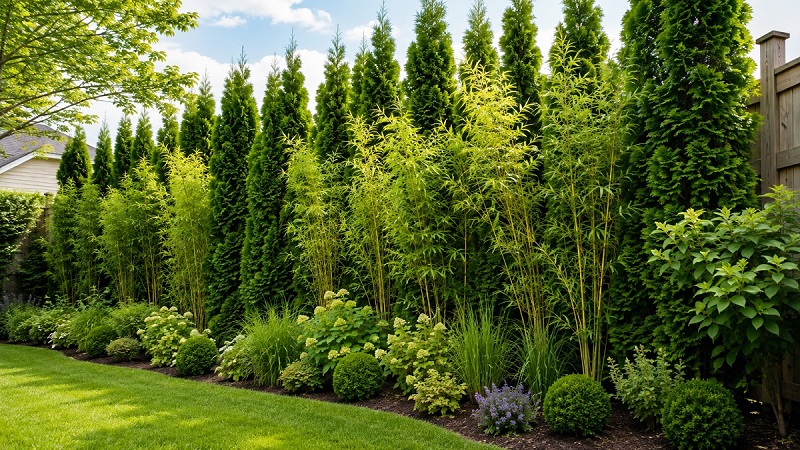
Top 10 Fast-Growing Privacy Screens for Your Garden
Discover the top 10 fast-growing privacy screens for gardens, yards, and outdoor spaces. Compare growth rate, mature size, evergreen options, sunlight needs, and care tips.
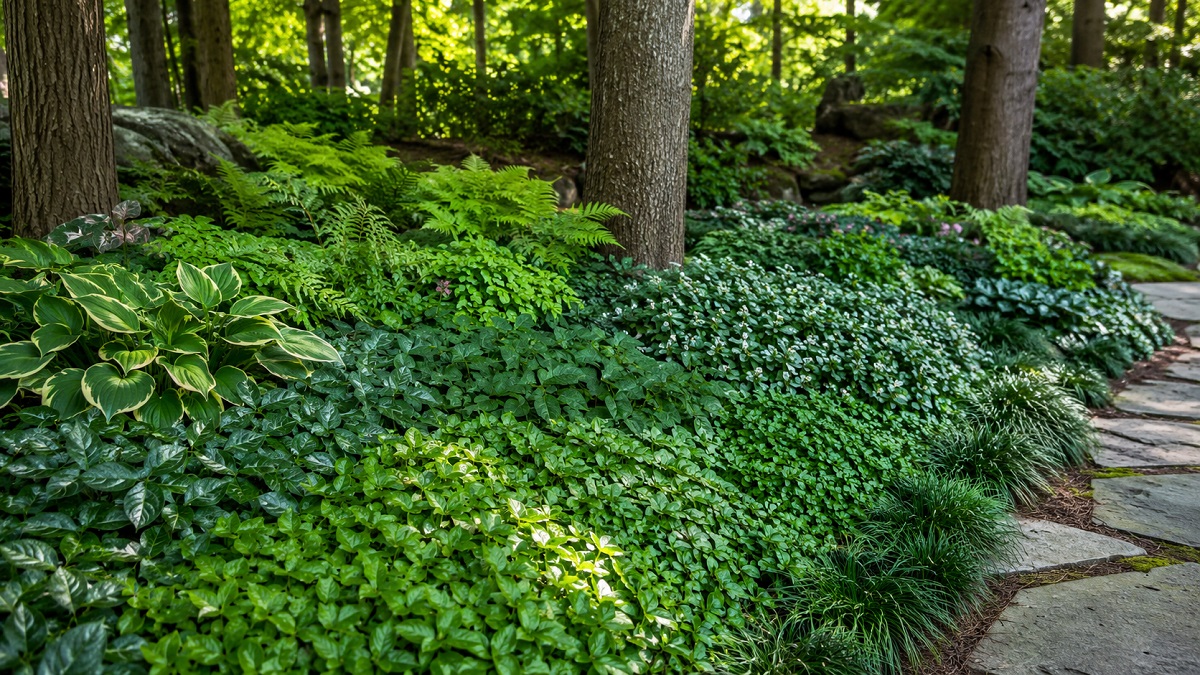
Deep shade can be one of the most difficult parts of a garden to plant. Beneath mature trees, along north-facing walls, under dense shrubs, or beside buildings, the soil may remain cool and damp while very little direct sunlight reaches the ground. Grass often becomes thin and patchy, flowering plants may struggle to bloom, and bare soil can quickly become an invitation for weeds and erosion.
Evergreen groundcovers offer a practical way to turn these difficult spaces into attractive, living garden areas. Instead of relying on seasonal flowers for interest, they provide foliage that remains useful through much or all of the year. The best choices form a low, spreading carpet, tolerate reduced light, and compete reasonably well with tree roots once established.
However, not every plant described as a shade groundcover is truly evergreen, and not every evergreen groundcover is suitable for the darkest corners of a garden. Some are better described as semi-evergreen, while others need bright filtered light rather than extremely deep shade. Choosing the right plant therefore means considering soil moisture, winter climate, mature spread, maintenance, and how aggressively the plant spreads.
This guide looks at 10 dependable evergreen or substantially evergreen groundcovers that can be useful in shady garden situations. It also explains where each plant performs best, what to watch for, and how to establish a healthy groundcover layer without creating a maintenance problem later.
Best results come from matching the groundcover to the shade, soil moisture, and climate.
Before choosing a groundcover, it helps to understand what "deep shade" actually means. A location may be shaded for most of the day but still receive bright reflected or filtered light. Another location may be almost completely dark beneath a dense evergreen tree. Those two situations can look similar from a distance, but plants respond to them very differently.
Deep shade generally describes areas that receive little or no direct sunlight for much of the day. North-facing areas, narrow spaces between buildings, locations beneath dense tree canopies, and heavily shaded woodland edges are common examples. Even in these locations, however, some ambient daylight is important for photosynthesis.
One of the biggest mistakes gardeners make is assuming that a plant labeled "shade tolerant" will thrive anywhere sunlight is limited. Shade tolerance exists on a spectrum. A plant may tolerate four or five hours of filtered light but struggle when placed in nearly continuous darkness.
Shade beneath mature trees is often surprisingly dry because established tree roots absorb large amounts of water. The soil may also contain dense networks of roots that make planting difficult. In contrast, shade beside a building or in a low woodland area may remain consistently moist.
This difference matters. Pachysandra, for example, appreciates evenly moist soil, while plants such as some Epimedium selections can handle periods of dry shade once established. A groundcover that is technically shade tolerant can still fail if its moisture requirements do not match the site.
Groundcovers are planted because they spread, but spreading behavior varies enormously. Some plants gradually form tidy colonies, while others can travel rapidly through underground stems or rooting branches.
Always consider the mature size before planting. A groundcover that looks harmless in a small nursery pot can occupy several square meters after a few growing seasons. This is especially important near natural areas, neighboring properties, paths, and ornamental beds.
The following plants are among the most useful choices for creating a low-maintenance foliage layer in shady gardens. Their exact performance varies by climate and cultivar, so local growing conditions should always be considered. Several are fully evergreen in mild climates but may become semi-evergreen or lose some foliage in colder regions.
Japanese pachysandra is one of the classic shade groundcovers. It is valued for its glossy, dark green foliage and its ability to form a dense carpet in locations where many other plants struggle. Once established, it can create a remarkably uniform planting beneath trees and along shaded foundations.
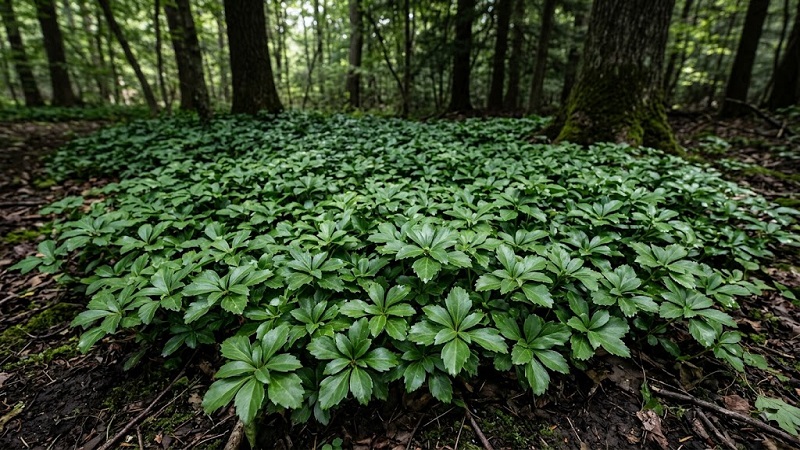
Pachysandra prefers partial to deep shade and performs best in soil that remains reasonably moist but drains well. It appreciates organic matter, particularly in woodland-style beds. Its low-growing habit makes it useful beneath shrubs, around taller shade plants, and along informal garden paths.
Small white flower spikes appear in spring, but the foliage is the main attraction. In suitable climates, the leaves provide year-round structure. The plant spreads through underground stems, gradually filling open ground.
The main drawback is that pachysandra can become too dense in poorly ventilated locations. Wet foliage and crowded growth can encourage fungal problems. Give new plantings reasonable spacing and avoid constantly keeping the leaves wet when watering.
Best for: Moist woodland beds, tree-shaded borders, foundations and large shady areas.
European wild ginger is an excellent choice when the goal is a refined, woodland-style groundcover rather than a brightly flowering carpet. Its rounded, glossy green leaves grow close to the ground and overlap as the plant gradually spreads.
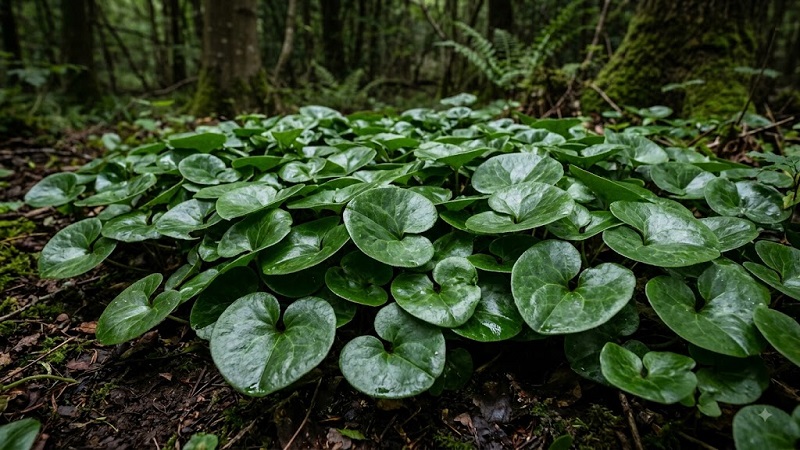
It prefers rich, humus-filled soil and performs particularly well in cool, shaded conditions. Once established, it can form an attractive foliage mat beneath trees and larger woodland plants.
The flowers are small and often hidden beneath the foliage, so this is primarily a foliage plant. That can actually be an advantage in a deep-shade garden where dramatic flowers are difficult to maintain.
European wild ginger is generally slower and more restrained than aggressive spreading groundcovers. This makes it attractive for gardeners who want good coverage without a plant rapidly escaping into every neighboring bed.
Best for: Woodland gardens, rich soils, shaded paths and naturalistic planting schemes.
Lesser periwinkle is widely grown as an evergreen or semi-evergreen groundcover for difficult shady areas. Its glossy leaves create a dense mat, while blue, violet-blue, or occasionally white flowers appear in spring.
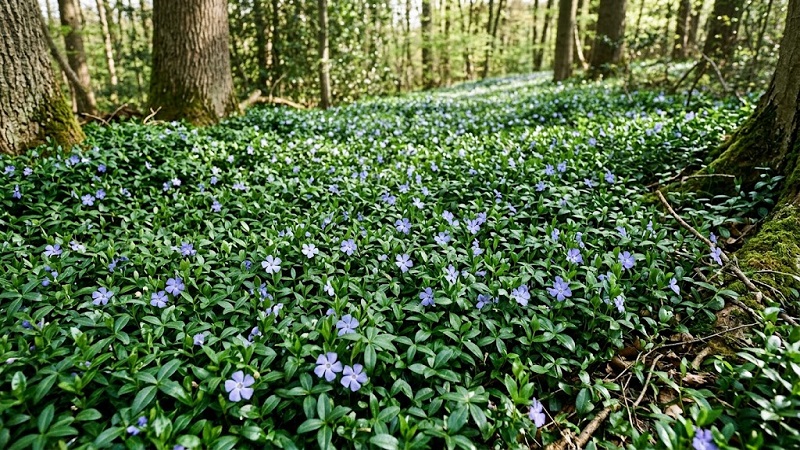
One reason it remains popular is its ability to cover ground relatively quickly. It can tolerate a range of soils and often handles dry shade better than gardeners expect once established. This makes it particularly useful under mature trees where competition for moisture is a problem.
Its vigorous spreading habit is also the reason for caution. Vinca minor can move beyond the area where it was originally planted, particularly where conditions are favorable. It should be kept away from natural woodland and monitored along property boundaries.
If you want a groundcover that establishes quickly, remains low, and provides both foliage and seasonal flowers, lesser periwinkle can be very effective. If containment is important, however, choose a more restrained species.
Best for: Large shady slopes, difficult tree-root areas and gardeners who need rapid ground coverage.
Epimedium is one of the most versatile plants for dry shade and woodland gardens. Many selections have evergreen or semi-evergreen foliage, although their winter behavior varies considerably by species and climate.
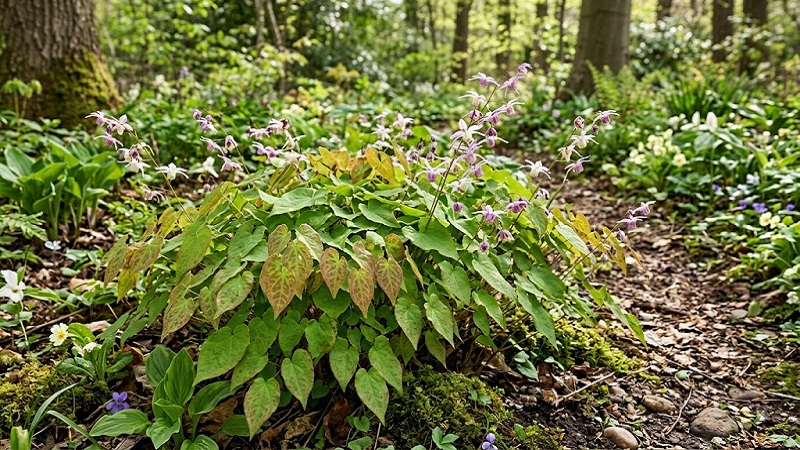
The heart-shaped leaves are often attractively marked, and delicate flowers appear in spring. Flower colors can include yellow, pink, red, white, or combinations depending on the cultivar.
One of the great strengths of Epimedium is its tolerance of root competition. Established plants can perform surprisingly well beneath mature trees where soil moisture is limited. They are also useful when you want a groundcover that looks more natural and varied than a single solid carpet.
In colder climates, old foliage may become tired or damaged over winter. Cutting it back before fresh spring growth emerges can restore a clean appearance. In mild climates, however, many selections hold their leaves for much of the year.
Best for: Dry shade, tree-root zones, woodland gardens and naturalistic borders.
Lilyturf is a clumping, grass-like groundcover that brings a different texture to shady planting areas. Its narrow leaves form dense tufts, and spikes of purple, lavender, or white flowers can appear during warmer months.
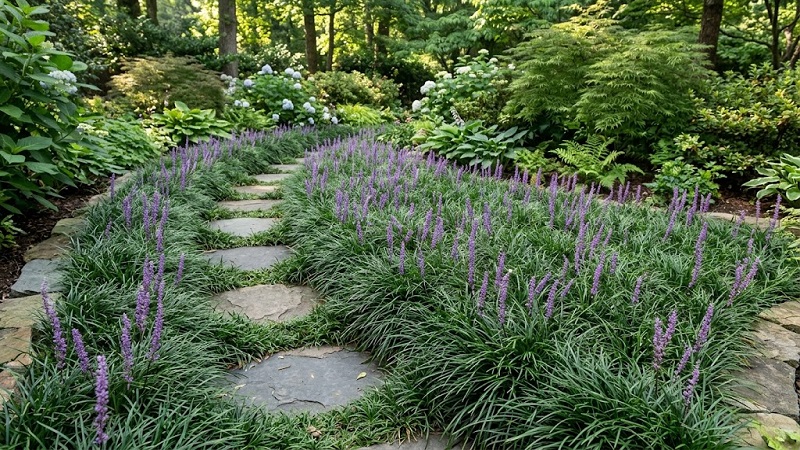
Although it can tolerate considerable shade, lilyturf generally looks strongest where it receives some filtered light. In very dark locations it may grow more slowly and flower less heavily.
Liriope is particularly useful along paths, under shrubs, at the front of woodland borders, and in places where a neat, grassy texture is desired. It also works well as a transition plant between larger shrubs and low groundcovers.
The plant is relatively easy to maintain. Remove damaged foliage when necessary and divide overcrowded clumps when they begin to lose vigor. Avoid treating it exactly like lawn grass; it is a perennial ornamental rather than a turf substitute.
Best for: Shady borders, paths, tree gardens and areas needing a grass-like evergreen texture.
Mondo grass is another excellent option for gardeners who like fine, strap-shaped foliage. Despite its common name, it is not a true grass. It forms clumps of dark green leaves that gradually create a low, textured groundcover.
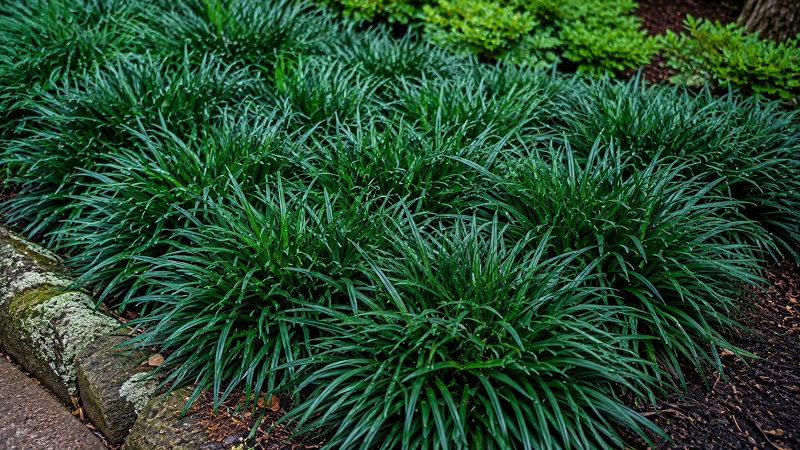
It is especially attractive in Japanese-inspired gardens, woodland borders, around stepping stones, and beneath taller shrubs. Its foliage remains useful through much of the year in suitable climates.
Mondo grass prefers moist, well-drained soil and can tolerate substantial shade. It is usually more restrained than highly aggressive vine-like groundcovers, making it easier to incorporate into carefully designed beds.
Give new plants adequate water while their roots establish. Once mature, they are considerably more forgiving, although prolonged drought can still cause browning and reduced growth.
Best for: Small shaded beds, woodland paths, Japanese-style gardens and formal groundcover planting.
Wintercreeper is a versatile evergreen or semi-evergreen plant with many cultivars offering green, white, yellow, or variegated foliage. Some forms stay low and spreading, while others can climb if they encounter a suitable support.
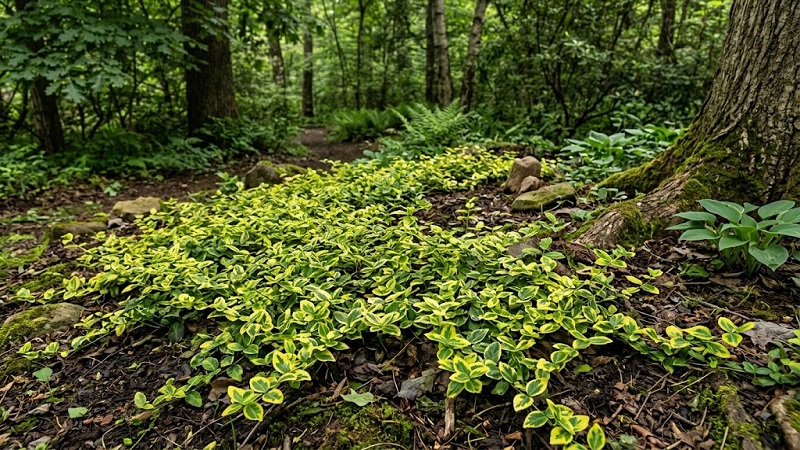
Its ability to tolerate shade makes it useful for challenging areas, and variegated selections can add brightness where a dark garden otherwise looks flat. The foliage can provide visual interest even when flowering plants are dormant.
However, wintercreeper should be selected carefully and managed responsibly. Some forms can become vigorous and difficult to contain. Before planting, check whether particular cultivars are considered invasive or problematic in your region.
For a controlled garden design, use it where its spreading habit can be monitored. Regular trimming can help maintain boundaries and prevent it from climbing into trees or neighboring vegetation.
Best for: Shady borders, slopes and locations where evergreen or variegated foliage is desired.
Wintergreen is a low-growing native woodland plant in parts of eastern North America. It combines evergreen foliage with small white flowers and bright red berries, giving it more seasonal interest than many conventional groundcovers.
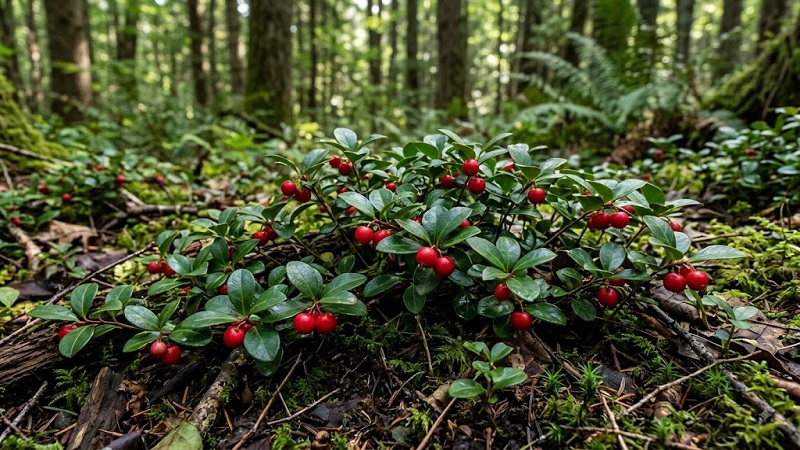
It prefers acidic, organically rich soil and is naturally adapted to woodland conditions. The foliage has a characteristic wintergreen fragrance when crushed, while the berries can provide additional ornamental interest.
This plant is particularly attractive in a woodland garden where the goal is to recreate a natural forest-floor appearance. It is not the fastest choice for covering a large area, but its restrained habit can be an advantage in smaller gardens.
Wintergreen is not a good choice for alkaline, compacted soil. If the natural conditions of the site are unsuitable, it is usually better to choose a groundcover adapted to the existing soil rather than trying to completely change a large planting area.
Best for: Acidic woodland gardens, naturalistic beds and cool, organic soils.
English ivy is one of the most recognizable evergreen groundcovers for shade. Its glossy foliage can quickly cover soil, rocks, walls, and slopes, making it effective where rapid coverage is a priority.
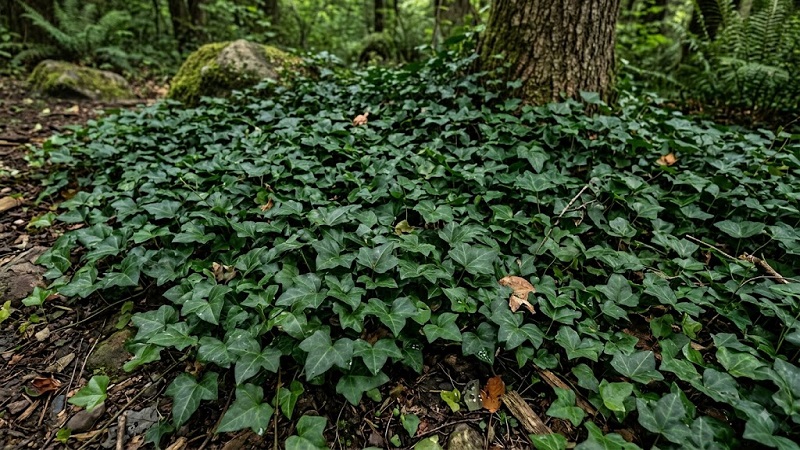
It tolerates low light and can remain attractive throughout much of the year. Different cultivars provide variations in leaf shape, size, and coloration.
The major concern is its aggressive growth. English ivy can climb trees, spread into natural areas, and become difficult to remove once established. In many regions it is considered invasive or environmentally problematic.
For that reason, it should not automatically be considered a good choice simply because it grows well in deep shade. Before planting it, check local invasive-plant guidance. In areas where it is restricted or known to escape, select a better-behaved alternative.
Best for: Only where locally appropriate and responsibly contained; otherwise choose a non-invasive alternative.
Christmas fern is not a conventional creeping groundcover, but it deserves consideration when the goal is to create a low, evergreen woodland floor. Its leathery fronds remain green through winter in many climates and form attractive clumps in shady locations.
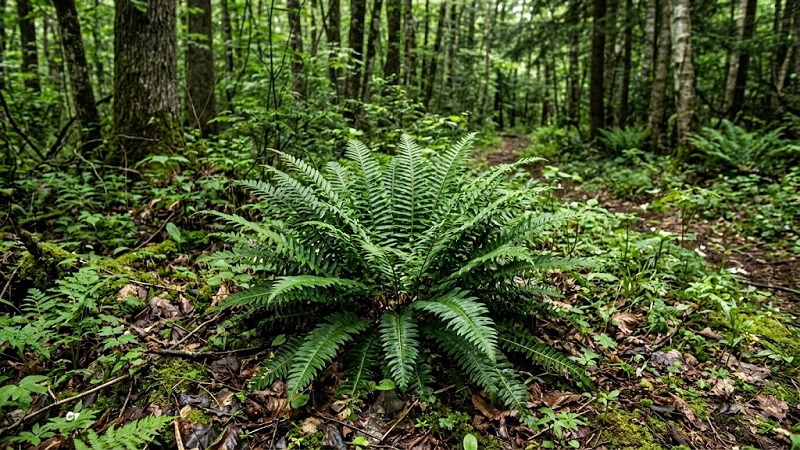
It is particularly effective beneath deciduous trees and alongside woodland shrubs. Instead of creating a perfectly uniform carpet, it provides a natural layered appearance that looks at home in a forest-inspired garden.
Christmas fern prefers moist, organically rich soil but is more adaptable once established. It can tolerate substantial shade and is useful for adding evergreen structure among deciduous perennials.
Because it grows as a fern rather than a creeping mat, it will not cover bare ground in exactly the same way as pachysandra or vinca. Its value lies in creating a durable, natural-looking evergreen understory.
Best for: Native woodland gardens, naturalistic beds, slopes and evergreen fern layers.
The following comparison gives a quick way to narrow down the choices. Remember that evergreen behavior can change with winter temperature, exposure, cultivar, and local climate.
| Groundcover | Shade Tolerance | Moisture Preference | Growth Habit | Main Feature |
|---|---|---|---|---|
| Japanese Pachysandra | Deep shade | Moderate moisture | Spreading carpet | Dense glossy foliage |
| European Wild Ginger | Deep shade | Moist, rich soil | Slow colony | Rounded evergreen leaves |
| Lesser Periwinkle | Deep shade to partial shade | Moderate | Vining carpet | Flowers and glossy leaves |
| Epimedium | Deep to filtered shade | Moderate to dry once established | Clumping/spreading | Flowers and attractive foliage |
| Lilyturf | Shade to partial shade | Moderate | Clumping | Grass-like foliage |
| Mondo Grass | Deep to partial shade | Moderate | Clumping | Fine evergreen texture |
| Wintercreeper | Shade tolerant | Moderate | Spreading/climbing | Evergreen and variegated forms |
| Wintergreen | Woodland shade | Moist, acidic soil | Low spreading | Red berries and fragrance |
| English Ivy | Deep shade | Moderate | Vigorous vine | Fast evergreen coverage |
| Christmas Fern | Deep shade | Moderate to moist | Clumping | Evergreen fern fronds |
The best groundcover is not necessarily the fastest-growing one. A plant that spreads rapidly may cover bare soil quickly but create years of maintenance later. In contrast, a slower plant may take longer to establish but fit the garden much better.
Start by observing the soil after rain and during a dry period. Does it remain damp for several days, or does it become dry almost immediately? Soil beneath mature trees can be particularly deceptive because the surface may appear moist after watering while deeper roots remain dry.
Moist woodland conditions favor plants such as pachysandra, European wild ginger, and Christmas fern. Drier shade may be better suited to established Epimedium and some other adaptable shade plants.
If the priority is rapid coverage, a spreading groundcover may be appealing. But speed should be balanced against containment. Fast spreaders require more attention at their edges and can become difficult to remove when planted in the wrong location.
For a smaller ornamental bed, a slower, clumping groundcover can often produce a more polished result. Mondo grass, lilyturf, Epimedium, and Christmas fern can be used to create layers rather than one uninterrupted carpet.
Evergreen foliage is particularly valuable in deep shade because shaded gardens can otherwise become visually empty during winter. However, "evergreen" does not always mean that every leaf will remain perfect all winter.
Cold, wind, snow, drought, and sudden temperature changes can damage foliage. Some plants are evergreen in mild climates but semi-evergreen in colder regions. If winter appearance is critical, select plants known to remain dependable in your local climate.
Good preparation is especially important in shade. Groundcover plants must compete with existing tree roots and established shrubs, so giving them the best possible start can make a noticeable difference.
Remove perennial weeds before planting whenever possible. Avoid aggressive digging around mature trees because cutting large roots can damage the tree. Hand removal is often the safest approach around established root systems.
Add a modest amount of finished compost or other suitable organic matter to the planting area when appropriate. Do not build a thick layer of soil over tree roots. Mature trees need access to oxygen as well as water, and burying their root zone can cause serious problems.
Close spacing gives faster visual coverage, but it also increases the initial cost. Wider spacing takes longer but can reduce crowding and improve air circulation. Use the mature spread of the selected cultivar as your guide rather than planting every groundcover at the same distance.
New groundcovers need consistent moisture while they develop roots. Water deeply enough to moisten the root zone rather than giving frequent, shallow sprinklings.
A thin layer of organic mulch can help conserve moisture and suppress weeds. Keep mulch away from plant crowns and stems. Thick mulch piled directly against plants can encourage rot and create conditions favorable to pests.
Once established, many evergreen groundcovers require surprisingly little attention. The first year or two are usually the most important because plants are developing their root systems and filling the available space.
Check the soil before watering rather than following a rigid schedule. Shaded ground can dry slowly, but tree-root competition can make it unexpectedly dry. Water deeply during extended dry periods, particularly for newly planted groundcovers.
Weed regularly while the groundcover is establishing. Small weeds are much easier to remove than large perennial weeds that have become entangled with the groundcover's roots.
Most established shade groundcovers do not need heavy fertilization. Excessive fertilizer can encourage soft, overly vigorous growth without solving the underlying problem if the site has poor drainage, insufficient moisture, or unsuitable light.
A soil test can be more useful than automatically applying fertilizer. If the soil is deficient in a particular nutrient, correct the deficiency based on the test results and the needs of the plant.
Remove damaged or diseased foliage when necessary. Some semi-evergreen plants benefit from being cut back or cleaned up in late winter or early spring before new growth begins.
Fast-spreading plants may need edge trimming several times a year. Do not wait until they have invaded surrounding beds before taking action.
Yellow leaves can result from several causes, including excessive moisture, poor drainage, nutrient deficiencies, root damage, or natural aging. Do not assume fertilizer is the solution. First inspect the soil and roots and consider recent weather.
Brown edges often indicate drought stress, root competition, winter injury, or excessive exposure to drying winds. This is common beneath mature trees, where the groundcover and tree are competing for available moisture.
If a supposedly shade-tolerant groundcover remains thin, the site may simply be too dark. Compaction, poor soil, drought, root competition, or unsuitable planting depth can also contribute.
Before replacing the plant, determine what changed. A healthy groundcover usually performs better after the underlying growing conditions are corrected.
Dense planting combined with consistently wet foliage can increase the risk of fungal diseases. Improve air movement where possible, water at the soil surface, avoid unnecessary overhead irrigation, and remove badly affected plant material.
This is one of the most important considerations when selecting a groundcover. Vinca, ivy, and some forms of Euonymus can spread aggressively under favorable conditions. Regularly inspect the edges of the planting and remove unwanted runners before they become established.
A shady garden does not have to be a single mass of green. Evergreen groundcovers work best when they are combined with different leaf shapes, heights, and textures.
Combine a low groundcover such as European wild ginger or pachysandra with taller ferns, shrubs, and shade-loving perennials. Allow some areas to remain slightly open so the planting feels natural rather than artificially carpeted.
Deep shade can reduce flowering, so foliage texture becomes especially important. Pair broad leaves with narrow leaves, glossy foliage with matte foliage, and upright forms with spreading forms.
Mondo grass and lilyturf provide narrow foliage, while wild ginger and pachysandra offer broader leaves. Ferns can add an entirely different texture and create a softer transition between ground level and taller plants.
Variegated groundcovers can reflect available light and make a dark planting area appear brighter. Wintercreeper cultivars are one possibility, although their growth habit and regional invasive status should be checked before planting.
A narrow path through a woodland garden can look much more established when its edges are softened with low foliage. Mondo grass, pachysandra, or suitable Epimedium selections can create a transition between paving and taller plantings.
It is tempting to think of evergreen groundcovers as a solution to any bare patch of soil. They are useful, but they still need the right basic conditions. A location with virtually no usable light, severe root competition, standing water, or heavily compacted soil may remain difficult regardless of the plant chosen.
The most successful shade gardens usually work with the existing conditions rather than fighting them. Observe the area throughout the year, identify whether it is dry or moist, determine how much filtered light reaches the soil, and then choose plants that naturally fit those conditions.
This approach also reduces maintenance. When a plant is well matched to its environment, it generally needs less watering, fewer interventions, and less corrective pruning.
For a dense, traditional carpet in moist shade, Japanese pachysandra is one of the strongest choices. For a more natural woodland appearance, European wild ginger and Christmas fern are excellent candidates. If dry shade beneath mature trees is the main challenge, Epimedium deserves serious consideration.
Gardeners looking for grass-like texture can choose mondo grass or lilyturf. Wintergreen is especially appealing for an acidic woodland setting, while lesser periwinkle provides quick coverage and seasonal flowers but requires attention to its spreading habit.
Wintercreeper and English ivy can provide strong evergreen coverage, but their aggressive growth potential means they should be considered carefully. In regions where either plant is invasive or environmentally damaging, choose a more appropriate alternative.
Ultimately, the best deep-shade groundcover is the one that matches your garden's light, moisture, soil, climate, and maintenance expectations. A slower-growing plant that stays where it belongs is often more valuable than a fast-growing plant that eventually takes over the garden.
There is no single best choice for every garden. Japanese pachysandra is a dependable traditional option for moist shade, while European wild ginger is excellent for woodland conditions. Epimedium is particularly useful where dry shade and tree-root competition are concerns.
Yes. Many shade groundcovers can grow beneath mature trees, but competition from tree roots can make establishment difficult. Water new plants consistently and avoid damaging large tree roots during soil preparation.
Shade-tolerant groundcovers can survive with very little direct sun, but they still require some ambient light for healthy growth. Extremely dark locations may be unsuitable even for plants described as deep-shade tolerant.
Epimedium is one of the strongest choices for dry shade once established. Some other shade groundcovers can also tolerate dry conditions, but performance depends on the specific plant, soil, climate, and degree of root competition.
English ivy tolerates deep shade and provides rapid evergreen coverage, but it can become invasive and difficult to control. Check local regulations and invasive-plant recommendations before planting it. In many gardens, a less aggressive alternative is preferable.
Spacing depends on the mature width and growth rate of the particular plant. Fast-spreading groundcovers can be planted farther apart than slow-growing clumping types. Follow the mature spread recommended for the selected species or cultivar.
A dense groundcover can reduce the amount of open soil available for weeds, but it will not eliminate weeds completely. Weed the area during establishment and maintain a healthy, well-spaced groundcover layer.
No. Evergreen behavior depends on climate, winter temperatures, exposure, and the particular species or cultivar. Some plants may remain fully evergreen in mild climates but become semi-evergreen or lose foliage in colder regions.
Deep shade does not have to mean bare soil or struggling grass. With the right evergreen groundcover, even the darkest parts of a garden can become attractive, cohesive planting areas with useful foliage throughout much of the year.
Start by studying the site rather than choosing a plant based only on appearance. Consider how much light reaches the ground, whether the soil stays wet or becomes dry, how much competition exists from tree roots, and how much spreading you are prepared to manage. Then choose a groundcover that naturally fits those conditions.
Whether you prefer the dense carpet of pachysandra, the refined foliage of wild ginger, the flowers of periwinkle, the resilience of Epimedium, the fine texture of mondo grass, or the natural character of evergreen ferns, there are plenty of ways to make a deep-shade garden feel intentional and inviting.
Continue exploring our gardening guides with more plant profiles, growing tips, gardening design ideas and practical advice for creating a healthy, productive garden.