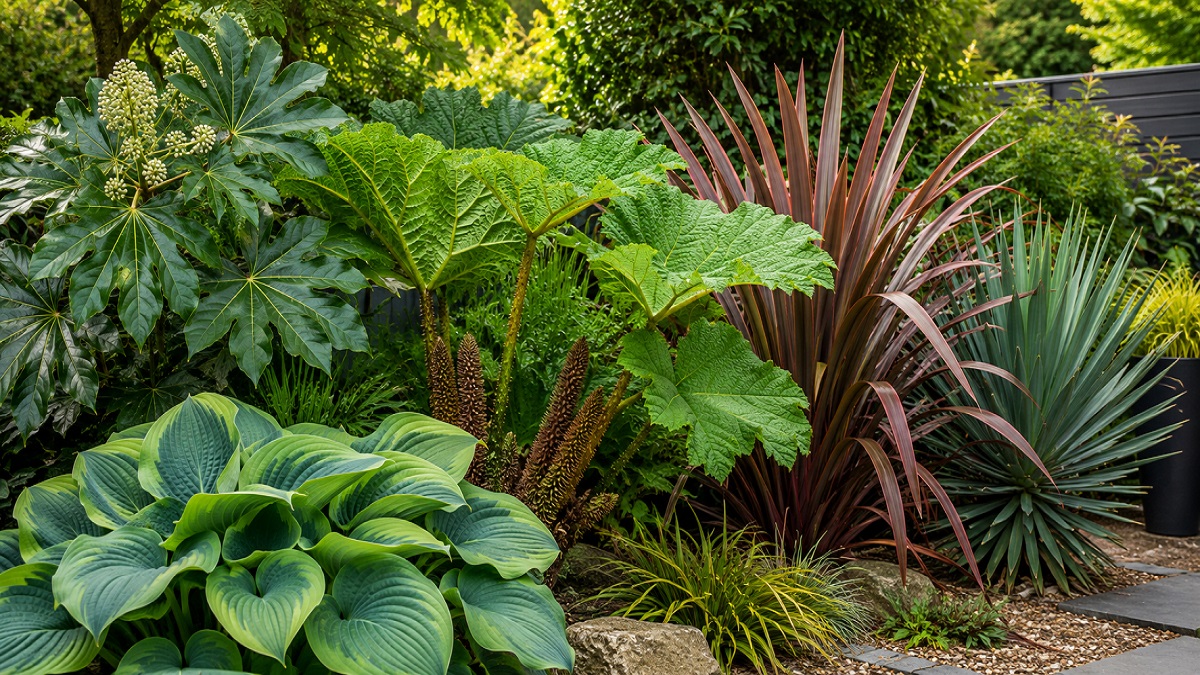
Architectural foliage plants such as Fatsia, Gunnera, Phormium, Yucca, and Hosta provide bold shapes, striking textures, and year-round structure for modern and traditional gardens.
When we visualize a breathtaking garden design, our minds frequently wander toward brief, explosive bursts of floral color. We anticipate the romantic flash of midsummer roses, the delicate nodding heads of spring tulips, or the vibrant, hot hues of late-season dahlias. Yet, professional landscape architects realize a fundamental truth that separates mediocre gardens from well-designed gardens: flowers are ephemeral, but structure lasts. Foliage forms the skeleton, muscle, and enduring canvas of any serious planting scheme.
Architectural foliage plants are the undisputed heavyweights of this structural philosophy. These are not your average, polite green backdrops that quietly blend into a hedge. Architectural plants demand attention. They are characterized by their dramatic scale, precise geometric outlines, deeply incised margins, or bold, tropical leaves that look less like biological specimens and more like living sculptures. By deploying these statements strategically, you can manipulate perspective, ground chaotic borders, introduce a sense of rhythm, and keep your garden looking incredibly dynamic long after the last flower petals have fallen.
Before selecting individual plants, it is crucial to understand how structural form operates in a landscape setting. Human eyes crave order amidst the biological chaos of a garden. When a border consists entirely of fine-textured plants—such as dainty perennial geraniums, wispy ornamental grasses, and scattered cosmos—the result can easily look messy, blurry, and visually fatiguing. The eye has nowhere to rest.
An architectural foliage plant acts as a visual anchor. Its distinct silhouette draws the gaze, provides a resting spot, and creates a clean contrast that instantly makes the surrounding fine texture look intentional rather than unkempt. Architects use these plants to frame views, accentuate entryways, anchor the corners of hard landscaping, or serve as spectacular solo focal points embedded in lawns or gravel fields. The primary criteria for these botanical wonders include:
Strong Silhouettes: Unmistakable outlines that remain recognizable even in low light, silhouette lighting, or under a dusting of winter frost.
Exaggerated Leaf Form: Leaves that are massive (megaphylls), deeply cut, strictly strap-shaped, or aggressively pointed.
Substance and Longevity: Tough, leather-like leaves, thick cuticles, or self-supporting stems that preserve their physical integrity across seasons without flopping or disintegrating easily.
Quick Reference: Core Architectural Typologies
Choosing the right structural style ensures your landscape matches your home's overarching architecture.
TypologyThe Giant Megaphyll
Visual ImpactJungle-like, massive, imposing scale
Best ExamplesGunnera, Fatsia, Tetrapanax
Ideal PositionDamp low spots, corner backdrops
TypologyThe Spiky Linear
Visual ImpactExplosive, razor-sharp, desert modern
Best ExamplesCynara (Cardoon), Melianthus, Acanthus
Ideal PositionMid-border accents, sunny statement zones
TypologyThe Sculptural Shaded
Visual ImpactCool, clean, high-contrast plates
Best ExamplesHosta 'Empress Wu', Darmera, Rodgersia
Ideal PositionNorth walls, wooded understories
1. The Hardy Exotics and Giants
Fatsia japonica (Japanese Aralia)
Fatsia japonica is an exceptional performer for urban settings, dark courtyards, and challenging shaded zones. Belonging to the ivy family (Araliaceae), it produces huge, glossy, deeply lobed leaves that closely resemble webbed giant hands. The reflective sheen of its foliage is particularly brilliant; it catches any ambient light filter down through an overhead canopy, brightening gloomy corners.
Growing into a substantial evergreen shrub reaching up to 8-10 feet high and wide, Fatsia provides a robust year-round presence. In late autumn, it produces exotic, globe-like clusters of milky-white flowers that resemble satellite dishes, followed by dark purple-black berries. For an extra designer flair, seek out the cultivar 'Spider's Web', which features fine white speckles across the leaf margins, offering a frosted appearance that enhances its architectural configuration.
Tetrapanax papyrifer 'Rex' (Chinese Rice Paper Plant)
If you wish to introduce sheer, unadulterated jungle drama, few hardy specimens can hold a candle to Tetrapanax papyrifer 'Rex'. This plant is a true prehistoric titan. In a single growing season, it can fling out heavily felted, deeply lobed leaves that stretch an astonishing three to over four feet across. The new growth emerges from a central, upright trunk, covered in a golden-brown indumentum (a velvet fuzz) that protects the emerging leaves.
While it thrives in full sun to partial shade and prefers fertile, moisture-retentive soil, its structural framework is surprisingly resilient. In colder northern zones, it behaves like a herbaceous perennial—dying completely back to its woody stump in winter before exploding with primeval force come spring. Give it plenty of physical space, as its leaves will easily swallow up weaker neighboring perennials.
Pro Designer Insight: Managing the Monsters
Plants like Tetrapanax and Gunnera require careful placing. Their true architectural value is unlocked when you can view them from a middle distance. Placing them too close to narrow walkways forces constant pruning, which ruins their natural symmetry. Plant them where they have room to breathe and unfurl without human interference.
Soil Preparation for Extreme Foliage
Huge leaves require a massive engine room. To support the rapid cell expansion of plants like Gunnera or Rodgersia, incorporate at least two full wheelbarrows of well-rotted garden compost or manure into the planting pit. Mulch annually with an organic layer 4 inches deep to preserve critical root moisture.
Companion Combinations
Pair the giant, broad plates of Fatsia japonica with fine-textured companions to heighten the contrast. Excellent choices include:
Elegant black mondo grass (Ophiopogon planiscapus 'Nigrescens')
Gunnera manicata (Brazilian Giant Rhubarb)
No discussion of architectural foliage is complete without mentioning Gunnera manicata. Known colloquially as Giant Rhubarb (though completely unrelated to the edible garden vegetable), this is the undisputed monarch of damp, waterside spaces. A mature specimen can easily reach 8-10 feet in height, with rough, sandpaper-textured leaves spanning up to 6-8 feet wide across thick, prickly, umbrella-like stalks.
Gunnera requires unique growing conditions: it must have constant access to water. It is a spectacular choice for the margins of natural ponds, deep drainage ditches, or bog gardens. In zones experiencing harsh winter frosts, the crowns must be protected by cutting off the massive leaves in late autumn and flipping them upside down over the central growing points to form a warm, insulating igloo against heavy ice.
2. Sharp and Spiky Silhouettes
While broad-leaved giants bring lushness, linear, spiky structures inject aggressive energy and clean modernity. They contrast beautifully with soft, rounded cloud-pruned boxwood, sprawling cottage garden favorites, or structural concrete walls.
Phormium tenax (New Zealand Flax)
Phormium tenax offers exceptionally crisp, rigid architectural geometry. It grows as an upright clump of sword-like, leathery leaves that shoot vertically out of the ground like a collection of blades. Available in a dizzying array of cultivated colors—from the dark, moody chocolate of 'Black Adder' to the vibrant coral pink and bronze striping of 'Jester'—Phormiums provide durable, colorful structure across all four seasons.
Phormiums are outstandingly salt-tolerant, making them a staple choice for exposed coastal gardens where wind-driven salt spray quickly shreds less resilient foliage. They work wonders when planted in minimalist, oversized geometric planters flanking an entrance or positioned as clean structural pillars within a gravel matrix.
Yucca gloriosa 'Variegata' (Moundlily Yucca)
For a sharper, more dramatic desert-modern aesthetic, Yucca gloriosa 'Variegata' provides unparalleled form. It forms a dense, spherical rosette of rigid, spine-tipped leaves that are blue-green in the center, boldly edged in creamy yellow. Over time, it slowly elevates itself on a sturdy woody trunk, giving it the appearance of an ancient exotic sculpture.
In late summer or autumn, it sends up a spectacular, massive flower spike that can top six feet, packed with hundreds of hanging, cream-colored bells. Yucca demands exceptional drainage and full sun. It is highly drought-tolerant and thrives in poor, sandy, or rocky soils where other plants perish. Position it away from path edges to avoid accidental punctures from its sharp, terminal spines.
Comparison Matrix: Spiky vs. Megaphyll Architectural Forms
Plant Name
Leaf Type
Mature Height
Sun Requirements
Soil Preference
Hardiness Zone
Fatsia japonica
Glossy Palmate Megaphyll
8 - 10 ft
Full Shade to Part Shade
Moist, well-drained fertile loam
Zones 7 - 10
Tetrapanax 'Rex'
Felted Lobed Megaphyll
10 - 15 ft
Full Sun to Part Shade
Rich, shelter-protected moist soil
Zones 7 - 11
Phormium tenax
Rigid Sword Linear
6 - 8 ft
Full Sun to Light Shade
Well-drained, tolerant of poor soil
Zones 8 - 11
Yucca gloriosa
Spine-Tipped Rigid Sword
4 - 6 ft
Full Sun Mandatory
Sharply drained, sandy/gravelly
Zones 7 - 11
3. Geometric and Sculptural Masterpieces
Cynara cardunculus (Cardoon)
The Cardoon is a close relative of the globe artichoke, but it is grown primarily for its deeply incised, arching, silver-grey leaves. A mature plant forms an expansive, fountain-like rosette of jagged foliage that looks like it was meticulously hand-carved out of weathered metal. The silver color is due to millions of tiny, light-reflecting hairs that help protect the plant from intense sun and dehydration.
By midsummer, the center of the silver fountain throws up heavy, architectural stems topped with large, electric-purple thistle flowers that draw in bees. Cardoons are perfect for the middle or back of a hot, dry Mediterranean-style border. They pair flawlessly with dark purple salvias, deep red verbascums, and golden rudbeckias, offering a reliable silver structural divider that breaks up monotonous greens.
Melianthus major (Giant Honey Flower)
Melianthus major is a sensational South African evergreen shrub that is prized for its highly styled, glaucous, peanut-butter-scented foliage. The leaves are compound, featuring large, sharply toothed leaflets that form a distinct zigzag pattern down the stem. The unique blue-grey-green coloration has an almost ethereal quality, catching subtle shifts in morning daylight.
Though it can be tender in frost-prone regions, it functions beautifully as a cut-back perennial. When clipped hard to the ground in late winter, it responds by sending up fresh, impeccably neat stems packed with pristine, architectural leaf structure. It makes a grand statement in large terracotta containers or integrated directly into contemporary sun-drenched pool yards.
4. Texture and Contrast for Deep Shade
Shade gardens do not have to be limited to basic ivy groundcovers. In fact, damp, shaded environments provide the ideal conditions for broad-leaved, architectural forest plants to develop flawless leaf surfaces free from sun scorch.
Hosta 'Empress Wu'
For gardeners who want structural scale in dense shade, Hosta 'Empress Wu' is a spectacular choice. Holding the title as one of the largest hosta cultivars ever introduced, a mature clump can spread over six feet wide and stand four feet tall. The individual leaves are deeply puckered, thick-textured, and measure up to two feet long.
The heavy substance of the foliage gives it an architectural presence that completely transforms a shade border. The thick leaves also offer excellent resistance against slugs, which typically ruin thin-leaved hostas. Plant 'Empress Wu' under a high canopy of old trees, alongside a north-facing brick wall, or near an entry porch where its scale can be appreciated up close.
Rodgersia podophylla
Rodgersia podophylla is an underutilized shade masterpiece that brings textural interest to moisture-rich settings. The common name, Rodgersia, honors Admiral John Rodgers, who discovered the plant during a Pacific expedition. It features large, palmate leaves that resemble those of a horse chestnut tree, ending in unique, jagged tips. The foliage undergoes a beautiful color transformation throughout the year: emerging with a metallic bronze hue in spring, turning deep green in summer, and shifting to coppery-brown in autumn.
Rodgersia loves wet feet, making it an excellent partner for damp woodlands or waterside borders. The distinct horizontal arrangement of its leaves forms a beautiful, tiered structure that breaks up the vertical lines of nearby rushes, sedges, or ferns.
Design Frameworks: Placement, Spacing, and Massing
Integrating these bold statement pieces requires careful design discretion. A common mistake is buying one of everything and scattering them randomly throughout a border. This creates visual noise rather than structure. Instead, employ these proven design frameworks:
The Solo Sentinel: Place a single, flawless architectural specimen (like an isolated Agave americanus or a solitary Tetrapanax) at the end of a long path or within a clean gravel field. This focuses the eye, providing a clear destination and giving the garden an intentional sense of direction.
The Rhythmic Repetition: Space matching architectural plants at regular intervals along a border or pathway—for example, planting a Phormium tenax every ten feet. This repetition acts like a visual metronome, establishing a steady rhythm that guides the eye smoothly through the space.
Juxtaposition of Scale: Always layer your plants based on texture. Place large, bold plates (such as Fatsia) directly next to fine, misty textures (such as Hakonechloa or fennel). The stark contrast sharpens the appearance of both plants, making the bold structures look cleaner and the fine details look softer.
Maintenance Strategies for Pristine Form
Because architectural plants depend entirely on their shape for visual impact, damaged or ragged leaves will quickly ruin the look. Follow these maintenance rules to keep your plants looking pristine:
Wind Shelter Protection: Large-leaved plants like Tetrapanax, Melianthus, and Gunnera possess vast surface areas that act like sails. High winds can easily tear the leaf margins, leaving them looking battered and tattered. Always site these giants in areas sheltered by fences, garden walls, or established windbreaks.
Proactive Grooming: Inspect your architectural specimens regularly. As lower leaves age, they will naturally yellow and begin to sag. Cut these spent leaves off cleanly at the base using sharp bypass pruners. Removing old growth maintains a clean silhouette and encourages the plant to direct its energy into fresh, upward growth.
Winter Mulching and Protection: Many architectural favorites originate from subtropical microclimates. Provide tender crowns with heavy winter protection by applying a thick layer of dry straw or autumn leaves over the central growing points, wrapping them in breathable burlap if freezing temperatures are forecast.
Frequently Asked Questions
Can I grow architectural foliage plants in containers successfully?
Absolutely. Plants like Phormium, Fatsia, and Melianthus thrive in containers. Choose large, heavy pots (such as concrete or terracotta) to prevent top-heavy plants from tipping over in the wind. Ensure the pot has excellent drainage holes and use a rich, loam-based potting mix.
How do I prevent slugs and snails from ruining my large-leaved shade plants?
Slugs love tender new growth. Choosing thick-leaved varieties like Hosta 'Empress Wu' or Rodgersia naturally reduces damage. Additionally, applying organic iron-phosphate slug pellets around the base of the plant in early spring, or creating a wide barrier of sharp grit or crushed eggshells, will protect the emerging crowns.
Are architectural plants fast-growing?
Growth rates vary significantly by species. Tetrapanax 'Rex' and Paulownia (when coppiced) grow incredibly fast, reaching massive sizes in a single season. Conversely, architectural yuccas, agaves, and standard evergreens like Fatsia grow much more slowly, taking several years to achieve full structural maturity.
What does "coppicing" mean, and how does it improve foliage quality?
Coppicing is the practice of cutting a woody plant down to ground level in late winter. This forces the plant to send up fresh, vigorous shoots. Because the established root system doesn't have to support old branches, it channels all its energy into creating fewer, drastically larger leaves, which maximizes their architectural impact.