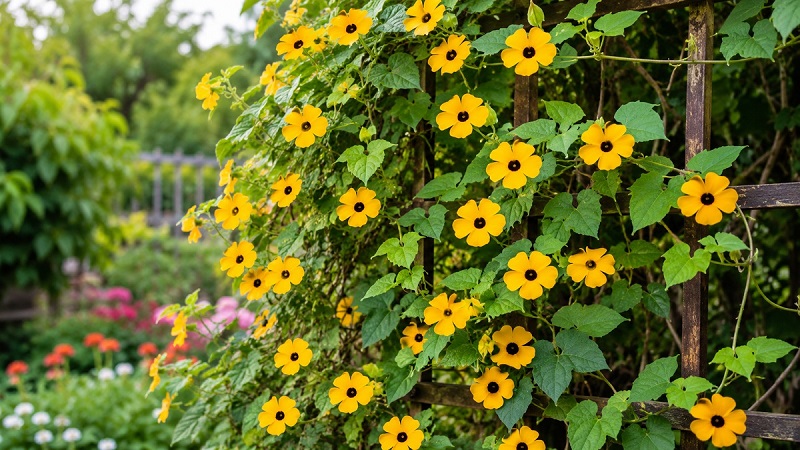
Growing & Caring for Black-Eyed Susan Vine (Thunbergia alata)
Learn how to grow and care for Black-Eyed Susan Vine (Thunbergia alata), including light, soil, watering, feeding, support, pruning, pests, propagation, and winter care.
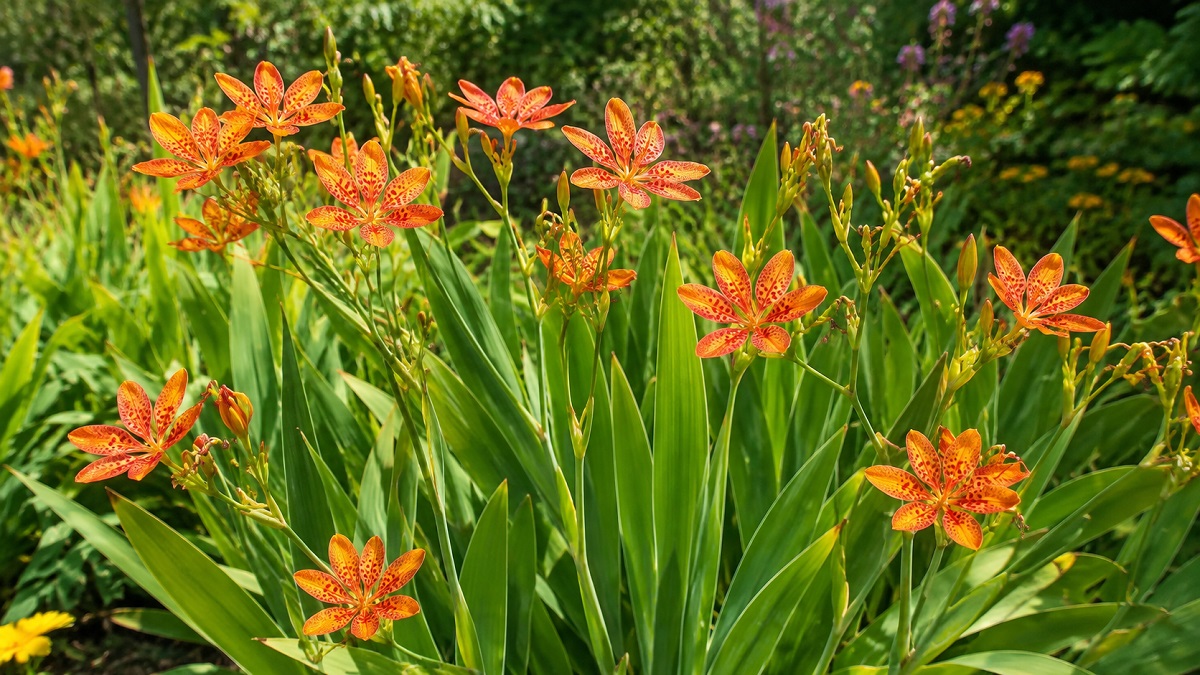
Blackberry Lily is one of those garden plants that becomes more interesting as the season progresses. In summer, it produces attractive orange flowers marked with darker spots, but the show does not end when the petals fall. The flowers are followed by clusters of glossy black seeds that resemble small blackberries, giving the plant its familiar common name. Its upright, sword-shaped foliage also adds a strong architectural element to sunny borders and perennial gardens.
Although it looks somewhat exotic, Blackberry Lily is generally an easy-care perennial when planted in the right location. It prefers plenty of sunlight, reasonably fertile soil, and especially good drainage. Once established, it can tolerate periods of dry weather better than many moisture-loving perennials. The biggest mistake is usually keeping the roots too wet rather than failing to water often enough.
This guide explains how to grow Blackberry Lily from planting through flowering and seed production. You will learn how to choose a site, prepare the soil, water and feed the plants, divide mature clumps, collect seeds, manage common problems, and keep the foliage looking attractive throughout the growing season.
A sun-loving perennial with ornamental flowers, foliage, and distinctive seed pods.
Blackberry Lily, botanically known as Iris domestica, is a clump-forming perennial valued for its combination of flowers and unusual seed clusters. It was formerly known by the botanical name Belamcanda chinensis, and many older gardening references still use that name. The plant is now classified within the iris family, which helps explain its sword-like leaves and overall appearance.
The common name can be slightly misleading because Blackberry Lily is not a true lily and does not produce edible blackberries. The name comes from the appearance of its mature seed clusters. After flowering, the seed capsules open to expose numerous shiny black seeds that look remarkably like a cluster of small berries.
In the garden, Blackberry Lily works particularly well in perennial borders, cottage gardens, rock gardens, sunny beds, and naturalistic plantings. Its foliage provides vertical structure before and after the flowering period, while the seed clusters add another decorative feature later in the season.
The plant is especially useful for gardeners who want something different from the usual summer perennials. It does not require constant attention once established, but it does appreciate a well-drained planting site. In heavy, poorly drained soil, the underground rhizomes can remain excessively wet, creating conditions that encourage rot and other problems.
| Attribute | Details |
|---|---|
| Common Name | Blackberry Lily, Leopard Lily, Leopard Flower |
| Botanical Name | Iris domestica (formerly Belamcanda chinensis) |
| Family | Iridaceae |
| Plant Type | Herbaceous Perennial |
| Mature Size | 2–3 ft. tall, 1–2 ft. wide |
| Sun Exposure | Full Sun to Part Shade |
| Soil Type | Loamy, Well-drained |
| Soil pH | 6.0–7.0 (Slightly acidic to neutral) |
| Bloom Time | Summer (July to August) |
| Flower Color | Orange or yellow with reddish-purple spots |
| Hardiness Zones | Generally USDA Zones 5–10 |
| Native Area | Himalaya to Japan and the Philippines, including parts of China, India, Korea, and Southeast Asia |
Blackberry Lily develops upright, fan-like foliage that resembles the leaves of many iris plants. The leaves are narrow, flattened, and sword-shaped, giving the plant a clean vertical form. Depending on growing conditions, mature plants can form substantial clumps rather than remaining as a single narrow stem.
The flowers rise above the foliage on branching stems. Individual blooms are generally orange to orange-red and marked with darker spots. Each flower is relatively delicate, and individual blooms may not last for a long time, but a healthy plant can produce a succession of flowers over its flowering period.
The seed capsules are one of the plant's most distinctive characteristics. As the capsules mature, they split open to reveal rounded black seeds. These seed clusters can remain decorative after flowering and are particularly attractive when viewed against the fading green foliage.
Do not mistake the dark seeds for fruit. They are seeds rather than edible berries, and the plant should be grown as an ornamental perennial rather than as a food crop.
Start with sunlight. Blackberry Lily performs best where it receives several hours of direct sun each day. Full sun encourages stronger flowering and helps the foliage maintain a sturdy, upright habit.
In very hot climates, some afternoon shade can be beneficial, particularly when the plant receives intense summer heat. A location with morning sun and light afternoon protection can help reduce heat stress while still providing enough light for good flowering.
Avoid planting it in a permanently dark corner or underneath dense tree canopy. Too little light can produce weaker growth and fewer flowers. If the plant is competing with large shrubs or trees for light, water, and nutrients, it may also become less vigorous.
Air circulation is another useful consideration. Leave enough space around mature plants for air to move freely. Good airflow allows foliage to dry more quickly after rain or irrigation and can reduce the likelihood of persistent fungal problems.
Well-drained soil is one of the most important requirements for Blackberry Lily. The plant can handle ordinary garden soil as long as excess water can move away from the root zone.
A moderately fertile loam is ideal. Sandy or gravelly soil can also work well because it drains rapidly. If your native soil contains a large amount of clay, improve the planting area with organic matter and, where appropriate, consider planting on a raised mound or in a raised bed.
Avoid creating a small planting hole filled entirely with rich material surrounded by heavy clay. Water can collect around the amended pocket, effectively creating a container underground. It is better to improve a broader area of soil so drainage and root growth remain more uniform.
Compost can be useful when preparing the site. Work a moderate amount into the existing soil rather than creating an extremely rich growing medium. Blackberry Lily generally does not need soil that is heavily fertilized to produce attractive growth.
Blackberry Lily can be planted from nursery-grown divisions or established plants, and it can also be propagated from seed. When planting an established plant, choose a site with good sunlight and drainage before removing it from its container.
Remove weeds, grass, and large stones from the planting area. Loosen the soil to a reasonable depth and mix in compost if the soil is poor or compacted. Do not overwork wet clay because digging saturated soil can destroy its structure.
Dig a hole slightly wider than the root system and deep enough to accommodate the plant at approximately the same depth at which it was growing in its container. Avoid burying the crown unnecessarily deep.
Return the original soil around the roots and gently firm it with your hands. There is no need to compact the soil heavily. The objective is to eliminate large air pockets while leaving enough pore space for oxygen and water movement.
Give the newly planted Blackberry Lily a deep watering. This settles the soil around the roots and gives the plant a good start. Continue monitoring the soil during the establishment period rather than relying on a fixed watering schedule.
A thin layer of organic mulch can help conserve soil moisture and suppress weeds. Keep mulch slightly away from the crown and base of the plant. A thick, constantly wet layer directly against the crown can contribute to rot.
Blackberry Lily prefers consistent moisture while becoming established, but it does not like standing water. Newly planted specimens should be watered whenever the upper layer of soil begins to dry, especially during warm or windy weather.
Once established, the plant generally becomes more tolerant of short dry periods. Water deeply rather than giving the plant a small splash every day. Deep watering encourages moisture to penetrate farther into the root zone.
During prolonged summer heat, check the soil before watering. If the upper few inches are dry and the plant shows signs of drought stress, give it a thorough watering. If the soil is still damp, wait rather than adding more water.
Container-grown Blackberry Lily usually needs more frequent monitoring because pots dry out faster than garden soil. Containers exposed to full sun may become particularly dry during hot weather.
Blackberry Lily is not a heavy feeder. If it is growing in reasonably fertile soil, excessive fertilizer is unnecessary and can encourage soft leafy growth at the expense of a balanced, attractive plant.
A layer of compost applied around the plant in spring is often enough for ordinary garden conditions. If the soil is particularly poor, a balanced slow-release fertilizer can be used according to the product label.
Avoid placing concentrated fertilizer directly against the crown or foliage. Water the plant after applying granular fertilizer so nutrients can move into the soil.
If the plant produces healthy foliage but very few flowers, first check sunlight and drainage before assuming it needs more fertilizer. Too little sunlight is a common reason for weak flowering, and adding more fertilizer will not correct a fundamentally unsuitable location.
The flowers are the main summer attraction of Blackberry Lily. Bright orange petals carry darker markings that give each bloom a spotted appearance. The contrast between the flowers and the upright green foliage makes the plant especially effective in mixed perennial borders.
After flowering, the developing seed capsules become increasingly noticeable. When they mature and open, they reveal clusters of shiny black seeds. This is the feature that gives the plant its memorable common name.
Gardeners who want to encourage self-seeding can leave mature seed capsules on the plant. If you prefer a tidier appearance, remove the spent flowering stems or seed capsules after they have finished their decorative period.
Leaving some seed heads in place can add late-season interest. The dark clusters provide contrast against green or fading foliage and can look particularly effective in informal or naturalistic plantings.
Blackberry Lily does not require complicated pruning. During the flowering season, remove individual spent blooms if you want to keep the plant looking tidy. You can also leave them in place if you want to enjoy the developing seed capsules.
After flowering, allow healthy foliage to remain as long as it is still green and actively functioning. The leaves help the plant replenish its energy reserves. Cutting everything back immediately after flowering is unnecessary.
Once the foliage has naturally declined and becomes yellow or brown, it can be cut back as part of seasonal cleanup. Remove damaged or diseased plant material and dispose of it rather than leaving obviously infected debris around the crown.
Avoid repeatedly cutting healthy green foliage simply to make the planting look perfectly tidy. Like many perennials, Blackberry Lily benefits from being allowed to complete its natural seasonal cycle.
Blackberry Lily can be propagated from seeds or by dividing established clumps. Seed propagation is useful when you want to produce many plants, while division is generally more convenient when you want a new plant that retains the characteristics of an existing specimen.
Collect mature black seeds after the capsules have opened. Remove the seeds carefully and allow any surface moisture to dry before storage or sowing. Fresh seed can be sown in a suitable seed-starting medium.
Keep the growing medium lightly moist rather than saturated. Seedlings should receive bright light once they emerge. When they have developed enough growth to handle safely, they can be transplanted into individual containers or into a prepared garden bed.
Seed-grown plants may take longer to reach flowering size than established divisions. Patience is part of the process, but starting from seed allows you to produce several plants at relatively low cost.
Mature plants may drop seeds around the parent clump. If the conditions are favorable, new seedlings can appear naturally. This can be useful in an informal garden, although gardeners who prefer precise spacing may want to remove some seed heads before they release their seeds.
Division is a practical way to rejuvenate an established clump and create additional plants. The best timing depends on climate and local growing conditions, but division is generally easiest when the plant is not under severe heat or drought stress.
Dig around the clump carefully and lift the plant from the soil. Separate the rhizomatous sections with a clean, sharp tool if necessary, making sure each division has healthy roots and growing points.
Replant the divisions promptly at an appropriate depth. Water them thoroughly and keep the soil reasonably moist while they establish. Avoid dividing plants during periods of extreme heat if you can postpone the work until more favorable weather.
Blackberry Lily is generally a straightforward perennial, but no garden plant is completely free from pests and disease. The best defense is good growing conditions. Healthy plants in appropriate soil are usually better equipped to recover from minor problems.
Excessive moisture is one of the biggest risks. If the planting site stays wet for long periods, roots and rhizomes may begin to deteriorate. Symptoms can include weak growth, yellowing foliage, wilting despite wet soil, and a generally declining plant.
Improve drainage where possible and avoid frequent irrigation when the soil is already saturated. In severe cases, moving the plant to a better-drained location may be more effective than trying to correct the problem through additional treatments.
Fungal or bacterial leaf spots can sometimes appear as discolored patches on foliage, particularly when leaves remain wet for extended periods. Remove badly affected leaves and improve air circulation around the plant.
Slugs and snails may occasionally feed on young foliage, particularly in damp gardens. Inspect plants regularly and reduce hiding places such as dense piles of wet debris close to the planting area.
Aphids and other small sap-feeding insects may occasionally gather on tender growth. Light infestations can often be managed by encouraging beneficial insects and using a strong stream of water to dislodge insects where appropriate.
| Problem | Possible Cause | What to Check |
|---|---|---|
| Few or no flowers | Insufficient light or excessive nitrogen | Sun exposure and fertilizer use |
| Yellowing leaves | Overwatering, poor drainage, or natural aging | Soil moisture and drainage |
| Wilting in wet soil | Root or rhizome stress | Drainage and root condition |
| Weak, floppy growth | Too little sunlight or excessive moisture | Planting location |
| Leaf spots | Persistent leaf moisture or disease pressure | Air circulation and watering method |
| Chewed leaves | Slugs, snails, or other garden pests | Inspect foliage at night or after rain |
Blackberry Lily can be grown in containers if you provide enough room for the root system and use a well-draining potting mix. Choose a container with drainage holes and avoid using a decorative pot that has nowhere for excess water to escape.
A quality container mix containing components that maintain both drainage and moisture retention is preferable to heavy garden soil. The container should be large enough to support the plant without becoming unstable as the foliage and flowering stems develop.
Place the pot where the plant receives plenty of sunlight. Container plants can dry out faster than plants growing in the ground, so check moisture more frequently during hot weather.
At the same time, do not compensate for rapid drying by keeping the pot constantly wet. Water thoroughly when needed and allow excess water to drain from the container.
The upright foliage and orange flowers make Blackberry Lily a useful partner for plants with contrasting forms and colors. It can be placed among low-growing perennials, ornamental grasses, groundcovers, and other sun-loving flowering plants.
Plants with soft, rounded foliage can contrast nicely with its narrow sword-shaped leaves. Blue, purple, white, and pale pink flowers can also create an attractive color relationship with the orange blooms.
When choosing companions, match their cultural requirements rather than choosing plants based only on appearance. Plants that all prefer similar sunlight and drainage are much easier to manage together.
| Season | Recommended Care |
|---|---|
| Spring | Clear old debris, check emerging growth, add compost if needed, and begin monitoring soil moisture. |
| Early Summer | Water during dry periods, remove competing weeds, and monitor developing flower stems. |
| Summer | Enjoy the flowers, maintain reasonable moisture, and watch for pests or signs of excessive wetness. |
| Late Summer | Allow seed capsules to develop if desired and avoid cutting healthy foliage too early. |
| Autumn | Collect mature seeds if propagating and remove declining foliage when it has naturally finished. |
| Winter | Keep the planting area free from excessive wetness and avoid unnecessary disturbance of dormant roots. |
The simplest approach to Blackberry Lily care is to work with the plant rather than trying to force it into conditions it does not prefer. Give it enough light, provide soil that drains well, water deeply when necessary, and avoid excessive fertilizer.
Regular observation is more useful than following a rigid watering or feeding schedule. Garden conditions change with temperature, rainfall, soil type, container size, and plant maturity. Check the soil and the plant before deciding what it needs.
It is also worth appreciating the plant beyond its flowers. The seed clusters are one of its strongest ornamental features, so gardeners do not necessarily need to remove every spent bloom. Allowing some flowers to develop into mature seed capsules can extend the plant's visual interest well beyond the main flowering period.
If you want a tidy formal border, remove unwanted seedlings and cut back old foliage at the appropriate time. If you prefer a relaxed cottage or naturalistic style, allow some self-seeding and leave selected seed heads standing.
Blackberry Lily is a rewarding perennial for gardeners who enjoy plants with more than one season of interest. Its orange, spotted flowers provide the first display, while its dark seed clusters create an unusual second act. The upright foliage adds structure even when the plant is not in bloom.
Its care requirements are relatively simple: choose a sunny or lightly shaded position, use well-drained soil, water consistently while plants establish, and avoid keeping the roots permanently wet. A modest amount of compost or balanced fertilizer is usually enough when the soil is reasonably fertile.
With good drainage and adequate light, an established Blackberry Lily can become a dependable part of a perennial planting. Whether you grow it for the spotted summer flowers, the distinctive blackberry-like seeds, or its iris-like foliage, it offers an interesting combination of qualities that few ordinary border plants provide.
Continue exploring our gardening guides with more plant profiles, growing tips, and practical advice for creating a healthy, productive garden.