How to Prune Abelia for Better Growth and More Flowers
Learn how to prune abelia for better growth and more flowers, including the best pruning time, cutting techniques, tools, common mistakes, and after-care.
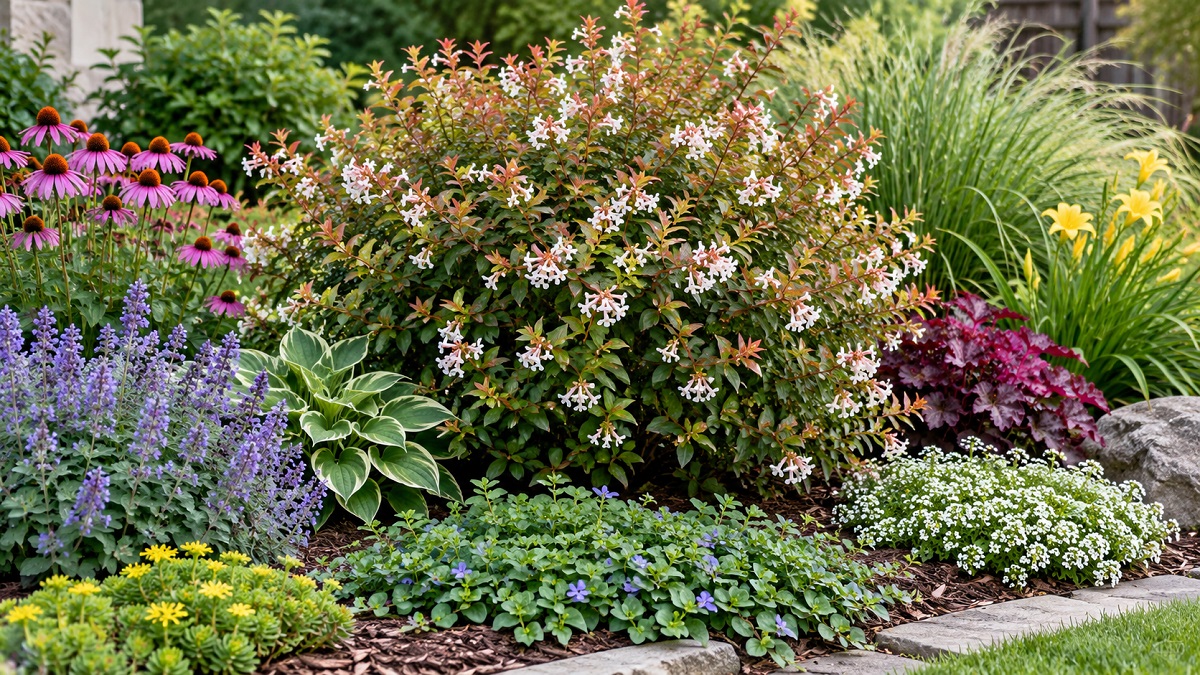
Abelia is one of those shrubs that can quietly hold a planting scheme together. Its arching branches, glossy foliage, and long-lasting flowers give a garden plenty of interest, but the shrub becomes even more useful when it is planted with carefully chosen companions. The right plants can fill gaps around the base, extend the flowering season, add contrasting foliage, soften hard edges, and create a more natural-looking border.
The best companion plants for Abelia are not simply plants that look attractive beside it. They should also fit the same general conditions. Abelia typically performs well in a sunny to partly shaded position with reasonably fertile, well-drained soil and regular moisture while it becomes established. Companions that tolerate similar conditions are easier to maintain and are less likely to compete aggressively for water or space.
This guide explains how to choose companion plants for Abelia and highlights shrubs, perennials, grasses, ground covers, bulbs, and pollinator-friendly plants that can work well around it. Rather than treating the garden as a collection of individual plants, think about the combination as a small community: each plant should have a role, enough room to grow, and a reason for being there.
Choose companions by growing conditions first, then by color, texture, height, and flowering time.
Abelia can be grown as a specimen shrub, but it is particularly effective in mixed borders. Its branching habit creates a useful middle layer between low plants and taller shrubs, while its flowers bring color during a period when many spring-flowering plants have already finished.
Companion planting can make that structure more interesting. A low-growing perennial can hide bare soil near the shrub's base, while an upright grass can provide a strong vertical contrast. An evergreen companion can maintain structure after deciduous plants lose their leaves, and a succession of flowering perennials can keep the surrounding bed colorful throughout the growing season.
Use low plants in front of Abelia, medium-height perennials around the sides, and taller or more upright plants farther back. This creates depth without making the bed feel crowded.
Combine early bulbs, summer perennials, late-season flowers, and evergreen foliage so the planting does not depend on Abelia being in bloom at one particular moment.
Abelia's relatively fine foliage pairs nicely with bold leaves, grass blades, rounded mounds, and airy flower heads. Texture contrast can be just as important as flower color.
Good combinations begin underground and at the canopy level. Two plants may look wonderful together in a photograph but perform poorly when they have very different water requirements, light preferences, or mature sizes.
Start by observing how much sunlight reaches the planting area. Abelia generally handles full sun and partial shade, but the amount of available light can change considerably from one garden to another. A bed beside a south-facing wall may be hot and bright, while an area beneath nearby trees may receive filtered light for much of the day.
Choose companions that can tolerate the same light conditions rather than automatically selecting plants because they are visually attractive. Sun-loving perennials are useful around a sunny Abelia, while woodland-style companions may be more appropriate when the shrub receives afternoon shade.
Abelia does best when its roots are not left in persistently waterlogged soil. Companion plants should therefore have compatible drainage needs. If the site is naturally wet, improving drainage or selecting plants suited to moisture is more important than simply adding more species.
A small plant at the garden center can eventually become much larger than expected. Check the mature width and height of every companion before planting. This is particularly important around Abelia because the shrub's branches can arch outward and occupy more horizontal space than its central trunk suggests.
A companion border looks more natural when plants take turns providing interest. Early bulbs can start the season, summer perennials can carry the middle of the display, and late-season flowers can continue the show after earlier plants fade.
Avoid filling the entire bed with plants that have the same rounded shape. A mixture of upright spikes, mounded foliage, arching grasses, spreading ground covers, and airy flowers gives the planting more movement.
There is no single list that works for every garden. The following plants are useful starting points because they can provide different design functions around Abelia. Local climate, cultivar, soil, and available light should still determine the final selection.
| Plant | Type | Main Contribution | Typical Position |
|---|---|---|---|
| Lavender | Herbaceous subshrub | Fragrant foliage and purple flowers | Sunny foreground |
| Catmint | Perennial | Long flowering and soft gray-green foliage | Front or middle layer |
| Salvia | Perennial | Upright flower spikes and pollinator value | Sunny middle layer |
| Black-eyed Susan | Perennial | Late-summer yellow flowers | Middle or rear layer |
| Daylily | Perennial | Strappy foliage and colorful flowers | Middle layer |
| Russian sage | Perennial | Airy form and silvery foliage | Sunny middle/rear layer |
| Ornamental grasses | Grass | Movement and fine texture | Middle or rear layer |
| Heuchera | Perennial | Colorful foliage | Foreground or partial shade |
| Hosta | Perennial | Bold foliage in shaded areas | Part-shade foreground |
| Creeping thyme | Ground cover | Low foliage and small flowers | Sunny edge |
| Salvia greggii | Flowering subshrub | Long-season flowers | Sunny border |
| Japanese forest grass | Ornamental grass | Graceful arching foliage | Part shade |
Flowering perennials are among the easiest ways to build a mixed planting around Abelia. They can provide color at different heights without competing visually with the shrub's branching structure.
Catmint has soft gray-green foliage and spikes of small flowers that can create a relaxed transition between the shrub and the lawn or path. Its cool foliage can also provide a useful contrast to Abelia's green leaves.
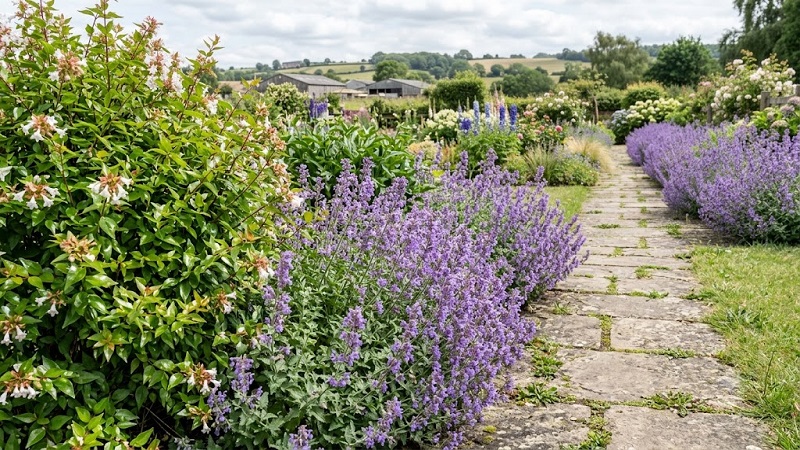
Plant catmint toward the front of a sunny border rather than directly against the main stems of the shrub. After flowering, trimming it can encourage a tidier second flush of foliage and flowers, depending on the variety and growing conditions.
Salvias are useful when you want vertical flower spikes rather than another rounded mound. Blue, purple, pink, or red-flowering varieties can be selected to complement the Abelia cultivar and the rest of the border.
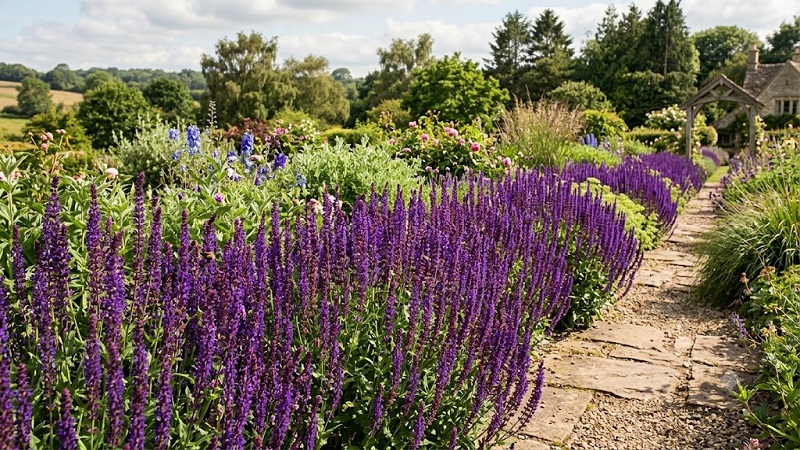
Their upright flowers also provide a visual bridge between the shrub and shorter edging plants. Give them sufficient light and avoid burying their crowns beneath mulch.
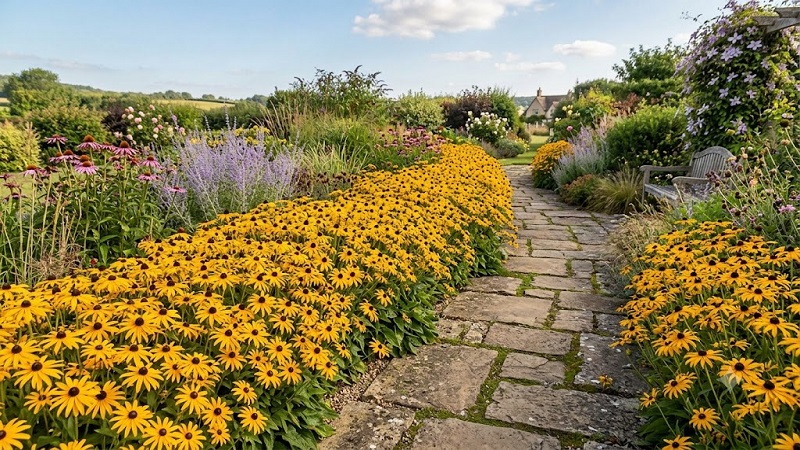
Black-eyed Susan adds strong yellow flower color and a noticeably different flower shape. Its daisy-like blooms can brighten a border during late summer, while the darker central cones contrast with lighter-colored Abelia flowers.
Daylilies bring long, strap-shaped leaves to the composition. Even when they are not flowering, the foliage helps break up a planting dominated by small-leaved shrubs and perennials.
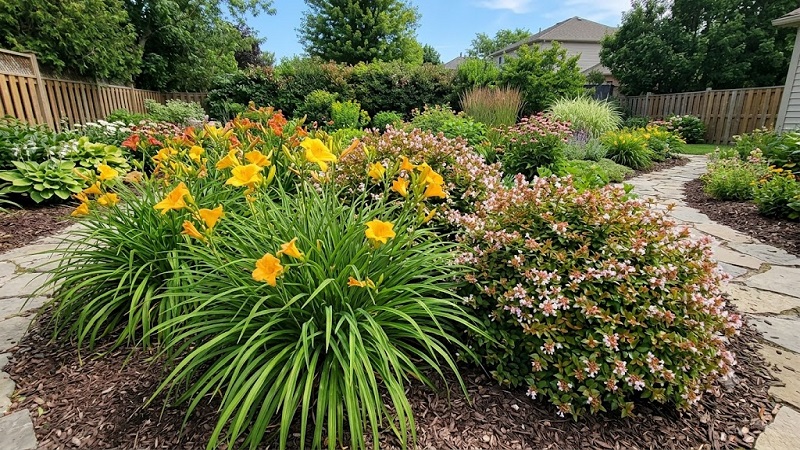
They work especially well where a medium-height plant is needed between Abelia and a low border edge. Allow enough space for the daylily clump to expand rather than treating it as a temporary filler.
Russian sage provides an airy texture that contrasts with the denser form of Abelia. Its silvery foliage and small flowers can make a sunny planting feel lighter and less crowded.
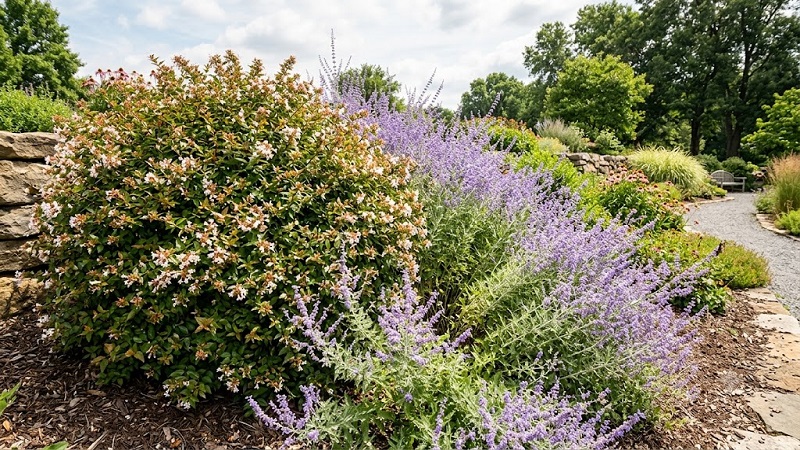
Because both plants can become substantial, avoid placing Russian sage immediately in front of a young Abelia. Give each plant enough room to develop its natural shape.
Heucheras are especially useful where Abelia receives partial shade. Their foliage comes in shades ranging from green and bronze to purple and other tones, depending on cultivar.
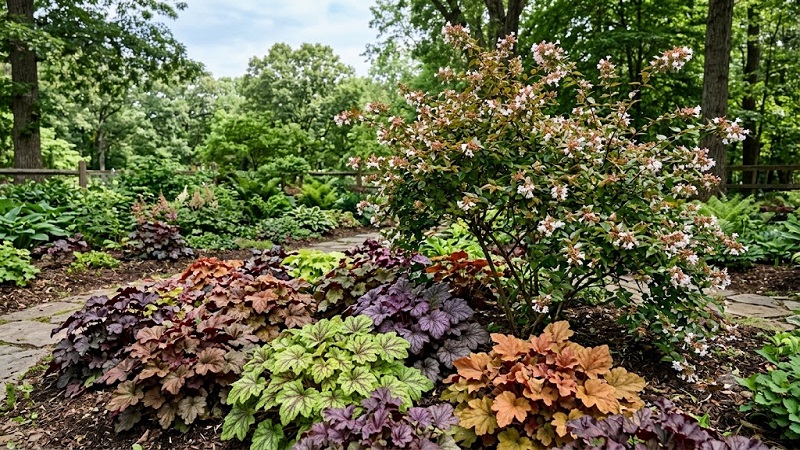
They are valuable primarily for foliage rather than relying on their small flowers. Place them near the front of the planting where their leaves can be seen easily.
Ornamental grasses can make an Abelia border feel more natural. Their narrow leaves contrast with the shrub's broader foliage, and their movement in wind adds an element that flowers alone cannot provide.
Fountain grasses can provide arching foliage and soft flower spikes. They are particularly effective in sunny beds where the Abelia is being used as a rounded or arching structural plant.
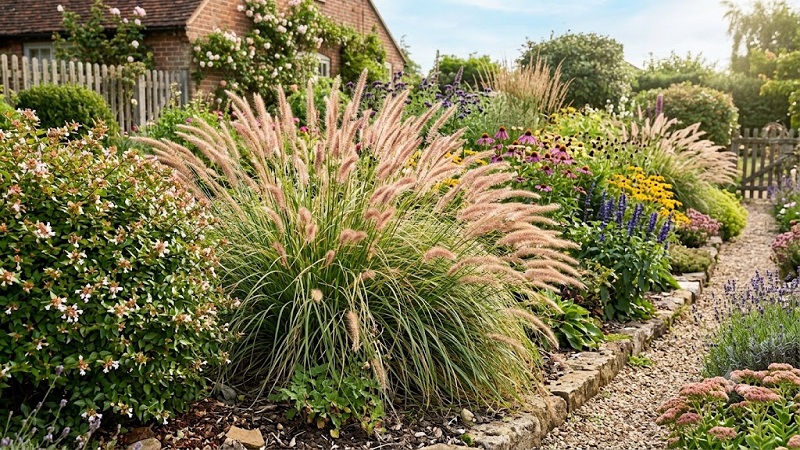
Position a grass slightly away from the shrub so both silhouettes remain visible. A small group of grasses can look more intentional than scattering individual plants throughout the border.
Japanese forest grass is a useful option for a shadier Abelia planting. Its cascading habit can soften the edge of a bed and contrast with the more upright woody structure of the shrub.
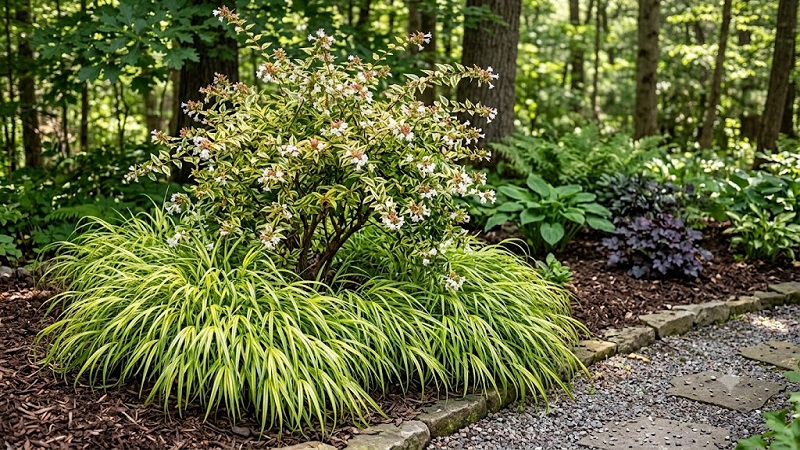
Use it where the soil retains reasonable moisture and the site provides shade or filtered light. It is less appropriate for an exposed, hot, dry location.
Small and medium clumping grasses can be used to create repeated shapes throughout a border. When choosing one, pay attention to whether it remains in a manageable clump or spreads aggressively.
If Abelia is part of a larger shrub border, surrounding it with other woody plants can create a stronger year-round framework. The key is to avoid selecting several shrubs that all reach the same height and have identical shapes.
Compact evergreen shrubs can provide structure when deciduous companions lose their leaves. Small conifers, compact hollies, and other appropriately sized evergreen forms can work as anchors around the edges of an Abelia planting.
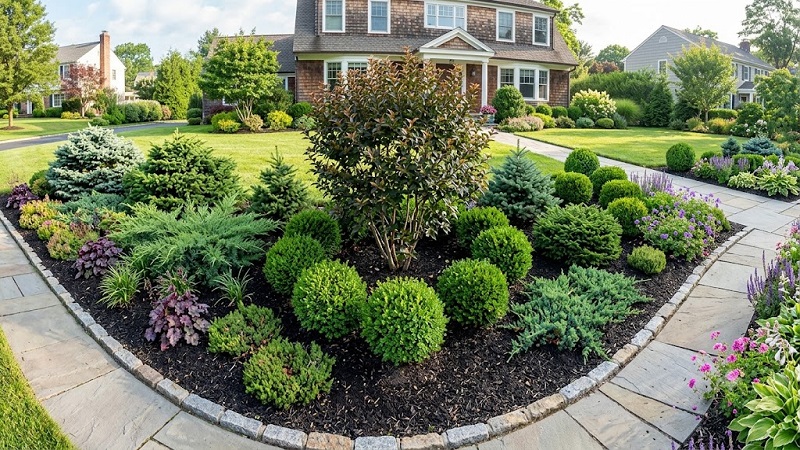
Choose varieties whose mature dimensions suit the available space. A slow-growing plant may still become too large if it is planted too close to the Abelia.
Hydrangeas can create an attractive contrast with Abelia when the planting site provides enough moisture and suitable light. Their larger leaves and flower heads differ substantially from Abelia's finer foliage and smaller flowers.
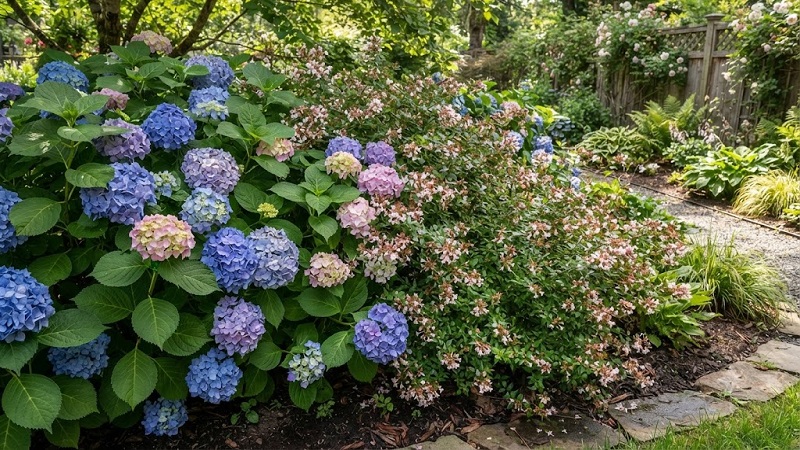
Give both shrubs adequate room. Crowding them together may reduce airflow and make pruning more difficult.
Spirea can be useful where a lower flowering shrub is needed. Its branching structure and flower clusters can complement Abelia without creating a completely uniform planting.
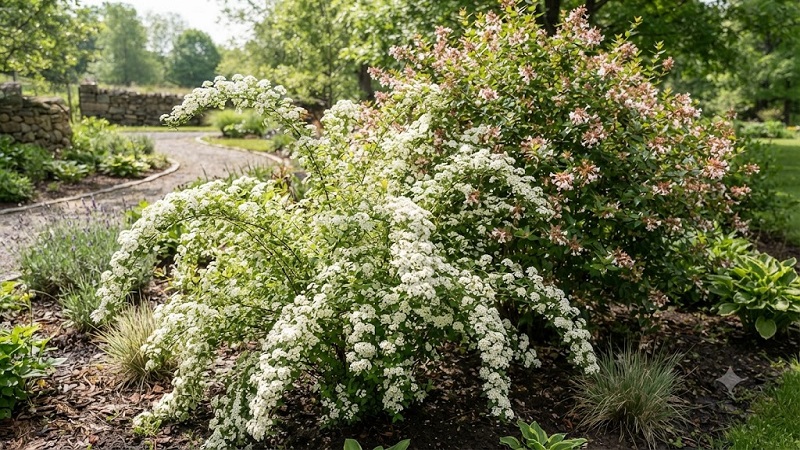
Use a smaller cultivar if the goal is to keep Abelia visually dominant. Repeating the same shrub at several points in a border can also produce rhythm without making every plant identical.
The area beneath and around a shrub often becomes an afterthought. Low-growing companions can solve that problem by covering exposed soil and creating a transition from the shrub to pathways, lawns, or other planting areas.
Creeping thyme can be useful along the sunny outer edge of a bed. Its low habit prevents it from competing visually with Abelia, while its small flowers provide another source of seasonal color.
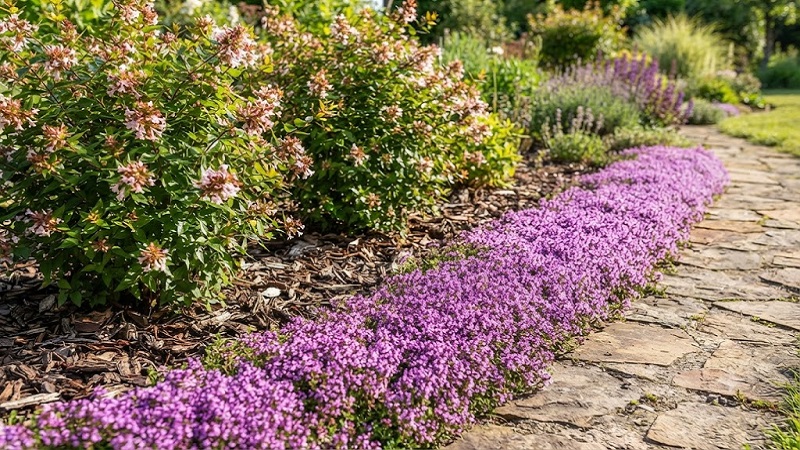
It prefers good drainage and is better suited to the outer, brighter portion of a bed than a permanently shaded position directly beneath dense shrub branches.
Low-growing sedums can work in sunny, well-drained locations where a drought-tolerant foreground plant is useful. Their succulent foliage gives the planting a texture very different from Abelia.
Some spreading ground covers can fill difficult spaces quickly, but their growth habit should be considered carefully. Plants that spread aggressively can move into the Abelia's root zone or neighboring beds and eventually require more management than expected.
Bulbs are particularly useful because they occupy relatively little visual space after flowering and can provide color before many summer perennials reach their peak.
Daffodils, tulips, crocuses, and other suitable spring bulbs can be planted around the outer root zone of an established Abelia. Early flowers give the border something to look at while the shrub is beginning its seasonal growth.
Plant bulbs in groups rather than placing single bulbs at random. Small clusters tend to look more natural and create clearer patches of color.
Summer-flowering bulbs and similar plants can be incorporated where the climate allows. Choose species according to local hardiness and drainage rather than simply matching flower colors.
Abelia's flowers can contribute to a wildlife-friendly garden, and surrounding the shrub with other nectar-rich plants can create a more continuous food source for visiting pollinators.
Salvia, catmint, lavender, black-eyed Susan, bee balm, yarrow, and other regionally suitable flowering plants can be incorporated into a mixed border. Try to choose several species with different flowering periods instead of relying on a single plant to provide all the color.
Native plants can also be valuable additions, particularly when they are adapted to the local climate and soil. The best choices will vary considerably by region, so local native-plant lists can help refine the selection.
Combine plants that flower at different times. Early bloomers can start the season, summer perennials can carry the display, and late-season species can keep the garden useful to pollinators for longer.
Combine tubular flowers, flat flower heads, spikes, and daisy-like blooms. Variety in flower form makes the planting visually richer and can attract a broader range of visitors.
An Abelia growing in partial shade calls for a different planting palette from one exposed to strong afternoon sun. Instead of forcing sun-loving plants into the bed, use foliage and flowering species that naturally tolerate lower light.
Hostas can provide broad foliage that contrasts strongly with Abelia. They are particularly useful at the front of a shaded border, where their leaves remain easy to see.
Heucheras offer smaller, colorful leaves and can be used to bridge the visual gap between Abelia and larger hostas. Different foliage colors can introduce contrast without relying entirely on flowers.
Ferns can create a softer woodland-style planting beneath or near an Abelia in a suitable shaded site. Their divided fronds provide a fine texture that contrasts with the shrub's woody stems.
Where conditions suit it, Japanese forest grass can provide graceful movement and a cascading form. It is especially useful along the edge of a part-shade planting.
A sunny Abelia gives you a wider range of drought-tolerant and sun-loving companions. This is an opportunity to use plants with silver foliage, strong flower colors, upright forms, and fine textures.
Lavender, catmint, salvia, yarrow, sedum, creeping thyme, Russian sage, black-eyed Susan, daylilies, and suitable ornamental grasses can all contribute different shapes and textures.
In hot climates, however, full sun can mean more than simply six hours of light. Reflected heat from paving, walls, or structures can make the planting considerably hotter and drier. In those situations, prioritize plants that tolerate the actual conditions rather than relying only on their general sun classification.
Good companion planting depends as much on spacing as on plant selection. An attractive combination can quickly become difficult to manage when every plant is placed too close together.
Do not plant a dense ring of companions directly around the base of the shrub. Leaving a little breathing room makes watering, mulching, pruning, and inspection easier.
A simple arrangement is to divide the bed into three visual levels:
The three-layer approach is only a starting point. A relaxed cottage-style planting can deliberately overlap these levels, while a formal border may use more consistent spacing and repetition.
Instead of choosing ten unrelated species, repeat several plants throughout the border. For example, three groups of catmint can visually connect several Abelia shrubs, while a repeated ornamental grass can establish a rhythm from one end of the bed to the other.
Some plants may be attractive companions but become problematic when their growth habit does not match the planting space.
Vigorous spreading plants can move beyond their intended location and compete with nearby plants. Before adding a ground cover, check how it spreads and whether it can be contained easily in your garden.
A large shrub planted close to Abelia may eventually dominate the bed. Even if both plants tolerate the same conditions, their mature sizes can make the combination impractical.
Avoid combining plants that require constantly moist soil with drought-adapted species in the same small planting pocket. It is usually easier to create separate moisture zones than to compromise the needs of every plant.
More plants do not automatically create a better border. Crowding reduces airflow, makes pruning harder, and can hide the natural shape of the Abelia. Give each plant enough room to become the plant you selected it to be.
The following combinations are examples of how different plants can be arranged around Abelia. They are design concepts rather than fixed recipes; adjust the species and spacing to suit your climate and garden conditions.
Use Abelia as the main shrub, with salvia and catmint in the middle layer, creeping thyme along the front edge, and a clumping ornamental grass toward the rear or sides.
The result combines upright flowers, low ground cover, fine grass texture, and the arching form of Abelia. Repeating the catmint or salvia in groups can make the planting look more intentional.
Pair Abelia with daylilies, black-eyed Susan, catmint, lavender, and a few spring bulbs. Allow the plants to overlap visually while maintaining enough physical space for mature growth.
This approach works particularly well when you want the border to feel informal rather than precisely geometric.
Combine Abelia with hostas, heucheras, ferns, and Japanese forest grass. Here, foliage does most of the design work, with flowers playing a secondary role.
Use different leaf sizes and forms to keep the composition interesting. Broad hosta leaves, finely divided fern fronds, colorful heuchera foliage, and grass-like leaves create plenty of contrast.
Start with Abelia and combine it with drought-tolerant plants suited to your local climate, such as lavender, creeping thyme, low sedums, and an appropriate ornamental grass.
This combination can reduce the need for frequent watering once plants are established, provided the chosen species genuinely match the site's conditions.
For year-round interest, combine Abelia with evergreen structural plants, spring bulbs, summer-flowering perennials, ornamental grasses, and plants with attractive autumn foliage.
The goal is not to make every plant interesting at the same time. Instead, let different plants take over the visual role as the seasons change.
Newly planted companions generally need more consistent attention than established plants. Water deeply enough to moisten the developing root zone, then allow the soil conditions appropriate to the individual species to guide the next watering.
Do not assume every plant in the bed needs identical watering. A newly planted perennial and an established drought-tolerant ground cover may have very different needs.
A layer of organic mulch can help moderate soil moisture and temperature, but keep mulch away from the base of woody stems and the crowns of herbaceous perennials. Excess mulch piled against stems can create persistently damp conditions.
Abelia generally looks best when allowed to retain some of its natural arching character. Avoid shearing it into an unnecessarily rigid shape simply to make it match formal companions.
Remove dead, damaged, or poorly positioned growth as needed and time heavier pruning according to the growth and flowering habits of the particular Abelia cultivar.
Perennials such as daylilies and other clump-forming plants can eventually occupy more space than they did when first planted. Dividing or relocating them can restore airflow and prevent the border from becoming congested.
If a companion begins growing directly into the Abelia's base, remove or relocate it before the problem becomes significant. A well-designed mixed border should allow every plant enough access to light, moisture, and nutrients.
Suitable companions include catmint, salvia, lavender, black-eyed Susan, daylilies, heucheras, ornamental grasses, creeping thyme, sedums, and appropriately sized shrubs. The best choice depends on the amount of sunlight, drainage, moisture, climate, and available space.
Lavender can be a good companion for Abelia in a sunny location with well-drained soil. Place it toward the front or edge of the planting rather than directly against the shrub, and make sure the soil conditions suit both plants.
Yes. Ornamental grasses can provide a useful contrast to Abelia's woody, arching form. Select a grass whose mature size and moisture requirements fit the planting area, and give both plants enough room to develop.
In partial shade, consider hostas, heucheras, ferns, and Japanese forest grass where local conditions are suitable. The exact choice should depend on how much direct and filtered sunlight the site receives.
Yes. Flowering perennials can provide seasonal color around Abelia. Catmint, salvia, daylilies, black-eyed Susan, and other compatible plants can create a layered display while helping extend the flowering season.
There is no single spacing that works for every companion. Base the distance on the mature width of both plants. Leave enough room for Abelia's branches and for companions to reach their mature size without becoming tightly packed.
Native plants can be excellent companions when they are adapted to the same site conditions. Local native species can add ecological value while providing flowers, foliage, and seasonal structure around the shrub.
It is generally better to leave some space around the shrub's base. Ground covers can be planted farther out to soften the border without creating a dense, damp layer immediately around the stems.
Final thought: The most successful Abelia companion planting does not depend on finding a single “perfect” plant. Instead, build a combination in which each species has a clear role. Use Abelia for structure and long-season interest, add perennials for changing flower color, grasses for movement, ground covers for the foreground, and evergreen plants for lasting structure. Match their light, soil, moisture, and mature-size requirements, and the border will become easier to maintain as it matures.
← Back to Plant GuidesContinue exploring our gardening guides with more plant profiles, growing tips, and practical advice for creating a healthy, productive garden.