Best Companion Plants for Abelia
Discover the best companion plants for Abelia, including flowering perennials, ornamental grasses, shrubs, ground covers, bulbs, and shade-loving plants.
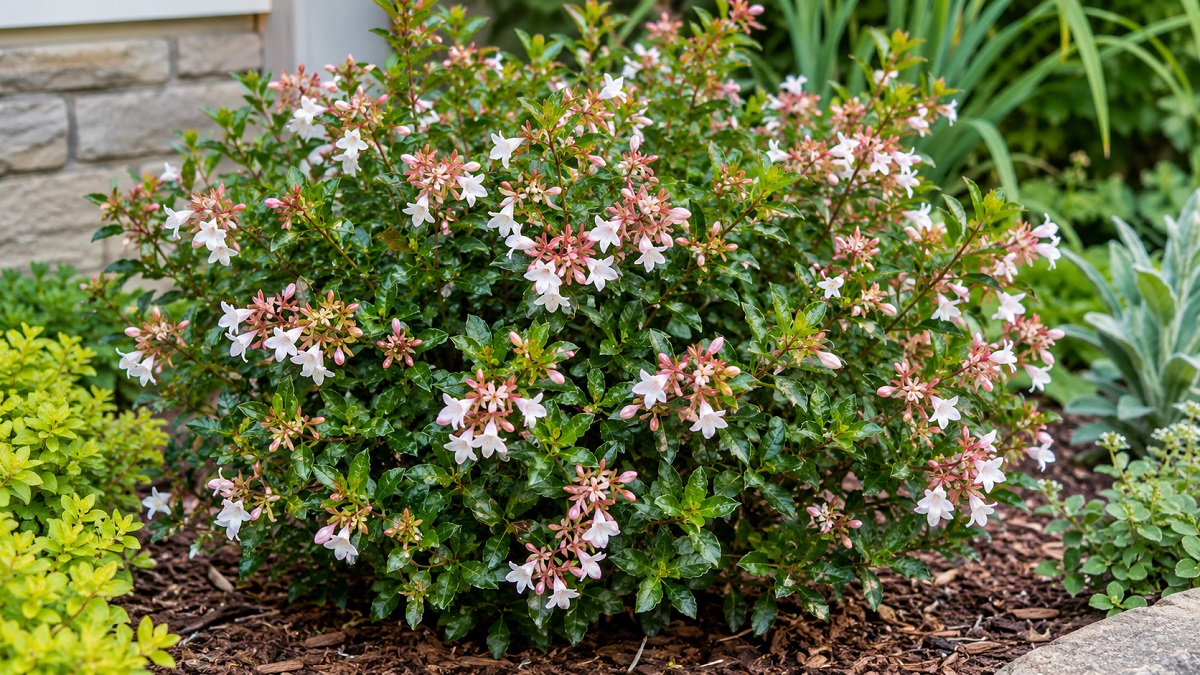
Abelia is one of those shrubs that can do several jobs in a garden without demanding a large amount of space. Compact cultivars bring the same general appeal of glossy foliage, long-lasting flowers and graceful branching into smaller borders, foundation beds, patios and containers. The trick is choosing a variety whose mature width suits the planting area rather than relying only on its height.
Among the most useful choices for small gardens are 'Kaleidoscope', 'Rose Creek', 'Little Richard', 'Confetti' and 'Funshine'. They differ noticeably in foliage color, mature spread and seasonal interest, so the right one depends on whether you want a colorful foliage accent, a flowering low hedge, a container plant or a compact foundation shrub.
Choose by mature spread first when planting near paths, windows, patios or other confined spaces.
Traditional glossy abelia can become too large for a narrow planting bed, particularly when allowed to mature without regular pruning. Compact forms solve that problem by keeping a lower, denser or more restrained shape.
Their usefulness goes beyond size. Depending on the cultivar, Abelia can provide variegated foliage, seasonal color changes, fragrant tubular flowers and attractive reddish or pinkish calyces after flowering. Many selections are also useful to pollinators, including butterflies and hummingbirds.
Abelias generally respond well to pruning, but a naturally compact cultivar usually requires less corrective trimming than a large standard form. Starting with the right plant therefore makes it easier to maintain a relaxed shape instead of constantly cutting the shrub back to fit its location.
The following selections are useful starting points for gardeners who want an Abelia that remains relatively restrained. Published dimensions can vary between references, nurseries and climates, so allow enough room for the plant to develop naturally.
| Cultivar | Approx. Height | Approx. Width | Foliage | Best Use |
|---|---|---|---|---|
| 'Kaleidoscope' | 2–3 ft | 3–4+ ft | Green, yellow and seasonal orange-red tones | Accent, container, low border |
| 'Rose Creek' | 2–3 ft | 3–5 ft | Dark green with pinkish new growth | Low hedge, foundation, mass planting |
| 'Little Richard' | About 3 ft | About 3 ft | Glossy green with seasonal color | Compact shrub, border, container |
| 'Confetti' | About 3 ft | About 3 ft | Green, cream and pink seasonal tones | Container, front border, accent |
| 'Funshine' | 2–3 ft | About 2–3 ft | Yellow, orange, caramel and chartreuse tones | Containers and small borders |
Dimensions are approximate rather than guaranteed limits. For example, extension references describe 'Kaleidoscope' as roughly 2–3 feet tall and slightly wider, while 'Rose Creek' is commonly listed around 2–3 feet tall with a broader spread.
'Kaleidoscope' is an excellent choice when foliage matters as much as flowers. Its compact, mounding habit is accompanied by green leaves edged in yellow, while cooler weather can bring orange, red and fiery tones to the foliage.
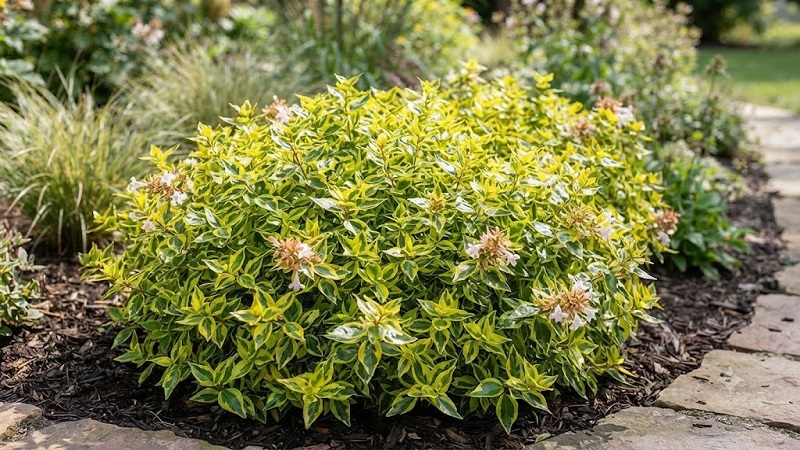
The plant is generally around 2 to 3 feet tall, although its spread can be wider than its height. It produces small white flowers during the warmer part of the growing season. Oregon State University describes it as a dense, low-mounding shrub approximately 24–30 inches tall and 36–42 inches wide, while other extension sources give somewhat broader dimensions.
Give it enough lateral room rather than squeezing it into a narrow strip. Its width is an important consideration in a small garden.
'Rose Creek' is a particularly useful compact Abelia for gardeners who want flowers combined with a dense, mounding habit. New foliage has a pinkish cast before becoming glossy dark green, and the plant develops reddish stems and persistent pinkish sepals around the white flowers.
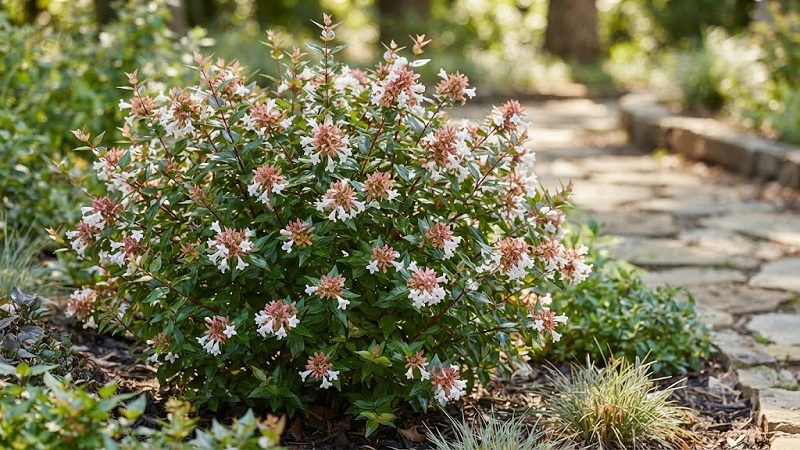
It generally reaches about 2 to 3 feet in height but can spread considerably farther. North Carolina State University lists a width of approximately 3–5 feet, making this a better choice for a low, broad planting than for a very narrow bed.
If your available space is narrow but has plenty of vertical room, 'Rose Creek' may not be the most space-efficient selection. In a wider bed, however, its low profile can be very effective.
'Little Richard' is a compact green-leaved selection that suits gardeners who prefer a simpler appearance rather than highly variegated foliage. It forms a dense shrub of roughly 3 feet by 3 feet in many descriptions.
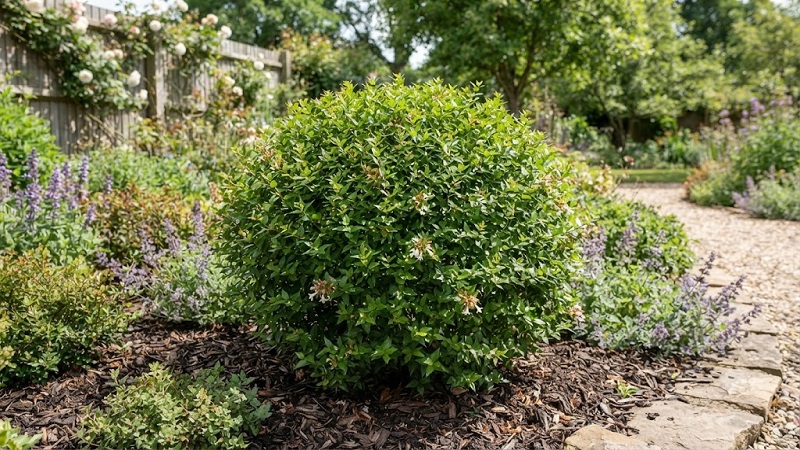
The glossy green summer foliage develops warmer tones as temperatures fall, while white flowers appear from summer toward frost in suitable climates. Oklahoma State University lists 'Little Richard' at approximately 3 by 3 feet and notes its seasonal tangerine-pink foliage color.
'Confetti' is worth considering when a small garden needs foliage interest without relying on flowers alone. Its variegated leaves combine green with cream, while cooler conditions can intensify pink or reddish tones.
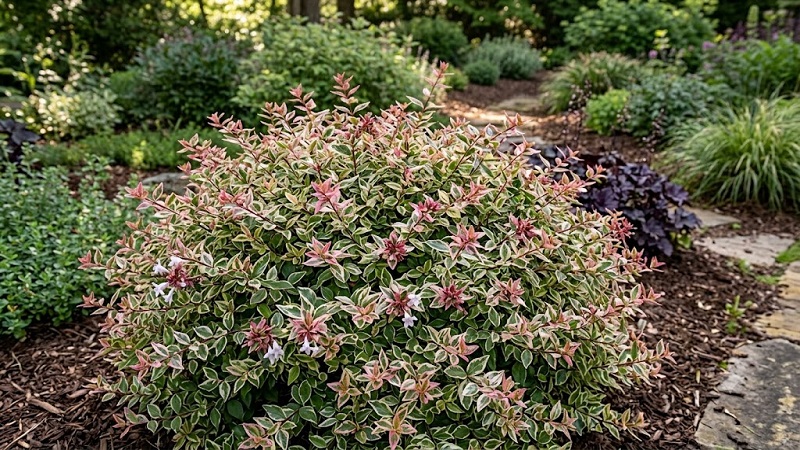
UF/IFAS lists 'Confetti' at about 3 feet tall and 3 feet wide, describing it as a compact selection with variegated evergreen foliage and white spring flowers.
This cultivar can brighten the front of a mixed border, a small patio garden or a large container. Its foliage makes it particularly useful where you want the shrub to contribute visual interest between flowering periods.
Avoid placing strongly variegated plants so close together that their foliage competes visually. One well-positioned 'Confetti' can often have more impact than several crowded specimens.
'Funshine' is another compact option for gardeners looking for foliage color. It develops warm yellow, orange and caramel tones in new growth before becoming more chartreuse as the leaves mature.
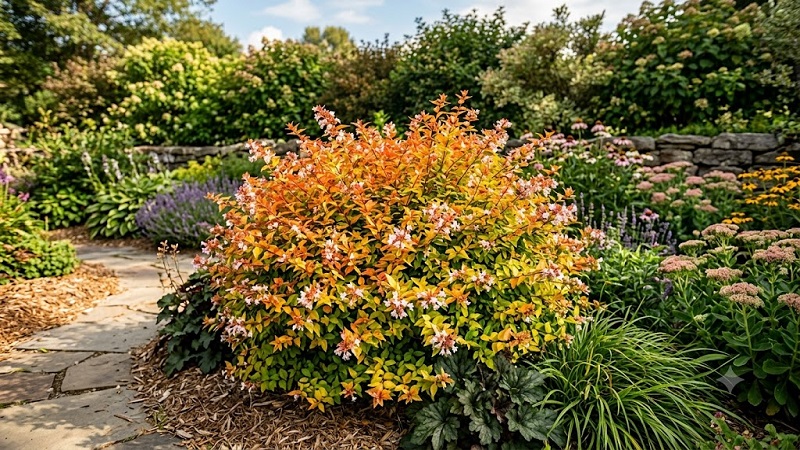
Garden references describe 'Funshine' as a dwarf, compact Abelia around 2 to 3 feet tall and wide, with a mounding habit and pale lavender flowers. Its manageable size makes it useful for containers, low borders and small landscape compositions.
Choose it when foliage color is a major part of the planting design. It can be especially effective against darker green shrubs or beside plants with deep purple, burgundy or blue-green foliage.
Instead of choosing solely by flower color, consider the entire plant throughout the year. A small garden has limited visual and physical space, so foliage, width and growth habit can matter just as much as flowering.
This is a strong option for gardeners who want a shrub that changes noticeably as the seasons progress. Its variegated leaves provide color even when flowers are not the main attraction.
If flowers and a dense mounding shape are the priority, 'Rose Creek' is worth considering. Just remember that its mature width can be considerably greater than its height.
This cultivar is a good fit when you want the compact form of an Abelia without strongly variegated leaves. Its green foliage also makes it easier to combine with colorful perennials.
'Confetti' brings cream and green foliage into a relatively compact package. It is particularly useful in containers and at the front of mixed borders.
Its yellow, orange and caramel-toned foliage can provide a brighter focal point than a conventional green shrub. Use it where foliage contrast is more important than creating a dense green screen.
Start by measuring the planting area from several directions. A bed that looks spacious when a young nursery plant is installed can become crowded after a few growing seasons.
Most compact Abelias perform well in full sun to partial shade. More sunlight generally encourages fuller growth and stronger foliage coloration in variegated cultivars. 'Kaleidoscope', for example, develops especially vivid foliage coloration in good light.
Use fertile, well-drained soil that holds some moisture without remaining waterlogged. Incorporating organic matter into poor soil can improve both structure and moisture management.
Do not automatically space shrubs according to their current container size. Use the expected mature width as your starting point. A cultivar advertised at 3 feet wide should not be planted with only a few inches between its crown and a wall or path.
Compact Abelias can also work in large containers. Choose a pot with drainage holes and enough volume to accommodate the root system and provide reasonable stability as the shrub grows.
Water newly planted shrubs regularly while their root systems become established. Once established, Abelias can tolerate periods of reduced moisture, but prolonged drought can still reduce flowering and cause foliage stress.
Container-grown plants generally require closer attention because their limited soil volume dries more quickly than surrounding garden soil.
A layer of organic mulch can help moderate soil temperature and reduce moisture loss. Keep mulch away from direct contact with the stems to reduce the chance of persistent moisture around the crown.
In reasonably fertile soil, compact Abelias usually do not need excessive feeding. If growth is weak, a soil test can help determine whether a nutrient deficiency is actually present before fertilizer is applied.
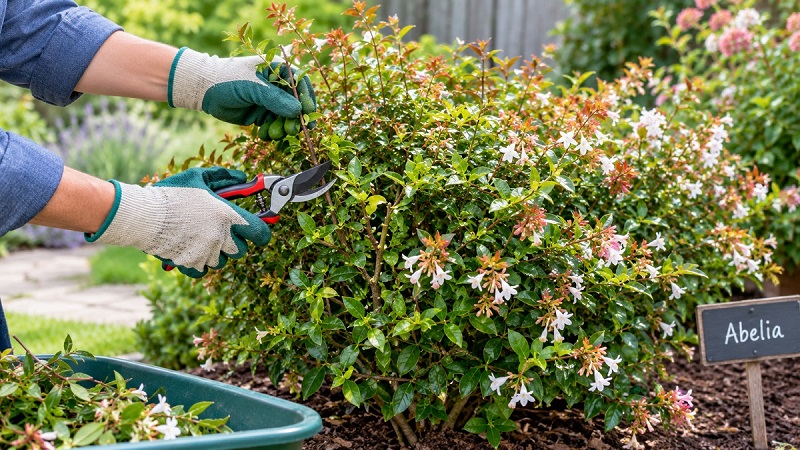
Prune primarily to remove damaged, crossing or poorly positioned branches and to maintain the desired shape. Avoid repeatedly shearing a naturally mounding shrub into a rigid geometric form unless that style is intentional.
Compact cultivars are generally easier to maintain when their natural growth habit is respected. Extension guidance also notes that pruning can be used to control size and that erratic shoots can be removed to preserve a compact appearance.
The word compact does not mean miniature. This is particularly important with Abelia because several cultivars remain low while spreading noticeably wider.
| Garden Situation | What to Look For | Suitable Choices |
|---|---|---|
| Narrow front border | Low height and restrained width | 'Kaleidoscope', 'Little Richard' |
| Wider foundation bed | Dense, mounding growth | 'Rose Creek' |
| Colorful foliage display | Variegation and seasonal color | 'Kaleidoscope', 'Confetti' |
| Container garden | Compact habit and manageable spread | 'Kaleidoscope', 'Confetti', 'Funshine' |
| Green shrub backdrop | Less variegated foliage | 'Little Richard', 'Rose Creek' |
If a planting location is extremely restricted, measure the available width before purchasing. In many cases, choosing a naturally smaller cultivar is preferable to relying on frequent hard pruning to keep a larger shrub within bounds.
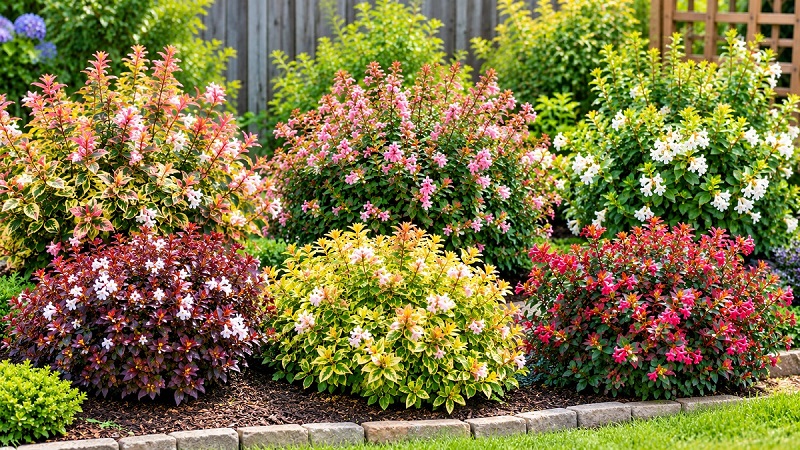
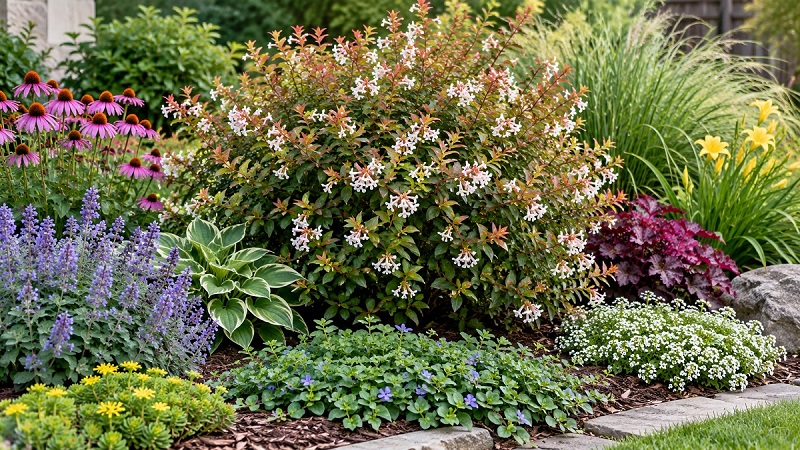
Compact Abelias are versatile enough to fit into several garden styles. Their rounded forms can soften the straight lines of patios and pathways, while variegated cultivars can brighten areas dominated by green foliage.
A single 'Kaleidoscope', 'Confetti' or 'Funshine' can provide a strong foliage accent in a small border. Surround it with lower perennials so the shrub remains visually prominent without needing to be oversized.
'Rose Creek' or 'Little Richard' can be used where a low, softer hedge is preferable to a tightly clipped evergreen screen. Leave sufficient space for each plant to reach its mature width.
A compact cultivar can bring shrub structure to a balcony, courtyard or paved patio. Pair the plant with trailing or low-growing seasonal flowers around the base, while keeping the container large enough for healthy root growth.
Several cultivars remain relatively compact. 'Kaleidoscope' is commonly listed around 2–3 feet tall, while 'Funshine' is also described as a dwarf, compact plant around 2–3 feet tall and wide. Actual dimensions vary with climate and growing conditions.
Yes. Its low, compact habit and colorful variegated foliage make it useful in small borders, containers and as an accent plant. Its spread should still be considered when space is limited.
It remains relatively low, commonly reaching around 2–3 feet in height, but it can become wider than that. North Carolina State University lists a potential width of approximately 3–5 feet, so it needs more horizontal room than its height might suggest.
Yes. Compact selections such as 'Kaleidoscope', 'Confetti' and 'Funshine' can be suitable for large containers. Use a well-draining potting mix, provide drainage holes and monitor moisture more closely than you would with plants growing in the ground.
Not necessarily. Occasional pruning can remove damaged or misplaced branches and maintain a desired size, but selecting a cultivar that naturally fits the planting area reduces the need for frequent trimming.
'Kaleidoscope', 'Confetti' and 'Funshine' are particularly useful when foliage color is a major consideration. 'Kaleidoscope' is known for yellow-and-green variegation and stronger orange-red tones as the season progresses, while 'Confetti' combines green and cream with seasonal pink coloration.
Compact Abelia cultivars are valuable in small gardens because they offer more than a short stature. The best choice depends on how much horizontal space is available, how much foliage color you want and whether flowers, containers or low hedging are the main goal. Measure the planting area, check the cultivar's expected mature spread and then give the shrub enough room to develop naturally.
For a foliage-focused planting, look closely at 'Kaleidoscope', 'Confetti' or 'Funshine'. For a compact flowering shrub with a broad mounding habit, 'Rose Creek' is worth considering, while 'Little Richard' provides a simpler green-leaved option for borders and containers.
Continue exploring our gardening guides with more plant profiles, growing tips, and practical advice for creating a healthy, productive garden.