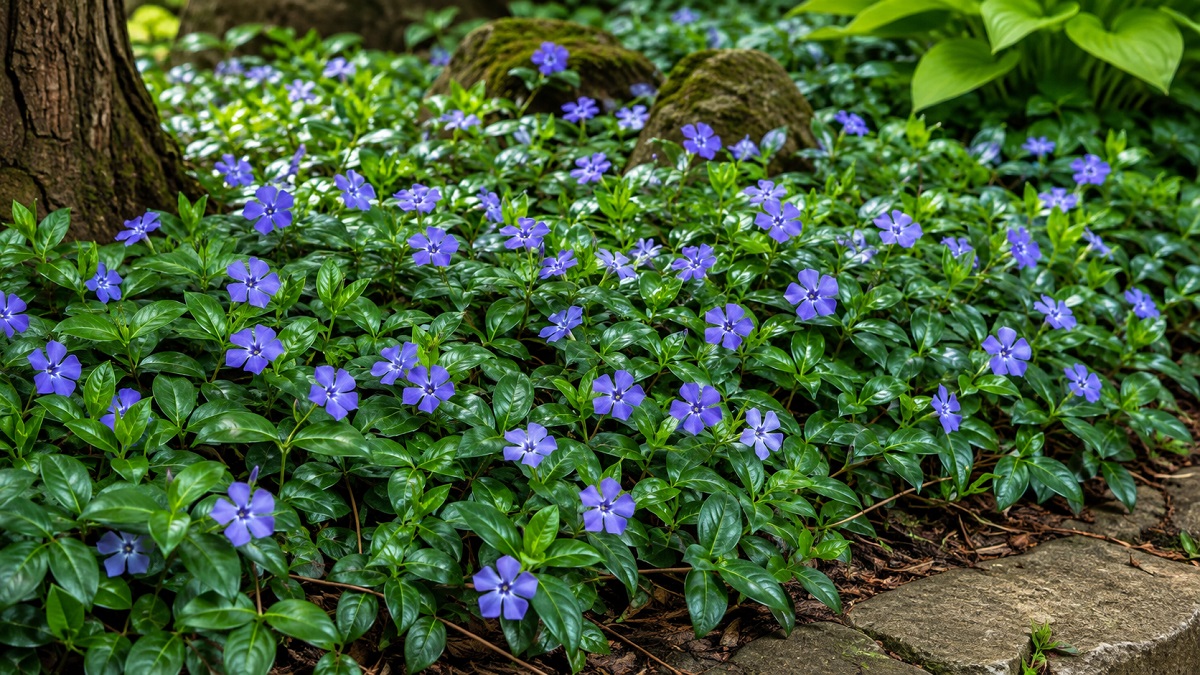
Bigleaf Periwinkle (Vinca major) creates a dense evergreen ground cover with attractive violet-blue blooms, making it ideal for shaded borders, slopes, and erosion control.
Quick Care Overview: Vinca major at a Glance
Bigleaf Periwinkle is a vigorous evergreen groundcover known for rich violet flowers, high adaptability, and rapid trailing coverage across shady slopes and erosion-prone garden beds.
LIGHT REQUIREMENTPartial Shade to Full Shade
WATERING NEEDSModerate (Drought Tolerant Once Set)
If you have ever stared at a difficult, steep bank under a dense shade tree where turfgrass stubbornly refuses to grow, you have likely met the ideal assignment for Bigleaf Periwinkle (Vinca major). Native to the sun-dappled coastal woodlands and scrublands of the Mediterranean region, Southern Europe, and Northern Africa, this broadleaf evergreen perennial vine has travelled across the globe as one of the most resilient, fast-spreading groundcovers in horticulture.
Belonging to the dogbane family (Apocynaceae), Vinca major is prized primarily for its handsome, leathery leaves and eye-catching five-petaled, pinwheel-shaped blossoms that erupt in a cool shade of lavender-blue to deep violet during mid-spring. Flowering often continues sporadically throughout the warm summer months before tapering off in early autumn.
Unlike erect perennials that remain localized in neat clumps, Bigleaf Periwinkle spreads through long, arching stems known as stolons. As these trailing stems touch moist earth, they develop root nodes—a habit known as rooting at the nodes—forming an interwoven, weed-suppressing mat between 12 to 18 inches tall. While its vigor makes it an incredible asset for rapid soil stabilization, it also demands thoughtful placement and periodic maintenance so that it stays a well-behaved garden resident rather than an uninvited squatter in adjacent beds.
2. Bigleaf Periwinkle (Vinca major) vs. Lesser Periwinkle (Vinca minor)
Homeowners and novice gardeners frequently confuse Vinca major with its smaller sibling, Vinca minor (commonly called Lesser Periwinkle, Common Periwinkle, or Myrtle). While both share similar floral geometry and evergreen habits, identifying which species you own or intend to plant is essential for structural planning and cold-hardiness expectations.
The table below highlights the physical and environmental differences that separate these two popular groundcovers:
Feature
Bigleaf Periwinkle (Vinca major)
Lesser Periwinkle (Vinca minor)
Foliage Size
1.5 to 3 inches long; heart-shaped to broad oval
0.75 to 1.5 inches long; narrow elliptical
Leaf Margin Details
Fringed with fine, microscopic hairs along edges
Completely smooth edges without hair margins
Mat Height
12 to 18 inches tall (more arching and open)
4 to 8 inches tall (dense, low-profile carpet)
Flower Diameter
1.5 to 2 inches across; prominent violet-blue
0.75 to 1 inch across; periwinkle blue or white
USDA Hardiness
Zones 7a to 11b (Tender below 0°F / -18°C)
Zones 4a to 9b (Extremely cold-hardy)
Growth Rate & Spread
Rapid; long arching runners that root aggressively
Moderate; forms dense, tight clumps over time
In summary: choose Vinca major when you need a taller, robust groundcover to quickly cover broad spaces, tumble over retaining walls, or fill large containers. Opt for Vinca minor if you live in colder northern climates (USDA Zones 4–6) or require a low, delicate carpet around small specimens where taller growth would overwhelm surrounding plants.
3. Notable Cultivars & Variegated Varieties
While the straight species features solid, glossy dark green foliage, plant breeders and horticulturists have selected several striking variegated cultivars that bring brightness and contrast to dark, shady garden corners.
Vinca major 'Variegata' (Bandwidth & Color)
Undoubtedly the most famous selection, 'Variegata' (sometimes sold as 'Elegantissima') sports dark green leaves bordered by rich, creamy white to butter-yellow margins. Its flowers are light blue-violet. This variety is slightly less aggressive than the wild species, making it easier to manage in mixed perennial borders and outdoor patio planters.
Vinca major 'Wojo's Jelly'
An eye-catching mutation, 'Wojo's Jelly' reverses the traditional variegated pattern. The interior center of each leaf features a broad swath of creamy yellowish-white, framed by a uneven, wavy margin of dark green. The stems take on a distinct reddish-pink hue in cooler weather, creating multi-season color interest.
Vinca major 'Maculata'
Also known as Gold Vein Periwinkle, 'Maculata' features bright yellowish-green splashes along the central midrib and primary veins of young leaves, which gradually mature to a soft chartreuse shade set against deeper green outer leaf margins.
Quick Cultivar Tip
Reversion Warning: Variegated cultivars like 'Variegata' or 'Wojo's Jelly' occasionally produce solid green shoots. Always snip these solid green stems off right at the base! Solid green stems contain higher levels of chlorophyll and will quickly outgrow and crowd out the variegated growth if left unchecked.
4. Light, Soil & Site Selection Requirements
Success with Bigleaf Periwinkle begins with picking the right site. Although this plant is notoriously adaptable—surviving in conditions that would cause lesser plants to drop leaves—understanding its ideal parameters ensures vibrant blooms, healthy foliage, and fewer disease issues.
Sunlight Exposure
Vinca major thrives best in partial shade to deep shade. In environments with dappled morning sunlight and filtered afternoon shade, plants produce a dense canopy of leaves along with an abundance of early spring flowers.
Can it handle full sun? Yes, but with conditions. In cooler northern sectors of Zone 7, Bigleaf Periwinkle can tolerate full sun exposure provided the soil remains consistently moist. However, in hotter southern zones (Zones 8–11), full afternoon sun will scorch the leaf tips, bleach the vibrant green foliage to a washed-out yellow, and cause thermal stress during mid-summer heatwaves. Conversely, deep shade reduces flower count but results in lush, rich green leaves.
Soil Composition & Drainage
Bigleaf Periwinkle is notably forgiving when it comes to soil texture. It grows reliably in sandy loams, silty soils, heavy clay, and gravelly ground. However, its absolute preference is rich, organic soil amended with leaf mold or well-aged compost.
The single most critical soil factor is drainage. While Vinca major likes moderate moisture, standing water and waterlogged soils encourage root rot and crown rot pathogens. Aim for a soil pH in the slightly acidic to neutral range (pH 6.0 to 7.2), though alkaline soils up to pH 7.8 are well tolerated.
5. How to Plant Bigleaf Periwinkle Step-by-Step
Planting Bigleaf Periwinkle is straightforward whether you are installing nursery-grown potted stock, bare-root plugs, or rooted cuttings harvested from an existing stand.
Spacing Guidelines
Because of its rapid arching growth, spacing dictates how quickly your bed closes into a continuous canopy:
Standard Coverage: Space plants 18 to 24 inches apart on center. Full coverage is usually achieved within 12 to 18 months.
Rapid Erosion Control: Space plants 12 to 15 inches apart on center. Ground coverage is achieved in a single growing season.
Step-by-Step Planting Process
Bed Preparation: Clear the planting area of invasive perennial weeds, grass roots, and large stones. Incorporate a 2- to 3-inch layer of organic compost across the surface and till or dig it into the top 6 inches of soil.
Digging Holes: Dig a hole for each container plant that is twice as wide as the root ball and equal in depth.
Root Teasing: Remove the plant from its nursery pot. If the roots are dense or root-bound, gently tease the lower roots apart with your fingers to encourage outward root exploration into surrounding native soil.
Positioning: Place the plant in the center of the hole, ensuring the root crown rests level with or slightly above the surrounding soil level. Never bury the crown too deep, as crown rot can occur.
Backfilling & Tamping: Backfill the hole with loose, compost-rich soil, firming gently around the base of the plant to collapse air pockets.
Initial Watering & Mulching: Water thoroughly until the root zone is saturated. Apply a 2-inch layer of shredded bark mulch between plants to conserve moisture and suppress competing weeds while the vines establish.
6. Watering, Hydration & Fertilization Routine
Watering Requirements
During its first season, Vinca major requires regular hydration to build a deep root network. Provide approximately 1 inch of water per week through rain or manual irrigation during spring and summer.
Once fully established (typically by year two), Bigleaf Periwinkle demonstrates impressive drought tolerance thanks to its thick, leathery leaves and expansive root system. In shaded zones, established beds often survive prolonged dry spells without supplemental water. However, during extended summer droughts or extreme heat, an occasional deep watering keeps the leaves plump and prevents edge crisping.
Fertilizer Application
Bigleaf Periwinkle is a modest feeder. Oversupplying nutrients—particularly high-nitrogen synthetic fertilizers—encourages sprawling, weak leafy growth at the expense of floral blooms, while increasing susceptibility to fungal stem blights.
Spring Feed: Apply a balanced, slow-release granular fertilizer (such as 10-10-10) in early spring just as new growth emerges, at a light rate of 1 pound per 100 square feet.
Organic Top-Dressing: Alternatively, spread a 1-inch top-dressing of fine leaf mold or well-rotted compost over the bed every spring. This improves soil structure and releases nutrients gradually throughout the growing season.
7. Pruning, Edging & Spread Management
Without intervention, a healthy patch of Vinca major will expand continuously outward into lawn edges, garden pathways, and neighboring flower beds. Routine pruning keeps the foliage dense, fresh, and contained within designated borders.
Spring Hard Pruning
Every 2 to 3 years in late winter or early spring (before new growth begins), shearing back your periwinkle bed invigorates the colony. You can use sharp hedge shears, string trimmers, or even set a lawnmower to its highest cutting deck setting (4 to 5 inches) over flat, established patches.
This hard pruning removes winter-damaged leaves, encourages branching, and opens up the interior canopy to light and air circulation, significantly reducing fungal disease pressure.
Edging & Perimeter Control
To keep Bigleaf Periwinkle from escaping into lawns or delicate perennial borders:
Install a physical subterranean landscape border or root barrier at least 6 inches deep around the perimeter of the bed.
Trench along the edges once or twice a year with a sharp spade, severing trailing stems that have strayed past your boundary. Lift and discard severed stolons.
8. Ecological Awareness & Containment Strategies
It is essential to discuss responsible gardening when growing Vinca major. In mild, moist Mediterranean climates—most notably in coastal California, parts of the Pacific Northwest, and areas across the Southeastern United States—Bigleaf Periwinkle is classified as an invasive species in riparian habitats and native oak woodlands.
Its thick growth can choke out native wildflowers, ferns, and tree seedlings along natural streams and forest floors. Stem fragments easily break off during high-water events and float downstream, colonizing new unmanaged areas.
Responsible Planting Guidelines:
* Check Local Status: Always verify with your local agricultural extension service whether Vinca major is listed as invasive in your specific county or watershed before planting.
* Avoid Waterways: Never plant Bigleaf Periwinkle near natural drainage ditches, seasonal creeks, riverbanks, or adjacent to wild woodland preserves.
* Use Natural Buffers: Enclose plantings within hardscape boundaries like concrete driveways, stone retaining walls, or lawn corridors where regular mowing keeps escaping runners contained.
Propagating Bigleaf Periwinkle is relatively easy. Because the plant's trailing stems naturally seek to root wherever node tissue touches moist ground, gardeners have three effective choices for expanding their collection.
Method 1: Stem Cuttings
In late spring or early summer, cut 4- to 6-inch non-flowering stem tips using clean, sharp pruning shears.
Strip the leaves from the lower half of each stem cutting, exposing at least two leaf nodes.
Dip the severed stem end in rooting hormone powder (optional, but accelerates root formation).
Insert the cutting into a tray filled with a moist mixture of 50% peat moss and 50% perlite.
Keep the cuttings under bright indirect light and maintain high humidity (cover with a clear plastic dome). Roots usually establish within 14 to 21 days.
Method 2: Layering (Harvesting Rooted Runners)
This is the simplest technique. Inspect mature stems trailing along the soil surface. You will frequently find nodes that have already sprouted fine white or brown roots into the topsoil. Simply sever the trailing stem behind the rooted node using shears, gently lift the rooted section with a hand trowel, and transplant it directly into a new pot or garden spot.
Method 3: Crown Division
In spring or early autumn, lift mature clumps using a garden fork. Slice the root ball into smaller sections using a spade or sharp knife, ensuring each divided section retains several rooted shoots and healthy foliage. Replant immediately and water thoroughly.
10. Pest Identification, Diseases & Troubleshooting
While Bigleaf Periwinkle is tough, it can occasionally face insect pests and fungal issues—particularly when planted in overly wet, crowded, or air-stagnant locations.
Issue / Disease
Symptoms & Visual Signs
Primary Cause
Management & Treatment
Vinca Stem Blight / Phoma Blight
Shoot tips turn black/brown, wilt rapidly; black lesions on stem bases near soil line.
Fungus Phoma exigua var. vinceae spread by splashing water.
Prune infected stems to ground level; clear fallen leaf debris; avoid overhead irrigation; apply copper fungicide in severe cases.
Landscape architects frequently rely on Vinca major to solve tricky design challenges in shaded areas. Its arching form and semi-glossy evergreen texture offer structural continuity across all four seasons.
Primary Landscape Applications
Erosion Control on Slopes: The dense, interlocked root and stolon network binds loose topsoil on steep hillsides, reducing runoff during heavy rains.
Underplanting Large Trees: Fits under shallow-rooted trees like maples, oaks, and conifers where turf grass fails due to competition for light and surface moisture.
Retaining Wall Cascades: Planted along the top edge of stone retaining walls or raised beds, the vines spill downward in gracefully weeping green curtains.
Container Spiller: Works wonderfully as the trailing "spiller" component in large outdoor urns, window boxes, and hanging baskets paired with upright shade annuals.
Ideal Companion Plants
Pair Bigleaf Periwinkle with shade-loving perennials that feature contrasting foliage colors, textures, and heights:
Ferns (e.g., Japanese Painted Fern, Autumn Fern): Feathery fronds create delicate visual layerings above the matted periwinkle vines.
Coral Bells (Heuchera): Deep purple, bronze, or caramel foliage pops vibrantly against variegated or dark green periwinkle.
Spring Bulbs (Daffodils, Alliums, Snowdrops): Sturdy spring bulbs push straight up through the low periwinkle mat, bloom, and fade away cleanly while the periwinkle covers their dying foliage in late spring.
12. Year-Round Seasonal Maintenance Calendar
Keep your Bigleaf Periwinkle bed looking pristine throughout the year with this seasonal task checklist:
Spring (March – May)
Shear back older beds to 4–6 inches before new growth bursts to refresh tired foliage.
Apply a light dose of balanced slow-release fertilizer or top-dress with aged compost.
Divide overgrown clumps and transplant rooted runners into new areas.
Snip off any solid-green shoots appearing on variegated cultivars to maintain color purity.
Summer (June – August)
Water during extended heatwaves if leaves show signs of wilting or edge curling.
Trench and trim perimeter edges to prevent unwanted spread into adjacent lawns.
Monitor undersides of leaves for aphids or scale insects and treat promptly with organic insecticidal soap.
Autumn (September – November)
Rake off fallen tree leaves from periwinkle beds; dense leaf cover traps moisture and invites fungal stem blight over winter.
Plant new bare-root or potted periwinkle specimens at least 6 weeks before your region's first hard freeze.
Final edging pass to cleanly define borders ahead of winter dormancy.
Winter (December – February)
In cold edge zones (USDA Zone 7a), apply a light blanket of evergreen boughs or straw over exposed beds if severe sub-zero cold snaps threaten without snow cover.
Clean, sanitize, and sharpen pruning tools for the upcoming spring shearing session.
13. Frequently Asked Questions
Is Bigleaf Periwinkle toxic to dogs, cats, or horses?
Yes. All parts of Vinca major contain vinca alkaloids (including vincristine and vinblastine). If ingested in large quantities by pets, it can cause gastrointestinal upset, vomiting, diarrhea, low blood pressure, and lethargy. Keep pets from chewing on dense stands, though most animals naturally avoid its bitter-tasting foliage.
Why is my Bigleaf Periwinkle not producing flowers?
Lack of blooms usually stems from two factors: excessive nitrogen fertilizer or deep, complete shade. While the foliage thrives in heavy shade, plants need dappled morning light or filtered bright light to initiate heavy floral buds. Reduce nitrogen feeding and thin overhead tree branches to increase light penetration.
Can Bigleaf Periwinkle be grown indoors as a houseplant?
Yes! Variegated cultivars like Vinca major 'Variegata' make excellent indoor plants when placed in bright, indirect light near an east or west window. Use a well-draining potting soil mix, keep the soil consistently moist but never soggy, and trim trailing stems regularly to maintain a bushy form.
How do I permanently remove Bigleaf Periwinkle if it has overgrown my yard?
Removal requires patience due to its deep root nodes. Manual removal involves digging out the entire root crown and sifting through soil to pull out all trailing stolons. Alternatively, smother the area with thick cardboard covered by 4 inches of wood chips for an entire growing season, or spot-treat actively growing foliage with a systemic broadleaf herbicide during warm weather.
Is Vinca major deer and rabbit resistant?
Yes, exceptionally so. The tough texture and bitter chemical alkaloids within the leaves make Bigleaf Periwinkle highly unpalatable to deer, rabbits, and small foraging mammals, making it an excellent choice for rural gardens plagued by wildlife browsing.
What causes the stems on my periwinkle to suddenly turn black and collapse?
This is classic Phoma stem blight (Vinca blight). It is caused by fungal spores carried in wet conditions. Immediately cut infected stems down to ground level, rake away all dead leaf litter, discontinue overhead sprinkling, and ensure the bed gets better airflow.