Growing & Caring for Aeoniums
Learn how to grow and care for aeoniums, including light, watering, soil, temperature, propagation, pruning, pests, flowering, and seasonal care.
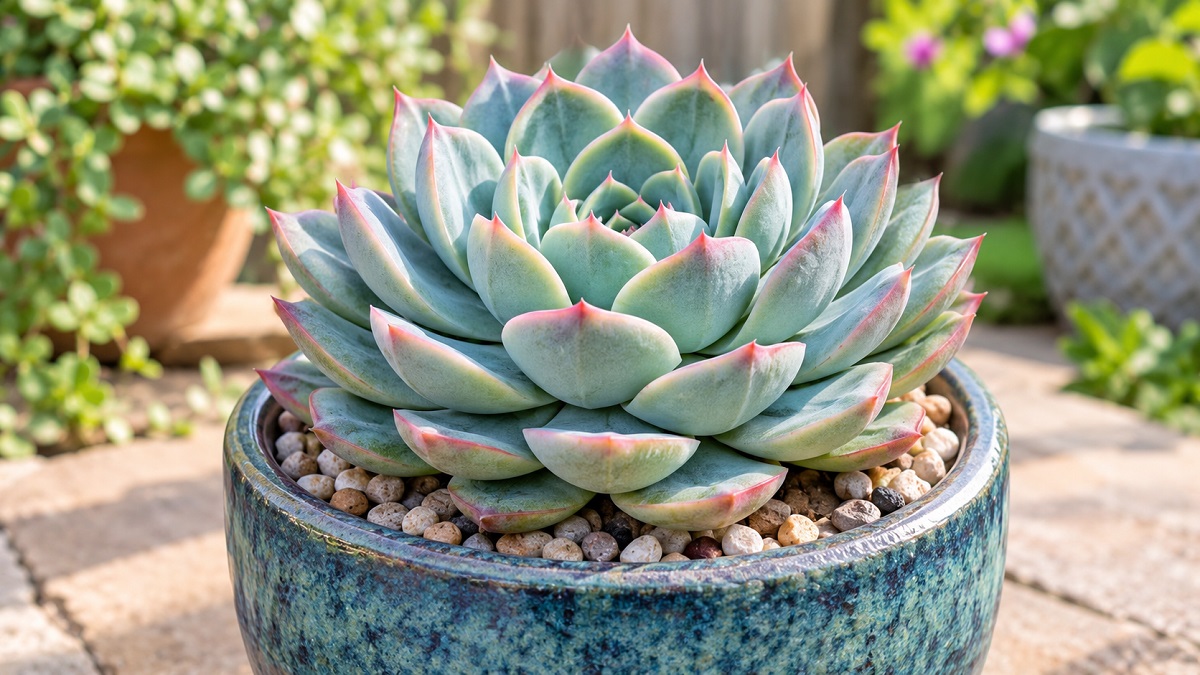
Echeveria is a favorite among succulent growers for good reason. Its neat rosette shape, fleshy leaves, wide range of colors, and relatively compact growth make it useful both as a houseplant and as an outdoor accent in suitable climates. Depending on the species or hybrid, the leaves may be green, blue-green, gray, pink, purple, reddish, or edged with contrasting tones. Some develop a smooth, powdery surface called a farina, while others have more pronounced leaf margins or pointed tips.
Although Echeveria is often described as an easy-care succulent, it is not completely maintenance-free. Most problems come from conditions that stay too wet, insufficient light, or sudden changes in exposure. The key is to treat the plant as a drought-adapted succulent rather than as an ordinary foliage houseplant.
This guide explains how to choose a good location, plant Echeveria in the right soil, water it properly, provide enough light, fertilize without encouraging weak growth, and deal with common problems such as stretching, leaf loss, rot, pests, and sun damage.
The basic formula: bright light, fast drainage, thorough watering followed by a dry period, and good airflow.
Echeveria is a large genus of succulent plants in the Crassulaceae family. Many species and hybrids form low-growing rosettes made up of thick, water-storing leaves. Their compact shape makes them particularly useful in pots, succulent arrangements, rock gardens, and other areas where excellent drainage is available.
One of the most appealing features of Echeveria is the variety within the genus. Some plants remain only a few inches across, while others eventually produce larger rosettes and offsets. Leaf shape ranges from broad and rounded to narrow and pointed, and coloration can change according to light, temperature, age, and growing conditions.
Many Echeverias also have a natural waxy or powdery coating known as farina. This coating can help protect the leaf surface from intense environmental conditions. It is easily rubbed away by handling, so avoid repeatedly touching the leaves if you want to preserve their original appearance.
Echeveria stores water in its thick leaves, allowing it to tolerate periods of dry soil. Instead of keeping the growing medium constantly moist, successful cultivation depends on alternating thorough watering with periods of drying.
The rosette is also an important clue to its care requirements. When the plant receives enough light, leaves generally remain relatively compact and overlap neatly. When light is inadequate, the stem may elongate and the leaves spread apart as the plant reaches toward a brighter source.
Echeveria can make an excellent indoor plant when placed close to a bright window. A sunny windowsill, bright sunroom, greenhouse, or suitable grow-light setup can provide the intensity needed to maintain compact growth.
The biggest indoor mistake is usually watering on a fixed schedule without checking the soil. Indoor pots often dry more slowly than outdoor containers, especially in cool or poorly ventilated rooms.
Because Echeveria includes numerous species, cultivars, and hybrids, individual plants can differ considerably. The following table describes the general characteristics and care requirements of commonly cultivated Echeverias rather than one particular cultivar.
| Characteristic | Echeveria |
|---|---|
| Botanical genus | Echeveria |
| Family | Crassulaceae |
| Plant type | Succulent perennial |
| Growth habit | Usually compact, low-growing rosette |
| Leaves | Fleshy, water-storing leaves arranged in a rosette |
| Light | Bright light with several hours of direct sun for many varieties when acclimated |
| Soil | Fast-draining, porous succulent or cactus mix |
| Soil moisture | Allow the growing medium to dry between thorough waterings |
| Water requirement | Low to moderate; varies with season, temperature, pot size, and light |
| Humidity | Average indoor humidity is generally adequate |
| Temperature | Prefers warm growing conditions; protect from frost and prolonged cold |
| Flowering | Bell-shaped flowers are commonly produced on tall flower stalks |
| Flower colors | Often pink, orange, red, yellow, or combinations of these tones |
| Propagation | Offsets, leaves, and stem cuttings depending on the plant |
| Fertilizer | Light feeding during active growth; avoid excessive fertilization |
| Common problems | Root rot, stretching, sunburn, mealybugs, and overwatering damage |
| Typical landscape use | Containers, rock gardens, succulent beds, windowsills, and dry gardens |
Light is one of the most important factors in maintaining a compact Echeveria. Most cultivated varieties perform best in bright light, and many appreciate several hours of direct sunlight each day once they have been gradually acclimated.
An Echeveria receiving insufficient light often becomes noticeably different in shape. The center may continue producing new leaves while the spaces between leaves increase and the rosette becomes loose. This elongated growth, commonly called stretching or etiolation, is difficult to reverse on the affected stem. Moving the plant into brighter conditions can help new growth remain compact.
A plant that has been growing indoors or in shade should not immediately be placed in intense afternoon sun. A sudden increase in light can cause pale or brown patches on the leaves.
Increase exposure gradually over several days or weeks. Morning sun is often an easier starting point than intense midday or afternoon exposure. Once the plant has adapted, it can usually tolerate substantially brighter conditions than it could when first purchased.
Choose a position where Echeveria receives plenty of light and where water does not remain around the roots. Good airflow is useful, particularly in humid climates, because it helps the foliage and soil surface dry more quickly.
Outdoor container plants can be placed on patios, balconies, terraces, raised shelves, or other bright locations. Indoors, place the pot near the brightest suitable window rather than deep inside a room.
The growing location should also make watering easy to control. Avoid areas where rain repeatedly saturates the container, especially during prolonged wet weather. A covered but bright position can be helpful in climates with heavy seasonal rainfall.
Echeveria needs soil that drains much faster than ordinary garden soil. Dense soil can stay wet around the roots for too long, particularly in a container without strong evaporation. Persistent moisture creates an environment where root and stem rot can develop.
A commercial cactus or succulent mix is a convenient starting point. If your existing mix remains wet for several days after watering, improve its structure with suitable mineral or coarse drainage material so that excess water can move away from the root zone.
Avoid relying on a layer of gravel at the bottom of an otherwise poorly draining pot as the main solution. The growing medium itself needs to be porous and suitable for succulent roots.
Choose a pot with at least one drainage hole. The container does not need to be very large; an oversized pot can hold more wet soil than the plant needs and may take longer to dry.
If the plant has recently been repotted or has damaged roots, give the root system time to recover before treating it like an established plant. Always handle the rosette carefully, particularly when the leaves have a visible powdery coating.
Correct watering is more important than frequent watering. Echeveria stores water in its leaves, so it can tolerate periods of dry soil. The goal is not to keep the roots continuously moist.
When the growing medium has dried sufficiently, water thoroughly enough to moisten the root zone and allow excess water to escape through the drainage holes. Then allow the soil to dry before watering again.
There is no single watering interval that works for every Echeveria. A plant in strong light during warm weather may dry much faster than one kept indoors in a cool room. Pot material, pot size, soil composition, humidity, airflow, and rainfall all affect drying time.
Rather than watering every seven or ten days simply because the calendar says so, check the soil and the plant's overall condition. During cooler or darker periods, watering may need to be reduced substantially.
Frequent small amounts of water can be especially unhelpful. It may keep portions of the root zone damp without thoroughly wetting the entire mix. When watering is appropriate, a thorough watering followed by adequate drying is generally a better approach.
Echeveria generally prefers warm growing conditions and should be protected from frost. Exact cold tolerance varies considerably among species and hybrids, so do not assume that every Echeveria has the same tolerance.
In regions with freezing winters, container-grown plants are usually easier to protect because they can be moved indoors or into a sheltered space. Even where temperatures remain above freezing, prolonged cold combined with wet soil can be stressful.
Echeveria does not normally require unusually high humidity. Average indoor humidity can be sufficient. In humid regions, the priority should be good ventilation, quick-draining soil, and careful watering rather than adding more moisture to the air.
Echeveria grows relatively well without heavy feeding. Excess fertilizer can encourage soft, overly vigorous growth that does not have the compact appearance many growers want.
During active growth, a balanced fertilizer diluted according to its label can be used occasionally. A fertilizer formulated for cacti and succulents is another practical option. Reduce or stop feeding during periods when the plant is barely growing.
Never use fertilizer as a substitute for good soil, light, or watering practices. A plant struggling because of poor drainage will not be fixed by additional nutrients.
Echeveria does not need frequent repotting simply because a certain amount of time has passed. Repot when the plant has outgrown its container, the soil structure has deteriorated, drainage has become poor, or the root system needs attention.
When repotting, inspect the roots and remove clearly dead or damaged material with clean tools. Replace old compacted growing medium with a fresh, fast-draining mix.
After repotting, avoid immediately soaking a plant whose roots have been disturbed or damaged. Give any damaged tissues an opportunity to dry and recover, then resume sensible watering as the plant settles into its new container.
Echeveria generally requires little conventional pruning. Grooming is mainly about removing damaged, dead, or dried leaves and managing old flower stalks.
Remove dead lower leaves carefully rather than pulling aggressively on healthy tissue. Old leaves sometimes detach naturally as the plant grows. If a leaf is stuck firmly, avoid tearing it away and damaging the stem.
Flower stalks can be removed after flowering has finished. Use clean, sharp scissors or pruners and cut the stalk close to its base without damaging the rosette.
Mature Echeverias can produce tall flower stalks that rise above the rosette. The flowers are often bell-shaped and may appear in shades of pink, orange, red, yellow, or combinations of these colors, depending on the species or hybrid.
Flowering is influenced by the individual variety as well as light, temperature, plant maturity, and general growing conditions. A healthy plant that does not flower is not necessarily unhealthy.
Once flowering is finished, the spent stalk can be removed if you prefer to keep the plant tidy. Some growers also allow flowers to remain for pollinators when the plant is grown outdoors.
Echeveria can often be propagated from offsets, leaves, or stem cuttings, although success varies with the species and the material being propagated. Offsets are generally one of the simplest methods when a mature plant naturally produces them.
Some Echeverias can produce new plants from individual leaves. Choose a healthy, mature leaf and remove it cleanly from the stem. The complete leaf base is important, because a damaged or incomplete leaf may not produce a new plant.
Place the leaf on a suitable dry propagation surface and provide bright, indirect light. Over time, some leaves develop roots and new growth at the base. Not every leaf will succeed, so propagation is best approached as a process rather than a guarantee.
Stem cuttings can be useful when an Echeveria has become elongated. A healthy section can be cut with a clean tool and allowed to callus before being placed in a suitable growing medium.
Do not immediately saturate the medium around a fresh cutting. The cut surface needs time to dry and form a protective callus before the cutting is encouraged to root.
Stretching is usually a sign that the plant needs more light. The rosette becomes loose, the stem elongates, and the leaves are spaced farther apart.
Move the plant gradually toward a brighter location. Avoid making an abrupt transition from deep shade to intense direct sunlight.
Soft, translucent, or mushy leaves can indicate excess moisture or tissue damage. Check the soil, drainage, roots, and stem rather than simply reducing water for one day.
If rot has developed, affected tissue may need to be removed. Healthy remaining portions can sometimes be saved and propagated, depending on how far the damage has progressed.
A small number of older lower leaves drying and dropping can be part of normal growth. Echeveria gradually replaces older leaves as the rosette develops.
However, widespread leaf loss, especially when accompanied by a soft stem or consistently wet soil, deserves closer attention.
Sudden exposure to strong sunlight can cause sunburn, particularly when a plant has previously been grown in lower light. Gradually acclimating the plant helps reduce this risk.
Wrinkled leaves can occur when the plant has used much of its stored water. Check the growing medium and consider whether it has remained dry for an unusually long period.
Wrinkling alone should not automatically trigger frequent watering. If the soil is already wet, investigate root health instead. Damaged roots may prevent the plant from taking up water even when moisture is present.
Echeveria can occasionally attract common succulent pests such as mealybugs, aphids, and scale insects. Mealybugs may appear as small cotton-like clusters around leaf joints, beneath leaves, or near the stem.
Inspect new plants carefully before placing them near an existing collection. Early detection makes pest management much easier.
For a small infestation, physically removing visible pests and following an appropriate treatment suitable for succulents can help. Repeat inspections are important because eggs or hidden insects may survive an initial treatment.
Spring is often a useful time to check the plant after winter. Remove dead leaves, inspect for pests, refresh the soil if necessary, and gradually increase watering as active growth resumes.
During hot weather, container Echeveria may dry rapidly, particularly in bright outdoor locations. Monitor the soil more closely, but do not confuse rapid drying with a need for constant moisture.
Very intense afternoon heat can also increase the risk of leaf scorch, especially in plants that have not been acclimated. Good airflow and sensible positioning are helpful.
As temperatures and light levels fall, growth may slow. Gradually reduce watering according to how quickly the soil dries rather than maintaining the same summer routine.
Winter care is often about avoiding excess moisture and cold damage. If the plant is indoors, give it the brightest available light and keep it away from cold drafts. Water less frequently when the plant is growing slowly and the pot remains dry for longer periods.
Containers are one of the easiest ways to grow Echeveria because the growing medium and drainage can be controlled. Choose a pot with a drainage hole and avoid selecting a container dramatically larger than the root system.
Unglazed clay pots can be useful because their porous sides may allow the growing medium to dry more quickly. However, the pot material does not replace good soil or sensible watering.
Echeveria also works well in shallow succulent arrangements. When combining several plants, group varieties with similar light and watering requirements. Avoid pairing a drought-tolerant Echeveria with plants that require consistently moist soil.
In warm, frost-free climates, Echeveria can be grown outdoors throughout much of the year. It is particularly effective in rock gardens, succulent beds, raised containers, gravel gardens, and sunny patios.
Climate suitability varies among Echeveria species and hybrids, so local winter temperatures should be considered before planting them permanently in the ground. In regions with frost or prolonged wet winters, containers provide greater flexibility.
Outdoor plants also need protection from prolonged rainfall. A location that receives abundant sunlight but drains poorly can be more problematic than a slightly less sunny site with excellent drainage.
Echeveria can adapt well to indoor cultivation when light is strong enough. Place it near a bright window where the plant receives substantial natural light.
Rotate the pot periodically if the plant begins leaning toward one direction. This does not replace adequate light, but it can help maintain more even growth.
If natural light is insufficient, a suitable grow light can be useful. Watch the plant's shape: increasingly open growth is often a more useful warning sign than waiting for the plant to become visibly unhealthy.
A compact Echeveria is usually the result of several conditions working together rather than one special care technique. Give it enough light, use porous soil, choose a pot with drainage, and let the growing medium dry between thorough waterings.
Avoid repeatedly moving the plant between very different light conditions. If it has been grown in a sheltered nursery environment, acclimate it gradually before exposing it to strong outdoor sun.
Finally, inspect the plant regularly. A few minutes spent checking the leaves, stem, soil, and drainage can reveal problems before they become serious.
Echeveria is relatively forgiving when its basic needs are understood. Give it strong light, sharply draining soil, a container with drainage, and a watering routine based on actual drying conditions rather than the calendar.
The most important lesson is to avoid treating Echeveria like a thirsty foliage plant. Its fleshy leaves are designed to store water, and constantly wet roots are far more dangerous than a short dry period. With the right balance of light, drainage, watering, and airflow, an Echeveria can maintain its attractive rosette and produce new growth and offsets for many seasons.
← Back to Plant GuidesContinue exploring our gardening guides with more plant profiles, growing tips, and practical advice for creating a healthy, productive garden.