Growing & Caring for Aeoniums
Learn how to grow and care for aeoniums, including light, watering, soil, temperature, propagation, pruning, pests, flowering, and seasonal care.
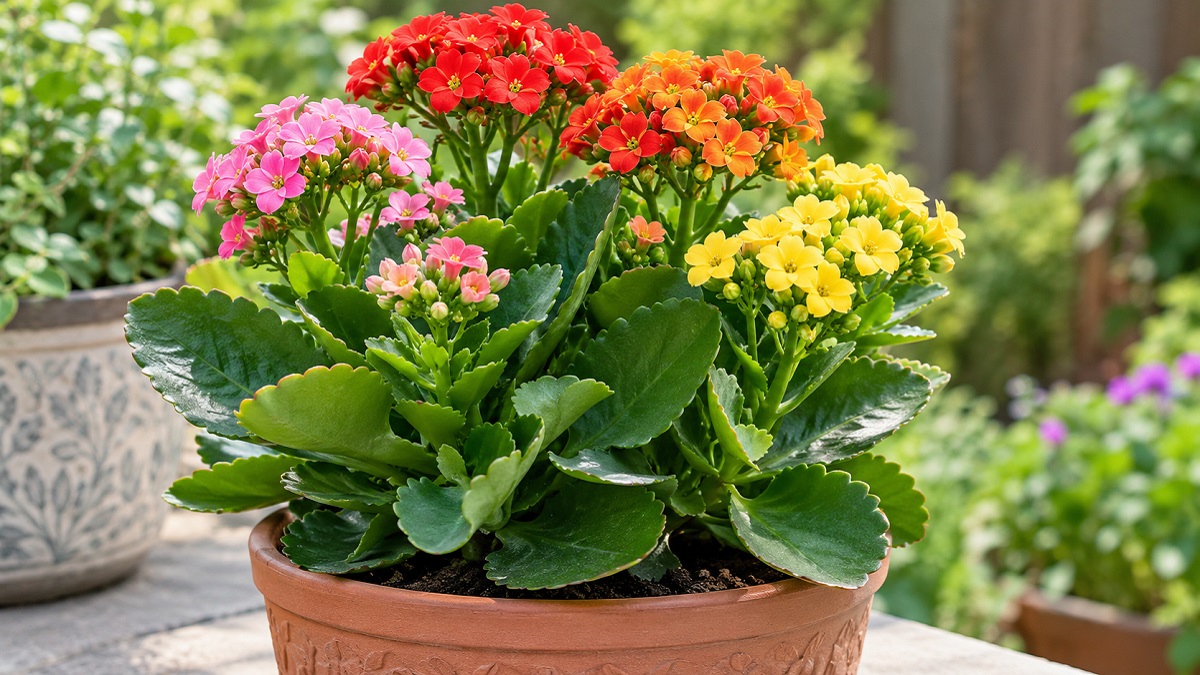
Kalanchoe is one of those plants that can brighten a windowsill without demanding constant attention. Its thick, fleshy leaves store water, while many commonly grown varieties produce colorful clusters of small flowers that can remain attractive for weeks. Given bright light, well-drained soil, and careful watering, Kalanchoe is remarkably forgiving.
The name Kalanchoe refers to a large genus of succulent plants in the family Crassulaceae. Different species have very different appearances, from the familiar flowering florist Kalanchoe to upright plants with unusual leaves. This guide focuses on the general growing requirements shared by commonly cultivated Kalanchoe, while noting where individual species or varieties may differ.
The key to healthy Kalanchoe is simple: plenty of light, excellent drainage, and restraint with watering.
Kalanchoe plants are succulents valued for their fleshy foliage, compact growth, and, in many cultivated forms, abundant flowers. Their ability to store water in their leaves means they generally cope much better with occasional dryness than with soil that remains wet for long periods.
One of the most widely sold flowering types is Kalanchoe blossfeldiana, often marketed simply as Kalanchoe or florist Kalanchoe. It produces dense clusters of small flowers in colors such as red, pink, orange, yellow, and white. Other Kalanchoe species are grown mainly for their foliage and unusual growth habits.
Despite their reputation as easy houseplants, Kalanchoe can struggle when treated like ordinary tropical foliage plants. Frequent watering, poorly draining potting soil, and insufficient light are three common causes of disappointing growth.
The thick leaves are an important clue to how this plant should be treated. They act as water-storage organs, allowing Kalanchoe to tolerate periods when moisture is unavailable.
Instead of watering on a fixed daily schedule, check the growing medium first. When the soil has dried sufficiently, water thoroughly and allow excess moisture to drain away.
Flowering Kalanchoe can stay attractive for a surprisingly long time when placed in a bright location. Removing faded flower clusters helps keep the plant tidy and directs attention toward new growth.
The following table summarizes the general characteristics and care requirements of commonly cultivated Kalanchoe. Because the genus contains many species, mature size, flower color, leaf form, and exact environmental preferences can vary.
| Characteristic | Kalanchoe Details |
|---|---|
| Botanical genus | Kalanchoe |
| Plant family | Crassulaceae |
| Plant type | Succulent perennial; often grown as a houseplant or seasonal container plant in colder climates |
| Native distribution | Native species occur primarily in tropical and subtropical regions of Africa, Madagascar and parts of Asia |
| Foliage | Typically thick and fleshy, with considerable variation in shape, margins and markings |
| Flowers | Many cultivated flowering forms produce small flowers in dense clusters |
| Common flower colors | White, yellow, orange, pink, red and related shades, depending on cultivar |
| Light requirement | Bright light; many plants appreciate several hours of gentle direct sunlight |
| Soil | Very well-drained succulent or cactus potting mix |
| Water requirement | Moderate to low; allow the growing medium to dry between waterings |
| Temperature | Warm conditions are preferred; protect from frost and prolonged cold |
| Humidity | Average indoor humidity is generally suitable; constantly humid conditions can increase problems when ventilation is poor |
| Fertilizer | Light feeding during active growth is generally sufficient |
| Propagation | Stem cuttings are commonly used; leaf propagation works for some species |
| Primary moisture problem | Root or stem rot caused by excessive moisture and poor drainage |
| Container requirement | Use a pot with drainage holes and a free-draining growing medium |
Light is one of the most important factors in growing a compact, attractive Kalanchoe. A bright windowsill with strong indirect light or gentle direct sunlight is usually a good starting point.
A plant kept in a dark corner may survive for a while, but growth can become stretched and weak. Flowering plants may also produce fewer flowers when light levels are inadequate.
Place the plant near a bright window where it receives plenty of natural light. An east- or west-facing window can work well. A bright south-facing window can also be suitable, although intense midday sun through glass may be too strong in some climates.
If the leaves begin looking pale, growth becomes elongated, or the plant consistently leans toward the window, consider moving it closer to a brighter light source.
Kalanchoe can tolerate direct sunlight, but sudden exposure to intense sun can cause leaf damage. If a plant has been growing indoors under filtered light, introduce stronger sunlight gradually rather than moving it directly into harsh afternoon conditions.
Overwatering is one of the easiest ways to damage a Kalanchoe. The plant's fleshy leaves already hold moisture, so the root system does not need constantly damp soil.
Rather than following a rigid weekly schedule, feel the growing medium and consider the plant's environment. During active growth and warm weather, it may need water more often. In cooler or darker conditions, the soil can remain wet for considerably longer.
A common mistake is watering a little every day. Small, frequent applications can keep the upper and lower portions of the pot inconsistently moist without properly wetting and draining the root zone.
Soft or yellowing leaves, a persistently wet potting mix, unpleasant soil odor, and darkening stems can indicate excessive moisture or developing root problems. If these symptoms appear, check the roots and drainage rather than simply adding fertilizer.
Kalanchoe performs best in a growing medium that drains quickly. A commercial cactus or succulent mix is usually a convenient choice. If using a general-purpose potting mix, improve drainage with suitable mineral or coarse materials rather than relying on dense soil alone.
The goal is not to make the soil completely incapable of holding water. Roots still need access to moisture. The important point is that excess water should be able to move away from the root zone quickly.
Always use a container with drainage holes. Decorative cachepots can be used around a nursery pot, but empty any standing water after irrigation.
Avoid choosing an unnecessarily large pot. A container that is much larger than the root system holds more unused wet soil, which can take longer to dry.
Kalanchoe generally prefers warm growing conditions and should be protected from frost. Indoor plants usually perform well at comfortable household temperatures when they receive adequate light.
Cold, wet conditions are particularly troublesome because evaporation slows while the soil remains damp. During cool weather, adjust watering rather than maintaining the same routine used during summer.
Average indoor humidity is normally adequate. There is little reason to mist Kalanchoe leaves regularly, and keeping the foliage wet without good air circulation can create an environment where disease problems become more likely.
Kalanchoe does not require heavy feeding. Too much fertilizer can encourage soft, excessive growth and may contribute to salt accumulation in the potting medium.
During active growth, use a balanced, water-soluble fertilizer at an appropriate diluted rate according to the product label. Fertilizing less frequently is generally safer than repeatedly applying concentrated feed.
Newly purchased flowering plants may already have sufficient nutrients in their growing medium, so there is no need to fertilize immediately simply because the plant has arrived home.
Kalanchoe usually does not need frequent repotting. Repot when the plant has become significantly root-bound, the potting medium has broken down, drainage has deteriorated, or the current container is no longer stable for the plant.
Choose a container only modestly larger than the existing root system. Refresh the potting mix and make sure the new container has adequate drainage holes.
After repotting, avoid immediately soaking a stressed plant repeatedly. Give damaged roots time to settle and adjust watering according to the condition of the new growing medium.
Pruning helps maintain a compact shape and removes damaged or spent growth. It is especially useful after flowering when old flower clusters begin to look tired.
Use clean, sharp scissors or pruning snips to remove faded flower clusters. Cut back to a suitable point above healthy foliage rather than leaving long, bare flower stems.
Remove yellow, damaged, or dead leaves as needed. Avoid repeatedly cutting healthy foliage simply to make the plant smaller; Kalanchoe needs its leaves for photosynthesis and energy storage.
If stems become long and sparse, insufficient light may be part of the problem. Pruning alone will not correct weak growth if the plant continues to receive inadequate light.
Flowering Kalanchoe needs good light and appropriate seasonal conditions. After the main flowering period, continue providing strong light and avoid keeping the soil constantly wet.
Some flowering Kalanchoe, particularly Kalanchoe blossfeldiana, respond to shorter day lengths when being prepared for flowering. In commercial production, controlled photoperiods are commonly used to initiate flowering. Home growers can sometimes encourage reblooming by providing a suitable period of long uninterrupted darkness, although results depend on the cultivar and growing conditions.
Once flower buds form, avoid constantly moving the plant or changing its environment. Keep it in a bright location and maintain sensible watering.
Many Kalanchoe can be propagated from stem cuttings, making it easy to produce new plants from healthy parent growth. Some species can also be propagated from leaves or plantlets, but methods vary considerably across the genus.
The biggest mistake during propagation is keeping the cutting constantly wet. A cutting without an established root system has limited ability to use excess moisture, so a free-draining medium and careful watering are important.
Leaf propagation is possible for certain Kalanchoe species, but it should not be assumed that every species will produce a new plant from a detached leaf. Species such as Kalanchoe daigremontiana are better known for producing plantlets along leaf margins.
| Problem | Possible Cause | What to Check |
|---|---|---|
| Yellow leaves | Overwatering, poor drainage, aging foliage or other stress | Check soil moisture, drainage and root condition |
| Soft or mushy stems | Excess moisture and possible rot | Inspect roots and stem base; improve drainage |
| Long, stretched growth | Insufficient light | Move the plant gradually toward brighter light |
| Leaves dropping | Watering problems, temperature stress or environmental change | Review recent changes in light, temperature and watering |
| No flowers | Insufficient light, inappropriate photoperiod or plant stress | Improve light and review seasonal conditions |
| Brown or scorched patches | Excessive direct sun or environmental stress | Consider the intensity and suddenness of sun exposure |
| Small insects on new growth | Possible aphids, mealybugs or other sap-feeding pests | Inspect leaf joints, stems and undersides of leaves |
Mealybugs can appear as small white, cotton-like clusters around leaf joints and stems. Aphids may gather around tender growth and flower stems. Regularly inspecting the plant makes these pests easier to catch before they spread.
For a small infestation, manually remove visible pests and consider an appropriate insecticidal soap treatment. Test any treatment on a small section first and follow the product directions carefully.
Prevention is much easier than recovering a badly rotted plant. Use a pot with drainage holes, choose a porous growing medium, and avoid watering simply because a certain number of days has passed.
Kalanchoe can be grown outdoors in warm, frost-free climates where the species is suited to local conditions. In cooler regions, containers make it easier to move plants indoors when temperatures fall.
An outdoor Kalanchoe should be protected from prolonged exposure to heavy rain if the soil remains saturated afterward. Morning sun or filtered light can be useful in very hot climates, while stronger light may be tolerated when plants are acclimated gradually.
Before planting a particular Kalanchoe permanently in the landscape, check its mature size and cold tolerance. The genus is diverse, so advice suitable for one species should not automatically be applied to another.
As light levels increase, Kalanchoe may begin producing fresh growth. This is a good time to assess the pot, replace badly degraded soil, prune damaged growth, and resume light feeding if the plant is actively growing.
Bright light and warm temperatures can increase water use, but do not assume the plant needs water every day. Check the potting medium before irrigating. Protect container plants from prolonged periods of intense heat and waterlogged soil.
As temperatures and light levels change, the plant may use water more slowly. Gradually reduce watering frequency when the growing medium takes longer to dry.
Indoor Kalanchoe should remain in a bright location during winter. Keep it away from cold drafts and windows that become extremely cold at night. Because evaporation is often slower, be particularly careful not to overwater.
Kalanchoe is easiest to care for when you work with its natural succulent characteristics instead of treating it like a moisture-loving houseplant. Give it strong light, allow the soil to dry between thorough waterings, and use a container and growing medium that drain freely.
Pay attention to the plant rather than relying entirely on a watering calendar. A Kalanchoe growing beside a bright window in summer may need very different care from one sitting in a cool room during winter.
Finally, remember that Kalanchoe is a diverse genus. Flowering florist Kalanchoe, paddle-leaved species, plantlet-producing species, and other forms can have noticeably different growth habits. When you know the exact species or cultivar, its specific requirements should take priority over general Kalanchoe care advice.
Continue exploring our gardening guides with more plant profiles, growing tips, and practical advice for creating a healthy, productive garden.