Growing & Caring for Blue Rug Juniper
Learn how to grow and care for Blue Rug Juniper, including sunlight, soil, watering, planting, pruning, winter care, propagation, pests, and landscape uses.
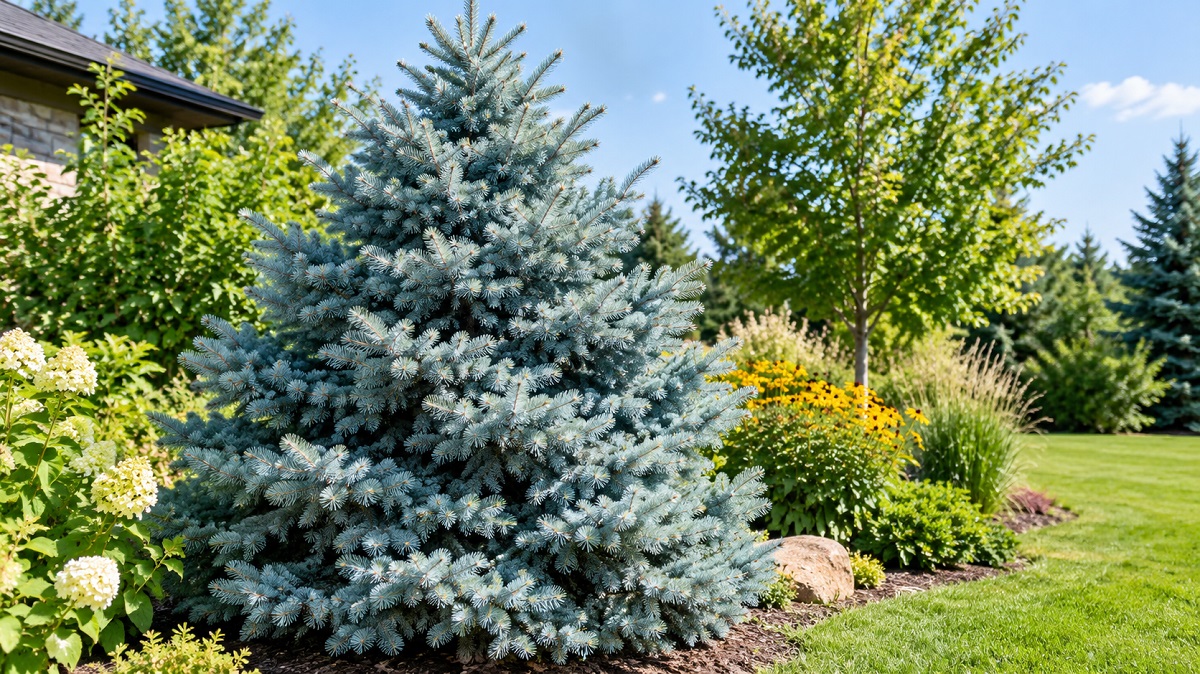
Blue Spruce (Picea pungens) is a long-lived evergreen conifer valued for its cool blue foliage, naturally conical shape, and strong presence in the landscape. Its stiff, four-sided needles range from blue-green to silvery blue, with the strongest coloration often developing when the tree receives plenty of sunlight. Mature trees can become substantial landscape specimens, making them especially useful as focal points, windbreaks, screens, or long-term lawn and garden trees.
Although Blue Spruce is often associated with cold climates and mountain landscapes, it can be grown successfully in suitable temperate regions when planted in well-drained soil and given enough space. The most important considerations are sunlight, drainage, air circulation, and avoiding prolonged periods of waterlogged soil. Once established, the tree can tolerate periods of dry weather better than a newly planted specimen, but consistent moisture is important while its root system is developing.
This guide covers the practical details of growing Blue Spruce, from choosing a planting site to watering, mulching, pruning, feeding, propagation, and troubleshooting common problems.
Blue Spruce is a large, sun-loving evergreen that needs room to develop its natural pyramidal form.
Blue Spruce is a distinctive conifer native to the central and southern Rocky Mountain region of North America. In the landscape, it is best known for its stiff branches and blue-gray needles arranged around the twigs. Young trees typically have a strong central leader and a neat pyramidal outline, while older specimens can develop a broader, more massive appearance.
The species is not a small ornamental evergreen. Given adequate space, it can eventually become a large tree, so planting location deserves careful consideration. Avoid placing it directly beneath utility lines or too close to buildings, driveways, patios, or property boundaries where its mature size could become a problem.
One of the tree's greatest ornamental features is its foliage. Blue coloration can vary considerably between individual trees and cultivars, ranging from greenish blue to noticeably silvery blue. Good light exposure generally helps the foliage display its characteristic color.
Blue Spruce offers dependable evergreen structure throughout the year. Its formal shape works well in large lawns, foundation-free landscapes, specimen plantings, and mixed evergreen borders. The blue foliage also creates contrast against green shrubs and trees.
Because the tree keeps its foliage through winter, it can provide visual structure even after deciduous plants have dropped their leaves. Its dense branching can also contribute to screening and wind protection when planted appropriately.
Before planting, think beyond the size of the nursery specimen. Blue Spruce is capable of becoming a large tree over time. Give it adequate horizontal and vertical room rather than planning to keep a naturally large tree permanently confined to a small planting area.
The following table summarizes the main characteristics and care requirements of Blue Spruce. Use these figures as practical gardening guidelines rather than assuming that every tree will reach exactly the same size or growth rate.
| Characteristic | Blue Spruce Details |
|---|---|
| Botanical Name | Picea pungens |
| Common Names | Blue Spruce, Colorado Blue Spruce |
| Plant Family | Pinaceae |
| Plant Type | Evergreen conifer tree |
| Native Range | Central and southern Rocky Mountain region of North America |
| Growth Habit | Upright and pyramidal |
| Mature Height | Commonly around 30–60 ft in cultivation, with larger specimens possible |
| Mature Spread | Often around 10–20 ft, depending on conditions and cultivar |
| Growth Rate | Moderate, particularly when young and growing under favorable conditions |
| Sunlight | Full sun; strong light supports dense growth and good foliage color |
| Soil | Well-drained, moderately fertile soil |
| Soil Moisture | Moderate; avoid prolonged waterlogging |
| Foliage | Stiff, prickly, blue-green to silvery-blue needles |
| Foliage Type | Evergreen |
| Flowers | Not grown for ornamental flowers; reproductive structures are cones |
| Cones | Elongated cones that mature from greenish or purplish tones to brown |
| Pruning | Usually minimal; remove damaged, dead, or poorly positioned branches |
| Fertilizer | Usually unnecessary in reasonably fertile soil; soil testing can guide feeding |
| Landscape Use | Specimen tree, screen, windbreak, evergreen structure, large-scale landscape planting |
Start with sunlight. Blue Spruce performs best in a location that receives full sun for much of the day. Bright exposure helps maintain a dense, attractive crown and supports the development of the characteristic blue-gray foliage.
Avoid planting the tree where surrounding buildings, tall trees, or structures will eventually cast heavy shade over it. A location that is sunny when the tree is young may become shaded as nearby plants mature.
Air circulation is another consideration. Avoid squeezing the tree into a narrow planting pocket surrounded by dense vegetation. Good spacing allows foliage to dry more quickly after rain and makes it easier to inspect branches for insect or disease problems.
Blue Spruce should be treated as a long-term landscape tree rather than a compact shrub. Check the expected mature dimensions before planting and allow enough clearance from structures, sidewalks, driveways, and other large trees.
Well-drained soil is one of the most important requirements for a healthy Blue Spruce. The roots need access to oxygen, and persistently saturated soil can create stressful growing conditions.
Before planting, observe the site after heavy rain. If water remains around the planting area for an extended period, improve drainage where practical or select a better location. Do not simply compensate for a poorly drained site by watering less; the underlying drainage problem still affects the roots.
A moderately fertile soil is generally sufficient. Adding large quantities of fertilizer to the planting hole is not a substitute for good soil structure. If the soil is compacted, improve the broader planting area rather than creating a small pocket of loose soil surrounded by hard, compacted ground.
Blue Spruce can tolerate a range of soil conditions, provided drainage is good. A soil test is useful when growth is poor or the foliage shows unexplained discoloration. Testing gives you information about pH and nutrient availability before you add amendments.
Planting correctly gives the tree a much better start than trying to correct problems later. Spring or fall can be suitable planting periods where local weather allows, with timing adjusted to avoid extreme heat, drought, or frozen ground.
Newly planted trees need more attention than established specimens. Monitor soil moisture regularly during the first growing seasons, especially during hot or dry weather.
Watering should be based on soil moisture, weather, tree age, and drainage rather than a rigid calendar. A recently planted Blue Spruce needs regular moisture while roots establish, whereas a mature tree with an extensive root system is generally more resilient once established.
During dry periods, water deeply enough to moisten the root zone instead of applying a small amount of water to the surface every day. Allowing the soil to dry somewhat between thorough waterings can help avoid constantly saturated conditions.
Check the soil around a newly planted tree frequently. Hot, windy weather can remove moisture faster than expected. Water when the soil begins to dry, and adjust the frequency after rainfall.
Established Blue Spruce generally needs less supplemental irrigation than a newly planted specimen. During prolonged drought, however, deep watering can reduce stress, particularly when natural rainfall is insufficient.
Mulch helps moderate soil temperature, reduce evaporation, and limit competition from grass and weeds around the root zone. Organic materials such as shredded bark, wood chips, or composted mulch can work well.
Keep mulch away from the trunk. A thick mound of mulch against the trunk keeps the bark unnecessarily moist and can create conditions that encourage problems. Instead, spread mulch outward in a broad, even layer.
Blue Spruce does not automatically need heavy fertilization. If the tree is growing well and the soil is reasonably fertile, additional fertilizer may provide little benefit and excessive nutrients can create unwanted growth or nutrient imbalance.
When growth is weak or foliage color is abnormal, investigate the underlying cause before feeding. Compacted soil, poor drainage, drought, root damage, pests, or disease can all affect the appearance of an evergreen.
A soil test is the most useful starting point when nutrient deficiency is suspected. If fertilizer is recommended, follow the product directions and avoid applying more than the label rate.
One of the advantages of Blue Spruce is its naturally attractive form. Routine shearing is generally unnecessary when the tree has enough space and is growing normally.
Prune primarily to remove dead, broken, diseased, or badly positioned branches. Make cuts carefully and avoid removing large amounts of healthy green growth simply to force the tree into an unnatural shape.
Light structural pruning can be performed when conditions are suitable. Removing damaged branches promptly after storms is more important than following a strict pruning date.
Evergreen conifers differ from many deciduous shrubs in their response to severe pruning. Avoid cutting deeply into bare, older portions of branches where there are no active buds or green shoots capable of replacing the removed growth.
Blue Spruce can be propagated from seed, but seed-grown trees may not reproduce the exact foliage color or ornamental characteristics of a selected parent tree. Seed propagation is therefore more useful for species propagation and long-term growing projects than for reliably duplicating a particular ornamental form.
Selected cultivars are commonly propagated vegetatively by specialized nursery methods. Home gardeners generally find growing a healthy nursery-grown tree much more practical than attempting to produce a landscape specimen from cuttings.
Seeds are obtained from mature cones and generally require appropriate preparation and favorable conditions for germination. Seedlings require patience because a large landscape tree takes years to develop.
The species is generally better suited to planting in the ground than to long-term container culture. Its eventual size and root system make permanent container growing impractical for most gardeners.
Young or dwarf forms may be grown in containers for a period of time, provided the container has adequate drainage and enough volume for the root system. Container-grown evergreens also dry out faster than trees planted in the ground, so moisture must be monitored carefully.
If you want a compact blue conifer for a patio or small garden, look for a naturally dwarf or slow-growing cultivar rather than expecting the standard species to remain small.
Blue Spruce can experience several insect and disease problems, particularly when trees are stressed or planted in unsuitable conditions. Good site selection, adequate spacing, appropriate watering, and regular inspection are important parts of prevention.
Spider mites can cause stippling, discoloration, and an unhealthy appearance in the needles. Hot, dry conditions can increase stress and may contribute to mite problems. Inspect foliage closely if needles begin to lose their normal color.
Sap-feeding insects can weaken individual shoots or branches. Look for clusters of insects, sticky residue, distorted growth, or unusual foliage discoloration. Natural predators may help keep some populations under control.
Needle cast diseases can cause older needles to turn yellow, reddish brown, or drop prematurely. Poor air circulation and prolonged moisture on foliage can contribute to disease pressure. If significant needle loss occurs, identify the problem before applying a fungicide.
Cytospora canker is a serious disease associated with stressed spruce trees. Symptoms can include branch dieback and resin production around affected areas. Improving overall tree health and removing affected branches where appropriate can help manage the problem, although severe cases may require professional diagnosis.
Blue Spruce is naturally adapted to cold conditions, so established trees generally require little special winter protection in climates appropriate for the species. The more important concern is preventing stress before winter arrives.
Water thoroughly during extended dry periods before the ground freezes, particularly for recently planted trees. Adequate soil moisture going into winter can reduce drought stress during periods when the ground is frozen and roots cannot readily access water.
A layer of organic mulch over the root zone also helps buffer temperature changes and reduces moisture loss. Keep the mulch away from the trunk.
| Problem | Possible Cause | What to Check |
|---|---|---|
| Needles turning brown | Drought, disease, root stress, or environmental damage | Soil moisture, drainage, symptoms on branches and needles |
| Premature needle drop | Needle cast disease, environmental stress, or normal aging of older needles | Pattern of discoloration and whether new growth is affected |
| Weak or sparse growth | Shade, drought, poor roots, compacted soil, or nutrient problems | Sunlight, soil condition, moisture, and root-zone health |
| Yellowing foliage | Water stress, nutrient imbalance, pests, or disease | Drainage, watering history, location of yellowing, and pests |
| Branch dieback | Canker disease, insect activity, drought, or physical damage | Branch lesions, resin, insects, and damaged tissue |
| Poor blue coloration | Genetic variation, insufficient light, or cultivar characteristics | Sun exposure and whether the tree is a blue-foliaged cultivar |
Blue Spruce is most effective when its size and strong visual character are used deliberately. A single specimen can serve as a focal point in a large lawn, while a properly spaced group can create an evergreen screen or windbreak.
The blue foliage contrasts especially well with plants that have deep green leaves, golden foliage, or warm-colored flowers. Its pyramidal outline also provides year-round structure in mixed landscapes where many surrounding plants change dramatically through the seasons.
A well-grown Blue Spruce can stand alone as a focal tree. Give it enough open space to display its branching structure rather than surrounding it with plants that will eventually crowd the lower branches.
Blue Spruce can be used as part of a privacy or windbreak planting, but spacing should account for mature width. Planting trees too close together may encourage competition and reduce airflow as the trees mature.
Its formal silhouette works particularly well in larger properties where a mature tree can be appreciated from a distance. In small urban gardens, a dwarf conifer may be more practical.
Growing Blue Spruce successfully is largely about choosing the right site and avoiding unnecessary stress. Give the tree plenty of sunlight, provide well-drained soil, water consistently while it establishes, and leave enough room for its mature size.
Once established in a suitable location, Blue Spruce can provide decades of evergreen structure and distinctive blue foliage. Regular inspection, sensible watering, good spacing, and restrained pruning are usually more valuable than an intensive maintenance routine.
If you are planting Blue Spruce for its color and architectural form, remember that the tree's mature dimensions are part of its appeal. Plan for the large, long-term landscape specimen you are growing rather than the small nursery tree you bring home.
Continue exploring our gardening guides with more plant profiles, growing tips, and practical advice for creating a healthy, productive garden.