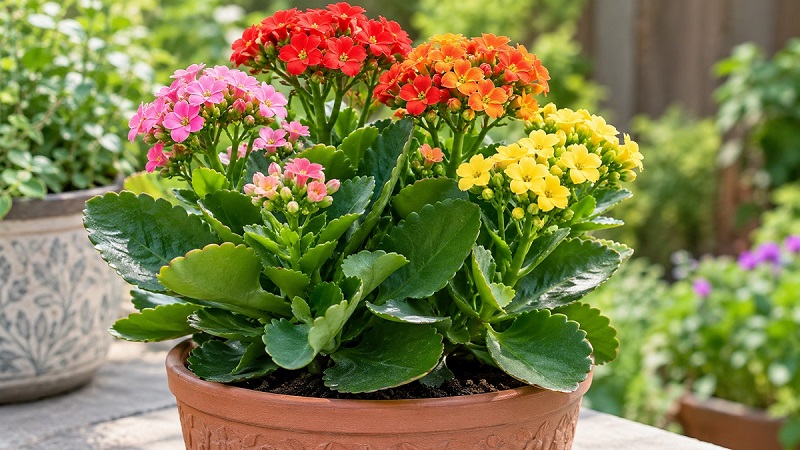
Growing & Caring for Kalanchoe
Learn how to grow and care for Kalanchoe, including light, watering, soil, temperature, fertilizing, repotting, pruning, flowering, propagation, pests, and common problems.
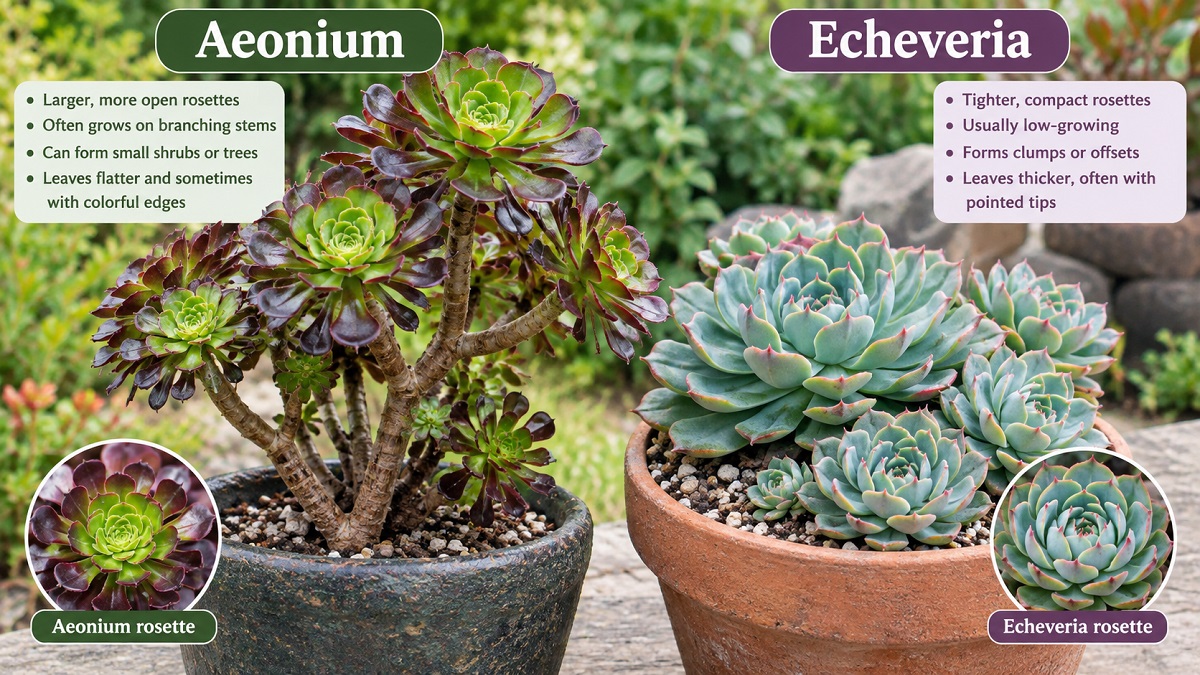
Aeoniums and Echeverias are two of the most popular rosette-forming succulents, and at first glance they can look remarkably similar. Both produce attractive layers of fleshy leaves, come in a wide range of colors, and work well in containers, rock gardens, succulent beds, and other dry landscapes. The similarities often make it difficult to tell them apart.
The important differences become easier to see when you look at their growth habits, leaf texture, seasonal behavior, flowering, and preferred growing conditions. Aeoniums generally have taller stems and often grow actively during cooler seasons, while Echeverias typically form compact rosettes close to the soil and are especially active during warmer conditions. Understanding these distinctions can help you choose the right plant and avoid giving either succulent the wrong care.
Aeonium and Echeveria are both rosette succulents, but their growth habits and seasonal needs are quite different.
Before comparing their differences, it helps to understand why these plants are so often confused. Both belong to the Crassulaceae family and are commonly grown as ornamental succulents. Their fleshy leaves are adapted to storing water, and many varieties develop symmetrical rosettes that make them especially attractive in containers and landscaped beds.
Both groups prefer excellent drainage and can suffer when their roots remain in constantly wet soil. They also appreciate plenty of light and are commonly propagated from cuttings or offsets, depending on the species and cultivar.
Despite these similarities, they should not be treated as interchangeable. Their response to heat, cold, moisture, and seasonal changes can be quite different.
Look at the stem beneath the rosette. A mature Aeonium commonly develops a visible stem, sometimes with several branches carrying rosettes. Many Echeverias remain much closer to the ground and maintain a compact, stemless or very short-stemmed appearance.
The easiest way to distinguish the two is to consider several characteristics together rather than relying on leaf color alone. Individual cultivars can vary considerably, but their overall growth patterns provide useful clues.
| Characteristic | Aeonium | Echeveria |
|---|---|---|
| Growth habit | Often upright, branching, or shrubby | Usually compact and low-growing |
| Rosette position | Often held at the end of stems | Usually close to the soil surface |
| Leaves | Generally flatter and often somewhat thinner | Usually thicker, fleshy, and often pointed |
| Seasonal behavior | Many species grow during cooler periods | Generally prefers active growth during warmer periods |
| Hot summer conditions | May slow down or become dormant | Usually handles summer growth better when properly watered |
| Flowers | Often produced from mature rosettes on tall stems | Flowers commonly rise above the rosette on arching stalks |
| Landscape use | Excellent for containers and architectural displays | Excellent for containers, rock gardens, and succulent arrangements |
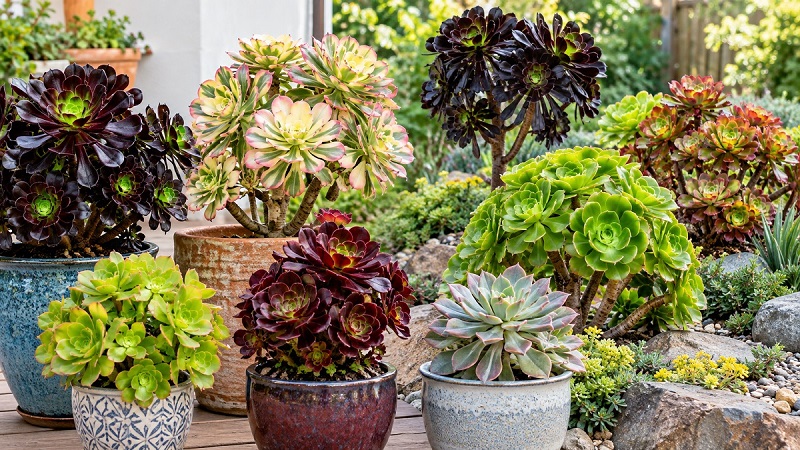
Growth habit is one of the most reliable visual differences between Aeonium and Echeveria. Aeoniums frequently develop elongated stems as they mature. Some species branch freely, creating a small shrub-like structure with rosettes positioned at the ends of the branches.
Echeverias, by contrast, are usually more compact. Their leaves overlap tightly to form rosettes that sit close to the soil. Some older plants can develop a short trunk, especially when lower leaves naturally drop away, but the overall appearance generally remains much more compact than that of a branching Aeonium.
Both genera contain plants with small and large rosettes, so size alone is not enough for identification. The arrangement of the rosette is more useful. An elevated rosette at the end of a branching stem is strongly suggestive of Aeonium, while a neat, ground-level rosette is more typical of Echeveria.
Echeveria leaves are often noticeably thick and fleshy. Depending on the variety, they may be rounded, triangular, spoon-shaped, pointed, powdery, or brightly colored. Many have a waxy or powder-like coating called farina, which gives the leaves a soft, dusty appearance.
Aeonium leaves can also be fleshy, but many species have flatter, broader leaves arranged in open or relatively shallow rosettes. Some develop green leaves, while others show burgundy, purple, bronze, yellow, or variegated coloring.
Leaf color should be treated as a supporting clue rather than the main method of identification. Sun exposure, temperature, watering, and the particular cultivar can all influence coloration.
Seasonal behavior is particularly important when caring for these plants. Many Aeoniums are adapted to regions with mild, relatively wetter winters and dry summers. As temperatures rise and conditions become hot and dry, they may slow their growth or enter a period of dormancy.
Echeverias generally follow a different pattern. Many grow actively during warmer portions of the year, although their exact response varies with species, temperature, and growing conditions. They still need protection from extreme heat, particularly when growing in containers that can become very hot.
A watering routine that works well for an actively growing Aeonium in cool weather may be inappropriate when the plant is dormant during summer. Likewise, reducing water too aggressively for a growing Echeveria can leave it stressed.
Instead of following a fixed calendar, check the plant and the soil. Watering should be adjusted according to temperature, growth, container size, soil drainage, and the plant's current activity.
Both Aeoniums and Echeverias can produce impressive flowers, although their flowering structures have different appearances.
Aeoniums generally flower from mature rosettes. Tall flower stalks rise above the foliage and carry clusters of small flowers. In many species, flowering is associated with the end of the rosette's life cycle. The affected rosette may decline after blooming, while offsets or other branches can continue growing.
Echeverias typically send up slender flower stalks from the rosette. The flowers are often bell-shaped and can appear in shades of yellow, orange, pink, or red depending on the species or cultivar.
If your main interest is foliage, flowers are a seasonal bonus. Good light, appropriate watering, and healthy growth are more useful than trying to force blooms.
Both genera appreciate bright light, but the ideal exposure depends on the local climate. Morning sun and bright afternoon light can produce strong growth and better coloration, while extremely intense afternoon heat may scorch foliage or overheat container roots.
Aeoniums can benefit from protection from severe summer heat, particularly in hot climates. Echeverias generally enjoy strong sunlight, but plants moved suddenly from shade into intense sun can also develop sunburn.
When moving either succulent into stronger light, increase exposure gradually. A sudden change can cause pale or scorched patches on leaves even when the final location would otherwise be suitable.
Good drainage is essential for both Aeoniums and Echeverias. A porous succulent or cactus mix is a useful starting point, particularly when combined with a container that has an adequate drainage hole.
Avoid keeping the soil continuously wet. Succulent roots need access to air, and prolonged saturation can lead to root problems. At the same time, succulent care does not mean withholding water indefinitely. Plants should receive enough moisture during active growth, followed by sufficient time for excess water to drain and the soil to dry appropriately.
Aeoniums may require more attention during their active cooler-season growth. When summer dormancy occurs, watering is generally reduced rather than maintained at the same frequency used during active growth.
Echeverias should also be watered according to active growth and environmental conditions. Allowing the growing medium to dry appropriately between thorough waterings is generally safer than frequent shallow watering.
Climate is one of the most important considerations when deciding between these plants. Aeoniums can struggle when exposed to prolonged extreme heat, particularly when their roots are confined to hot containers. Their tendency toward summer dormancy is an important adaptation to dry, hot conditions.
Echeverias also vary in heat and cold tolerance from one species to another. Many appreciate warm growing conditions but can suffer when exposed to prolonged freezing temperatures or waterlogged soil during cold weather.
Neither group should be assumed to have identical hardiness. If winter temperatures in your area regularly approach freezing, container growing can make seasonal protection much easier.
Both genera can be propagated, but the easiest method depends on the plant and its growth habit.
Stem cuttings are particularly useful for Aeoniums because many species develop elongated branches. A healthy stem section can be allowed to dry at the cut surface before being placed into a suitable growing medium.
Echeverias can be propagated using offsets, stem cuttings, and in some cases individual leaves. Leaf propagation can take patience, and not every leaf will produce a new plant, so healthy offsets or stem cuttings are often more predictable when available.
Whatever method you choose, use healthy plant material and avoid keeping newly propagated pieces excessively wet while roots are developing.
The better choice depends on the look you want and the conditions you can provide.
| If you want... | Consider... | Why |
|---|---|---|
| A taller, branching succulent | Aeonium | Many species develop stems and multiple rosettes. |
| A compact rosette for containers | Echeveria | Its low-growing form works especially well in pots and arrangements. |
| A succulent for a cooler-season display | Aeonium | Many Aeoniums are particularly attractive during their active season. |
| Colorful, tightly formed rosettes | Echeveria | There is a wide range of rosette shapes, colors, and leaf forms. |
| A plant for a small succulent garden | Echeveria | The compact growth habit fits easily into limited spaces. |
| A more architectural specimen | Aeonium | Stems and branching growth can create additional height and structure. |
One of the most common mistakes is assuming that every succulent follows the same watering and seasonal schedule. Aeonium and Echeveria can respond differently to summer heat and winter conditions, so observe the plant rather than relying on a universal routine.
Heavy soil that holds water for long periods can create problems for both genera. Choose a growing medium that drains freely and use containers with drainage holes.
Even sun-loving succulents can burn when suddenly moved from low light to intense direct sunlight. Gradual acclimation is safer.
A succulent that appears to have stopped growing is not necessarily unhealthy. Aeoniums in particular may slow considerably during hot summer weather. Changing watering and light management to match seasonal behavior can prevent unnecessary stress.
Red, purple, green, blue-green, and variegated foliage can occur across different succulent groups. Identify the plant by considering its structure, leaves, growth pattern, and seasonal behavior rather than color alone.
Neither genus is universally better. Aeoniums are excellent choices when you want branching stems, elevated rosettes, and a succulent that can provide a strong architectural presence. Echeverias are especially appealing when compact rosettes, diverse leaf shapes, and colorful foliage are the priority.
The biggest practical difference is seasonal behavior. Many Aeoniums are most active during cooler periods and may slow during hot summers, whereas Echeverias generally fit more naturally into warm-season succulent displays. Once that distinction is understood, it becomes much easier to provide the right watering and growing conditions.
In short, look beyond the rosette. The plant's stem, leaf shape, seasonal growth pattern, and response to heat will usually tell you more than appearance alone. Choose the one that matches your climate, available light, container space, and preferred garden style.
Continue exploring our gardening guides with more plant profiles, growing tips, and practical advice for creating a healthy, productive garden.