Rain Gardens: Complete Guide to Design, Planting & Maintenance
Learn how to design, build, plant, and maintain a rain garden. Discover site selection, soil, drainage, plant choices, sizing, watering, and stormwater tips.
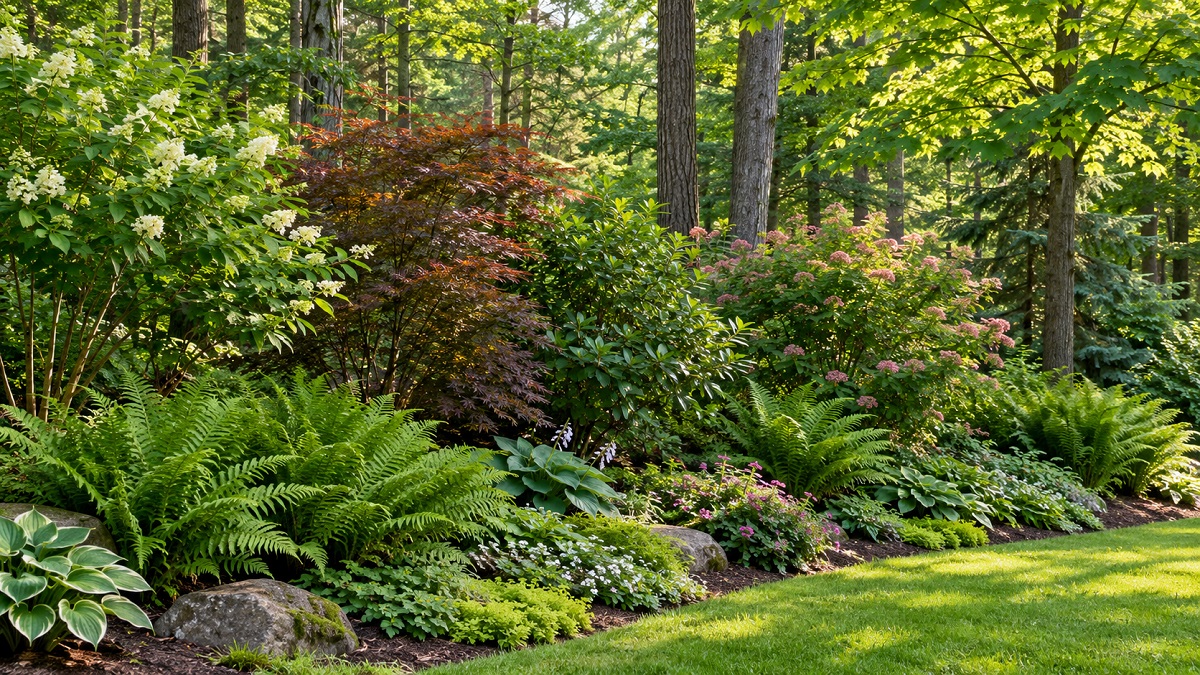
Woodland edges are some of the most interesting places to garden. They sit between two very different environments: the darker, sheltered interior of a woodland and the brighter, more exposed conditions of an open garden. Instead of treating this transition as an ordinary flower border, you can use it to create a layered planting area that feels relaxed, supports wildlife and changes throughout the year.
A woodland edge does not need to be large, and it does not require an existing forest. Even a narrow border beneath mature trees or beside a shaded fence can capture some of the character of a natural woodland margin. The key is to work with the conditions you already have rather than trying to force sun-loving plants into deep shade or moisture-loving species into dry soil.
The most successful woodland-edge gardens usually contain several layers. Taller trees provide the upper canopy, shrubs occupy the middle level, herbaceous plants and ferns fill the lower layer, while ground covers occupy spaces around rocks, roots and paths. When these layers are combined thoughtfully, the border looks fuller without needing dozens of unrelated plants.
Think in layers rather than individual plants. A woodland edge works best when each planting level has a purpose.
A woodland edge is the transition zone between a wooded area and a more open landscape. In nature, this boundary may occur where a forest meets a meadow, clearing, stream, road or open field. Conditions at the edge are usually different from those beneath a closed canopy. There may be more sunlight, greater air movement and a wider range of temperatures.
Gardeners can recreate this character by arranging plants in loose groups rather than placing everything in a straight line. A few small trees can form the upper structure, shrubs can create visual depth behind the lower planting, and perennials can occupy the spaces closest to paths or lawns.
The result should feel like a gradual transition rather than a hard boundary. A lawn does not have to stop abruptly at a row of shrubs. Instead, grasses, ferns, bulbs, ground covers or small flowering plants can soften the meeting point between the two areas.
Woodland-edge planting offers more than an attractive backdrop. Because it combines different heights, textures and flowering periods, it can become one of the most dynamic parts of a garden.
Woodland-style planting is useful when you want to soften a fence, property boundary, lawn edge or transition between different garden areas. Irregular groups tend to look more natural than a perfectly straight row.
A layered border can provide spring flowers, summer foliage, autumn colour, berries and attractive winter stems. Evergreen plants can supply structure when deciduous species lose their leaves.
Dense vegetation gives birds, insects and other small animals places to feed, shelter and move through the garden. Flowering plants can also provide nectar and pollen during periods when fewer garden plants are in bloom.
Before choosing plants, spend some time observing the site. “Woodland” does not automatically mean deep shade and damp soil. An edge beneath mature trees can receive several hours of direct sunlight, while dense tree roots may make the ground surprisingly dry.
Light changes considerably through the year. A location that appears sunny in winter may become shaded after trees leaf out in spring. Likewise, deciduous trees can allow substantial sunlight to reach the ground before their foliage fully develops.
Watch the area at different times of day before planting. Morning light, afternoon sun and dappled light filtered through leaves create different growing conditions. Choose plants according to the actual light they receive rather than relying only on the label “woodland.”
Established trees can compete strongly with new plants for water and nutrients. Their roots are often concentrated close to the surface, so digging large planting holes may damage important roots.
When planting beneath mature trees, work carefully and avoid cutting large roots. Smaller plants that can be tucked into existing gaps are often easier to establish than large specimens requiring extensive soil disturbance.
Shade can reduce evaporation, but tree roots can also make woodland-edge soil dry. The two conditions may exist in the same garden. A shaded border beside a lawn may remain reasonably moist, while the ground immediately beneath a large tree can dry rapidly.
A woodland interior can be protected from wind, while the outer edge may experience much stronger air movement. Consider this when choosing delicate plants or arranging taller shrubs. A dense planting layer can gradually reduce wind exposure for plants growing closer to the ground.
Layering is the foundation of a convincing woodland-edge garden. Instead of filling every available space with flowers, think about how the border looks from the ground upward.
| Layer | Purpose | Planting Examples | Design Role |
|---|---|---|---|
| Upper canopy | Height and structure | Small trees and suitable native trees | Creates the woodland framework |
| Shrub layer | Depth and screening | Flowering, berry-producing or evergreen shrubs | Connects trees with lower plants |
| Herbaceous layer | Flowers and foliage | Ferns, perennials and woodland flowers | Provides seasonal detail |
| Ground layer | Soil cover | Low-growing plants and suitable ground covers | Softens bare soil |
| Natural features | Habitat and texture | Logs, stones, leaf litter and natural debris | Adds character and wildlife value |
Trees establish the long-term character of the garden, so selection deserves particular attention. A woodland edge generally benefits from trees that suit the available space rather than species that will eventually dominate the entire border.
Small and medium-sized trees can be particularly useful in residential gardens. They provide canopy without creating the extreme shade and root competition associated with very large trees.
Consider the mature height and spread, not just the size of a young nursery plant. Think about overhead power lines, buildings, paths, drainage systems and neighboring properties before planting.
Trees do not need to be planted at identical intervals. Slightly irregular spacing often creates a more natural appearance. However, randomness should still have a purpose. Place larger trees where they can frame a view, provide shade or anchor the end of a border.
If space is limited, one carefully positioned small tree may have more impact than several crowded specimens.
Shrubs are the middle layer that connects the tall canopy with low planting. They can provide flowers, berries, foliage colour, winter structure and nesting cover.
Use a mixture of shapes instead of selecting shrubs that all mature into identical rounded forms. Upright plants can create vertical accents, arching species can soften pathways, and spreading shrubs can fill broader spaces.
Flowering shrubs add strong seasonal moments without making the border dependent on annual bedding plants. Choose varieties appropriate for the site's light, soil and climate.
Shrubs that produce fruit can provide valuable food for birds and other wildlife. If wildlife is one of your goals, look for plants that provide resources at different times of year rather than concentrating all fruit production in one season.
A few suitable evergreen shrubs can help keep the garden visually connected during winter. They are especially useful where deciduous trees and shrubs leave the border looking open for several months.
The lower-middle layer is where a woodland edge can become particularly expressive. Foliage is often just as important as flowers. Fern fronds, broad leaves, fine grasses and low-growing plants create contrast even when nothing is blooming.
Select plants according to the amount of light and moisture available. Plants suitable for bright woodland edges may perform poorly in deep shade, while species adapted to low light can struggle if exposed to intense afternoon sun.
Ferns are natural partners for woodland-inspired planting. Their foliage provides texture and works well around rocks, tree trunks and shaded paths. Different fern forms can be combined to vary height and visual weight.
Spring is an important season for woodland gardens because deciduous trees may allow more sunlight to reach the ground before the canopy closes. Spring-flowering bulbs and woodland perennials can take advantage of this temporary window.
Once the tree canopy is fully developed, foliage becomes the main attraction. Plants with contrasting leaf sizes, shapes and shades can keep the border interesting even during periods with fewer flowers.
Autumn can bring another dramatic change as leaves turn colour and berries mature. Seed heads should not automatically be removed as soon as flowering ends. Some can remain attractive through autumn and provide food or shelter for wildlife.
Bare soil can make a woodland edge look unfinished, but covering every square inch immediately is not always necessary. Plants need room to establish, and overly aggressive ground covers can eventually compete with slower-growing species.
Use low-growing plants to connect larger groups and soften the edges of paths or stepping stones. Where appropriate, leaf litter can also provide an attractive natural surface and contribute organic material as it breaks down.
Avoid choosing a ground cover simply because it spreads quickly. A plant that races through a border may eventually become difficult to manage and crowd out more desirable species.
Start with the shape of the space rather than a shopping list of plants. Look at existing trees, buildings, paths and views. Decide where you want people to walk and where you want the planting to feel more secluded.
Avoid an abrupt line between lawn and woodland. Allow groups of lower plants to extend toward the open area. A few scattered plants can visually pull the woodland into the garden without making the lawn difficult to mow.
Repetition gives a naturalistic planting scheme coherence. Rather than buying one of everything, select several complementary species and use them in small groups throughout the border.
Put taller shrubs toward the back where they screen boundaries, but do not create a rigid wall. Some medium-sized plants can move forward into the planting to create overlapping layers.
Newly planted borders often look sparse. Resist the temptation to fill every gap immediately. Plants need space to reach their mature size, and an overcrowded garden becomes harder to maintain.
A woodland edge can be used to direct attention. Leave deliberate openings toward a favorite tree, seating area, sculpture, water feature or distant view.
A gently curved border often looks more relaxed than a perfectly straight line. Curves can also create deeper planting pockets where taller shrubs and small trees can be grouped.
Healthy soil is particularly important when planting beneath trees. Before adding new plants, check the soil texture and drainage. Avoid heavy excavation around established roots.
Organic matter can improve many garden soils, but additions should match the site's existing condition. Very wet soil needs a different approach from loose, rapidly draining ground.
A layer of organic mulch can help conserve moisture and reduce competition from weeds. Keep mulch away from direct contact with tree trunks and shrub stems. Deep piles against trunks can create persistently damp conditions and may encourage decay.
Leaf litter can be especially appropriate in a woodland-style garden. Allowing some naturally fallen leaves to remain in suitable areas can reduce the need for intensive cleanup while making the planting feel more connected to its surroundings.
Newly planted woodland-edge plants usually need more attention than established specimens. Water slowly and deeply enough to moisten the root zone rather than giving the surface a quick sprinkle.
During prolonged dry weather, check the soil before watering. Shade does not guarantee adequate moisture, especially beneath mature trees.
Once plants have developed strong root systems, watering can often become less frequent, depending on the species and local rainfall. Plants should still be monitored during unusual heat or drought.
A natural-looking garden is not necessarily a maintenance-free garden. The goal is usually to reduce unnecessary intervention while keeping the planting healthy and preventing aggressive plants from taking over.
Young woodland borders benefit from regular inspection. Pull or remove unwanted seedlings while they are small. This is much easier than clearing a dense mass later.
Avoid shearing every shrub into a uniform shape. Prune to remove dead, damaged or crossing growth and to maintain appropriate size. Some flowering shrubs should be pruned according to when they produce their flowers.
Newly planted perennials and shrubs may need additional watering during their first growing seasons. Mulch can help moderate soil conditions, but it should not replace monitoring.
Fallen branches, old leaves and decaying wood can provide habitat for insects and fungi. You do not need to leave everything untouched, but retaining some natural material in an appropriate corner can increase the ecological value of the garden.
Woodland edges can become valuable wildlife corridors when they contain a mixture of vegetation rather than a single uniform hedge.
Include plants that flower at different times so nectar and pollen are available across a longer season. Berry-producing shrubs can provide food later in the year, while dense branches offer shelter.
Avoid excessive tidying. A completely sterile border with bare soil, clipped shrubs and no fallen leaves offers fewer hiding places than a planting scheme with some natural debris.
Birds may use shrubs and trees at different heights, while insects and other small creatures can make use of leaf litter, stems and ground-level vegetation. A layered border therefore offers more opportunities than a single row of plants.
If pests appear, first identify the problem and consider whether the damage is actually significant. Encouraging predators, improving plant health and removing severely affected material can sometimes solve minor problems without broad pesticide applications.
Flowers are attractive, but a woodland edge depends heavily on foliage and structure. Include plants with interesting leaves, stems and forms so the border remains appealing between flowering periods.
A young tree or shrub can look perfectly proportioned at planting time and become enormous a few years later. Check mature dimensions before committing to a location.
Deep digging beneath mature trees can damage roots. Where possible, use smaller planting pockets and work around existing roots rather than cutting through them.
A woodland edge should have some looseness. Removing every fallen leaf, stem and branch can make the area look artificial and reduce habitat value.
Spring is a good time to inspect the border for winter damage and emerging weeds. Newly planted areas may need watering if rainfall is limited. This is also when many woodland-style bulbs and early flowering plants provide their strongest display.
Watch soil moisture during hot weather, particularly beneath mature trees. Check young shrubs and perennials regularly because they are more vulnerable to drought than established plants.
Autumn is an excellent planting season in many climates because soil can remain warm while air temperatures become milder. Fallen leaves can be left in suitable areas or moved beneath trees and shrubs as a natural mulch.
Winter reveals the underlying structure of the garden. This is a useful time to assess whether the tree and shrub layers are balanced. Interesting bark, evergreen foliage, seed heads and branching forms can keep the border attractive even without flowers.
There is no single plant list that works for every woodland edge. Climate, soil, rainfall and existing vegetation all influence what will thrive. Instead of copying a planting scheme exactly, build your selection around the conditions of your own garden.
| Garden Condition | Useful Plant Characteristics | Design Approach |
|---|---|---|
| Light woodland shade | Plants tolerant of filtered sunlight | Use flowers and foliage to create seasonal transitions |
| Dry shade beneath trees | Drought-tolerant shade plants | Plant sparingly and improve moisture retention where appropriate |
| Moist woodland edge | Moisture-tolerant shrubs and perennials | Use lush foliage and layered planting |
| Sunny outer edge | Plants suited to greater exposure | Gradually transition from sun-loving plants into shade-tolerant layers |
| Small urban garden | Compact trees and restrained shrubs | Prioritize vertical structure without overcrowding |
You do not need an established forest to create the feeling of a woodland edge. Begin with one or two appropriately sized trees and build the planting outward from them.
Smaller gardens can use a single ornamental or native tree as the focal point. Add shrubs around the perimeter and lower plants toward the front. Over time, the canopy and planting layers will develop together.
If the garden is very small, resist the urge to recreate an entire forest ecosystem. A few carefully selected layers can give the space the desired woodland character without making it feel cramped.
A path can make a woodland border feel like a destination rather than simply a planting bed. Curved paths work particularly well when space allows because they reveal different plants gradually instead of showing the entire border at once.
Keep paths wide enough for comfortable movement and consider how foliage will spread as plants mature. Stepping stones can work in informal gardens, while a more permanent path may be preferable in areas that receive frequent foot traffic.
Naturalistic planting does not mean careless planting. The border still needs a visual rhythm. Repeat shapes, textures or selected species while varying their positions slightly.
Avoid creating obvious rows. Instead, plant in groups of different sizes and allow some groups to overlap visually. Taller plants can appear behind and between medium-sized shrubs, while lower species fill the foreground.
A useful test is to view the border from several distances. From far away, the overall layers and shape should read clearly. From close up, there should be smaller details such as leaves, bark, flowers, seed heads and ground-level textures to discover.
A woodland edge is less about collecting a particular group of plants and more about creating a convincing transition between shade and open space. Trees, shrubs, perennials and ground covers each contribute something different, and the garden becomes stronger when those roles overlap naturally.
Start by studying your site. Notice where sunlight reaches the ground, where roots are concentrated, how quickly the soil dries and which existing plants are already thriving. From there, build the border gradually rather than trying to complete everything in one season.
The best woodland edges are allowed to mature. As shrubs fill out, trees develop their canopies and ground-level planting spreads, the individual components begin to work together. With thoughtful planting and moderate maintenance, even an ordinary garden boundary can become a richly textured space that feels connected to the natural landscape.
Continue exploring our gardening guides with more plant profiles, growing tips, gardening design ideas and practical advice for creating a healthy, productive garden.