Growing & Caring for Black Gum Tree (Nyssa sylvatica)
Learn how to grow and care for Black Gum Tree (Nyssa sylvatica), including planting, sunlight, watering, soil, pruning, propagation, pests, and fall color.
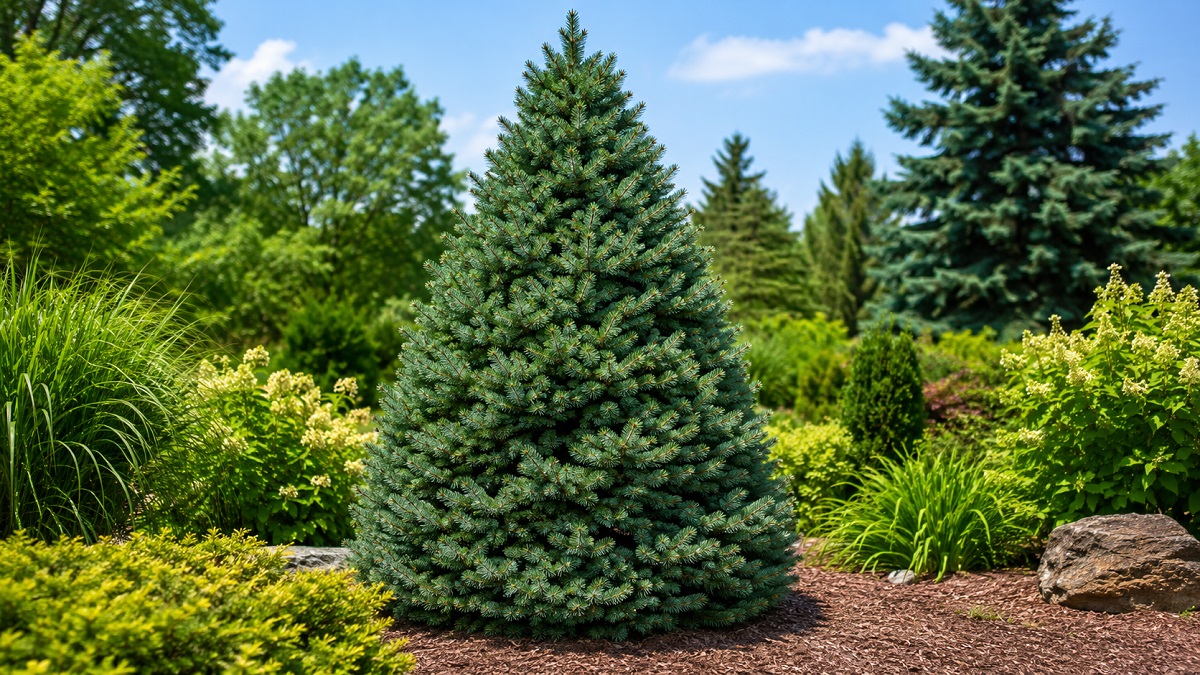
Black Hills Spruce is one of those evergreen trees that earns its place in a landscape without demanding much attention once it is established. Known botanically as Picea glauca var. densata, this regional form of white spruce is valued for its compact growth, dense branching, blue-green to dark green needles, and naturally symmetrical shape. Unlike some large spruce trees that can eventually become overwhelming in a small landscape, Black Hills Spruce generally grows at a more manageable rate and often maintains a neat pyramidal habit with little pruning.
This spruce is especially useful when you want year-round structure. It provides a strong vertical accent in a mixed planting, works well as a specimen tree, and can be planted in groups to create an evergreen screen or windbreak. Its dense foliage also provides shelter for birds and other wildlife. With the right planting site, Black Hills Spruce can tolerate cold winters, dry periods after establishment, and a range of ordinary garden soils.
The key to growing a healthy tree is choosing a sunny location with good drainage, allowing enough room for mature growth, and avoiding repeated overwatering. Young trees need more attention while their root systems are becoming established, but mature specimens are generally much easier to maintain.
Best results come from full sun, well-drained soil, and consistent moisture while young.
Black Hills Spruce is a naturally occurring form of white spruce associated with the Black Hills region of South Dakota and Wyoming. Its scientific name is Picea glauca var. densata. Gardeners often choose it when they want the familiar appearance of a spruce but prefer a tree with dense foliage and a more restrained landscape presence than some of the larger spruce species.
Like other spruces, Black Hills Spruce is an evergreen conifer. It keeps its needles through winter, so its contribution to the landscape does not disappear after deciduous trees lose their leaves. The dense branches can create an attractive backdrop for flowering shrubs and perennials, while the pyramidal silhouette gives gardens a sense of height and permanence.
It is particularly well suited to colder climates. Once established, the tree can handle winter temperatures that would damage many ornamental evergreens. However, hardiness does not mean that the tree can be planted anywhere. Poor drainage, excessive shade, root disturbance, and prolonged drought can still cause problems.
Black Hills Spruce combines several useful landscape qualities. It has evergreen foliage, a naturally attractive form, good cold tolerance, and relatively modest maintenance requirements. The tree can also be useful where a dependable evergreen screen is needed.
Its dense growth provides visual privacy and can help soften fences, buildings, driveways, or other hard landscape features. A single tree can serve as a focal point, while several trees planted with appropriate spacing can create a substantial evergreen planting.
One of the biggest advantages of Black Hills Spruce is that it generally develops its shape naturally. Regular ornamental pruning is not normally necessary. Instead of repeatedly cutting the tree to maintain a formal shape, allow its natural pyramidal habit to become part of the landscape design.
Black Hills Spruce is recognized for its dense, full appearance. The branches tend to form a fairly regular pyramidal structure, particularly when the tree receives adequate sunlight. Needles are short, stiff, and pointed, with coloration that can range from green to blue-green depending on the individual tree and growing conditions.
The bark is generally gray-brown and becomes more noticeable as the tree matures. Small cones develop on mature trees and add seasonal interest, although the foliage and overall form are usually the main reasons this spruce is planted ornamentally.
| Feature | Black Hills Spruce |
|---|---|
| Scientific name | Picea glauca var. densata |
| Plant type | Evergreen conifer |
| Growth habit | Dense, pyramidal |
| Foliage | Green to blue-green needles |
| Light requirement | Full sun preferred |
| Growth rate | Slow to moderate |
| Typical landscape role | Specimen, screen, windbreak, accent |
| Pruning requirement | Low |
The best location receives full sun for most of the day. Plenty of sunlight encourages dense branching and helps the tree maintain its characteristic shape. Black Hills Spruce can tolerate some light shade, especially when young, but growing it in a heavily shaded location can result in thinner foliage and a less symmetrical form.
Before planting, look carefully at nearby buildings, utility lines, driveways, fences, mature trees, and other permanent features. Spruce trees should not be squeezed into a narrow space simply because the young tree fits there. Good planning at planting time prevents difficult pruning or removal problems later.
Avoid locations where water regularly stands after rain. Although the tree needs adequate moisture, its roots also require oxygen. Repeatedly saturated soil can weaken the root system and increase the likelihood of root-related problems.
Full sun is the preferred exposure. A location with several hours of direct sunlight is much better than a site shaded by a building or large deciduous tree for most of the day. Morning and afternoon sunlight both contribute to healthy, balanced growth.
Good air movement around the branches is also helpful. Avoid planting several trees so closely that their mature crowns become permanently crowded. Adequate spacing allows foliage to dry more quickly after rain and gives the tree room to develop its natural form.
Planting a Black Hills Spruce correctly is more important than trying to compensate for poor planting later. Container-grown and balled-and-burlapped trees are commonly planted in spring or fall, when weather is less stressful and soil moisture is easier to manage.
Select a sunny location with good drainage and enough room for the tree's mature size. If you are planting several spruce trees for screening, determine the desired spacing based on the mature dimensions of the particular cultivar or nursery-grown selection rather than the size of the young plants.
Dig a hole that is broad enough to accommodate the root system without bending or tightly packing the roots. The planting hole generally needs to be wider than the root ball but should not be excessively deep.
Place the tree so that the upper portion of the root ball sits at approximately the same level as the surrounding soil, or slightly above it in heavy soils. Do not bury the trunk flare. The point where the trunk begins to widen into the roots should remain visible after planting.
Refill the hole with the excavated soil unless a soil test or site condition indicates a specific amendment is needed. Avoid creating a pocket of highly amended soil that is dramatically different from the surrounding ground, because roots need to move naturally into the native soil.
Water slowly and deeply after planting so the soil settles around the roots. Check the planting area regularly during the first growing season. Newly planted evergreens can lose moisture through their needles even when temperatures are cool.
Apply a layer of organic mulch around the root zone, leaving several inches of clear space around the trunk. Mulch helps moderate soil temperature, reduces evaporation, and limits competition from grass and weeds.
Black Hills Spruce performs best in fertile, well-drained soil that holds enough moisture for steady growth without remaining saturated. It can grow in a variety of soil types, but compacted or poorly drained ground is much more challenging than loose soil with good pore space.
If your garden has heavy clay, improve the planting site by addressing drainage and compaction rather than simply filling the planting hole with rich potting soil. Where drainage is extremely poor, consider a different planting location or a raised planting area.
A soil test can be useful when the tree is struggling or when the existing soil is unusually poor. Avoid applying large quantities of fertilizer or amendments without a reason. Healthy evergreen trees generally benefit more from appropriate site preparation than from repeated feeding.
Watering requirements change as the tree matures. A newly planted Black Hills Spruce needs regular attention because its existing root system is relatively small compared with the amount of foliage above ground. Once established, the tree becomes considerably more resilient.
During the first growing season, check soil moisture regularly rather than relying only on a fixed watering schedule. Water deeply when the soil begins to dry, allowing moisture to penetrate the root zone. Frequent, shallow watering encourages a less desirable root distribution and can leave deeper soil dry.
In hot or unusually dry weather, newly planted trees may need additional irrigation. Trees planted in sandy soil may also dry out faster than those planted in heavier soil. Conversely, trees in poorly drained clay can remain wet for too long.
Established Black Hills Spruce generally needs less supplemental water than a young tree. Natural rainfall may provide most of its needs in an average climate. During prolonged drought, however, deep watering can help reduce stress, particularly when the soil becomes dry well below the surface.
Water the root zone rather than repeatedly wetting the foliage. A slow application allows water to move into the soil instead of running off the surface.
Black Hills Spruce is not usually a heavy-feeding landscape tree. If it is growing well, producing healthy new growth, and maintaining good needle color, routine heavy fertilization is unnecessary.
Before fertilizing a declining tree, look for other causes such as drought, poor drainage, compacted soil, root damage, planting too deeply, pest activity, or unsuitable light. Adding fertilizer cannot correct these underlying problems and excessive nutrients can create additional stress.
A soil test can help determine whether nutrients are actually deficient. If fertilizer is recommended, use a product appropriate for evergreen trees and follow its label directions. Apply nutrients to the surrounding root zone rather than concentrating fertilizer against the trunk.
Maintaining a healthy layer of organic mulch is often more useful than repeated fertilization. As organic mulch slowly decomposes, it contributes to soil structure while helping conserve moisture. Keep mulch away from direct contact with the trunk.
One of the reasons Black Hills Spruce is popular in low-maintenance landscapes is that it naturally develops an attractive pyramidal shape. Most specimens require little or no routine shaping.
Pruning is mainly used to remove dead, damaged, diseased, or badly positioned branches. If a branch has been broken by snow or wind, remove the damaged portion with clean, sharp pruning equipment. Make cuts carefully without leaving large unnecessary stubs.
No. Topping an evergreen destroys its natural form and can leave large wounds. It is far better to select an appropriate planting location and allow the tree to develop naturally.
Dead or damaged branches can generally be removed when necessary. For any significant structural pruning, avoid indiscriminate cutting into old, bare wood because spruce branches may not readily produce new growth from areas without viable buds.
Mulch is one of the simplest ways to improve the growing environment around a Black Hills Spruce. A 2- to 4-inch layer of organic mulch can help conserve moisture, moderate soil temperatures, and reduce competition from lawn grass and weeds.
Keep the mulch several inches away from the trunk. A thick mound of mulch piled directly against the trunk creates a consistently damp environment around the bark and can contribute to decay and other problems.
Extend the mulched area outward as the tree grows. The goal is to protect as much of the root zone as practical rather than creating only a small circle immediately around the trunk.
Black Hills Spruce is generally a durable tree, but no evergreen is completely free from pests or environmental problems. Many issues become more likely when trees are stressed by drought, poor drainage, excessive heat, root damage, or unsuitable planting conditions.
| Problem | Possible Symptoms | First Response |
|---|---|---|
| Spider mites | Faded or stippled needles, fine webbing | Check foliage closely and reduce drought stress |
| Spruce gall insects | Abnormal cone-like or gall growth near shoots | Inspect new growth and identify the pest before treatment |
| Spruce beetles | Declining branches, boring activity, resin or bark symptoms | Investigate tree stress and seek local pest identification |
| Needle diseases | Discolored, spotted, or prematurely falling needles | Improve air circulation and remove severely affected material |
| Root problems | General decline, poor growth, yellowing or branch dieback | Check drainage, watering, planting depth, and root-zone conditions |
| Drought stress | Dry needles, browning, premature needle loss | Provide deep irrigation during prolonged dry periods |
Brown needles do not automatically mean that a disease is responsible. First consider recent weather and growing conditions. Drought, winter injury, root damage, poor drainage, transplant stress, and pest activity can all contribute to discoloration.
Examine the pattern carefully. Browning concentrated on older interior needles may be part of normal seasonal needle turnover, while widespread browning of current-season growth deserves closer investigation.
Spruce can host several insect pests, including aphids, mites, sawfly larvae, and gall-forming insects. Rather than treating every insect seen on the tree, identify the pest and determine whether its population is actually causing meaningful damage.
Regular inspection is often the best first step. Look at new shoots, undersides of branches, needle clusters, and areas where discoloration first appears. Early identification makes management much easier.
Some fungal diseases can cause needle discoloration or premature needle drop. Crowded plantings, poor air movement, prolonged wet foliage, and stressed trees can increase vulnerability. Keep the planting area open enough for air circulation and avoid unnecessary overhead irrigation.
Black Hills Spruce is well adapted to cold climates, which is one of its strongest landscape advantages. However, winter care still matters, especially for newly planted trees.
Before the ground freezes, make sure newly planted trees have adequate soil moisture. Evergreen foliage continues to lose water during winter, and roots cannot easily replace that moisture when the ground is frozen.
Cold, drying winds can increase moisture loss from evergreen foliage. Trees planted in exposed locations may experience winter stress even when the soil initially contained adequate moisture. Proper site selection and fall watering are often more useful than attempting to manipulate the tree's natural shape.
Black Hills Spruce has a naturally strong form, but exceptionally heavy or wet snow can still weigh down branches. Avoid aggressively knocking ice from branches because brittle frozen branches can break easily. If snow accumulation becomes excessive and it can be removed safely, use gentle methods that do not damage the foliage or branch structure.
In spring, inspect the tree for broken branches, winter browning, animal damage, and signs of pests. Remove damaged branches when appropriate and resume regular watering as the growing season begins.
Black Hills Spruce is versatile enough to serve several landscape roles. Its naturally conical form makes it an excellent specimen tree, while its dense evergreen foliage makes it useful for screening and background planting.
A single Black Hills Spruce can become a strong focal point in a lawn, front garden, or large perennial bed. Give it enough open space to display its natural form rather than placing shrubs directly against the trunk.
Several trees can be used to create an evergreen screen. Plan the spacing carefully. Planting trees too close together may produce a dense screen initially, but overcrowding can eventually reduce air circulation and force difficult maintenance.
The dense branching structure can also contribute to wind protection when trees are planted as part of a properly designed windbreak. For effective wind reduction, consider the overall arrangement rather than relying on a single row of trees.
Because Black Hills Spruce provides year-round green structure, it pairs well with plants that offer contrasting foliage, flowers, or seasonal color. Hardy shrubs, ornamental grasses, ground covers, and flowering perennials can all work around the outer edge of the root zone.
When choosing companions, remember that plants directly beneath a dense evergreen may receive less light and moisture than plants elsewhere in the garden. Select shade-tolerant companions for areas close to the tree and keep aggressive lawn growth away from the trunk.
Black Hills Spruce is most commonly purchased as a nursery-grown tree rather than propagated by the home gardener. Spruce can be propagated from seed, but seed-grown plants may not always reproduce every characteristic of a selected cultivated form.
Seed propagation also requires patience because conifers generally take considerably longer to develop into landscape-sized trees than many common garden plants. For homeowners who want a dependable specimen with known characteristics, purchasing a healthy nursery tree is usually the most practical approach.
Look for a tree with evenly distributed branches, healthy foliage, an intact root system, and no obvious signs of insect infestation or disease. Avoid trees with severe trunk damage, extensive dead branches, or roots that have been allowed to dry out.
If buying a container-grown tree, inspect the root system when possible. Severely circling roots may require careful correction during planting. Never ignore a root problem simply because the foliage looks attractive above ground.
Black Hills Spruce generally has a slow to moderate growth rate. Growth varies with climate, soil, moisture, sunlight, age, and overall tree health. Young trees may appear to establish slowly, but consistent care during the early years helps them develop a strong root system and healthy framework.
Full sun is preferred. The tree can tolerate some light shade, but insufficient sunlight may lead to thinner growth and a less dense appearance. For the best pyramidal form and foliage density, choose an open location with plenty of direct sunlight.
Newly planted trees need regular watering while their roots become established. Water deeply when the soil begins to dry rather than applying small amounts every day. Established trees generally require supplemental irrigation mainly during extended periods of drought.
Usually very little. Black Hills Spruce naturally develops a pyramidal shape, so routine shaping is generally unnecessary. Prune mainly to remove dead, damaged, diseased, or structurally problematic branches.
It can grow in clay if the soil drains adequately. The major concern is not clay itself but prolonged saturation and severe compaction. If water remains around the roots after rain, improve drainage or select a more suitable planting location.
Browning can result from drought, transplant stress, winter injury, poor drainage, root damage, insects, or needle diseases. Examine where the browning occurs, inspect the needles and branches closely, and review recent watering and weather conditions before choosing a treatment.
Yes. Its dense evergreen foliage and naturally pyramidal habit make it useful for evergreen screening. However, trees should be spaced according to their mature size rather than planted extremely close together for an immediate screen.
Yes. Black Hills Spruce is notably cold hardy and is suited to regions with severe winter conditions. Newly planted trees still benefit from adequate moisture before the ground freezes, especially when exposed to drying winter winds.
Growing Black Hills Spruce successfully is mostly about getting the fundamentals right. Choose a sunny site, provide well-drained soil, plant the tree at the correct depth, and give it consistent moisture during establishment. Once the root system is established, the tree is capable of handling considerably more environmental stress with relatively little routine maintenance.
Resist the temptation to over-prune or over-fertilize. Its naturally pyramidal form is one of its greatest landscape features, and excessive pruning can permanently spoil that shape. Likewise, fertilizer should be based on an identified nutritional need rather than used as a general solution for poor growth.
Pay particular attention to the root zone. Good drainage, adequate moisture during drought, a protective layer of mulch, and freedom from lawn competition all contribute to long-term health. Inspect the tree periodically for unusual needle discoloration, pest activity, broken branches, and other changes.
With thoughtful placement and basic care, Black Hills Spruce can become a dependable evergreen centerpiece for many years. Its cold tolerance, dense foliage, natural shape, and year-round presence make it an excellent choice for homeowners looking for a durable conifer that does not require constant pruning or complicated maintenance.
Continue exploring our gardening guides with more plant profiles, growing tips, and practical advice for creating a healthy, productive garden.