Growing & Caring for Bird of Paradise (Strelitzia)
Learn how to grow and care for Bird of Paradise (Strelitzia). Discover light, watering, soil, humidity, fertilizing, blooming, pruning, propagation, and pest control tips.
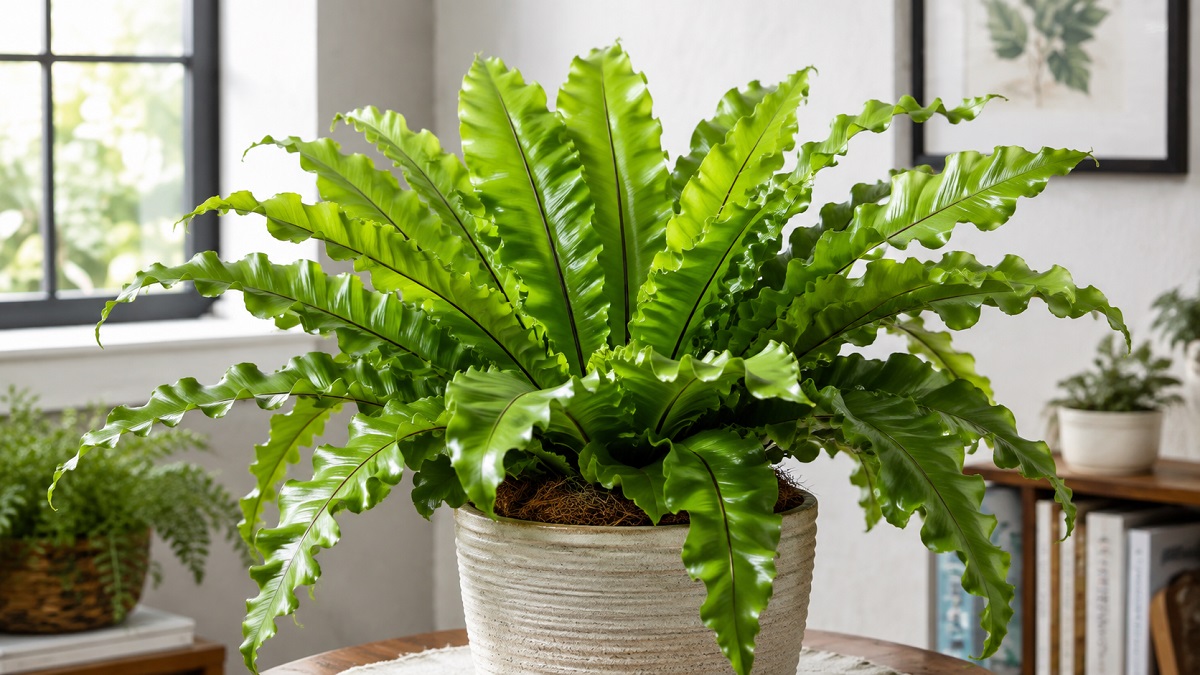
Bird’s Nest Fern (Asplenium nidus) is one of those plants that can completely change the feel of a room without demanding the kind of attention that many flowering houseplants need. Its broad, undivided fronds emerge from a central rosette and gradually form the characteristic “nest” shape that gives the plant its common name. Unlike many ferns, it does not have the delicate, feathery appearance associated with traditional fern varieties. Instead, the leaves are long, glossy, gently wavy, and architectural.
This tropical fern is especially useful for gardeners who want a lush green plant for a shaded garden, bathroom, covered patio, greenhouse, or bright indoor space. The main challenge is not keeping it constantly wet, as is sometimes assumed with ferns. The real key is finding the right balance between moisture, humidity, drainage, light, and airflow.
With the right conditions, Bird’s Nest Fern can remain attractive for years. New fronds develop from the center of the plant, while older leaves gradually age and can be removed when necessary. This guide explains how to grow and care for Asplenium nidus, including lighting, watering, humidity, soil, feeding, repotting, propagation, pruning, common problems, pests, and practical tips for keeping the foliage healthy.
Tip: Consistent moisture, bright indirect light, and good humidity are the foundation of healthy Bird’s Nest Fern growth.
Bird’s Nest Fern is a tropical fern recognized by its central rosette of broad, strap-like leaves. The fronds emerge tightly from the center and slowly unfurl as they grow. In a healthy plant, the newest leaf appears from the center and is usually lighter in color before gradually becoming darker and more substantial.
The plant gets its common name from the way the central crown resembles a bird’s nest. Unlike many familiar fern species, its fronds are generally not divided into numerous small leaflets. This gives the plant a much bolder appearance and makes it particularly attractive in modern interiors and tropical-style gardens.
In its natural environment, Bird’s Nest Fern grows in warm, humid conditions and is commonly associated with sheltered locations. This helps explain why it tends to perform better indoors when protected from harsh direct sunlight, dry air, cold drafts, and sudden changes in temperature.
Although it has a reputation for being a humidity-loving plant, it does not need a constantly saturated root system. In fact, poor drainage combined with frequent overwatering can cause more trouble than slightly dry conditions. The goal is evenly moist growing media with enough air around the roots to prevent them from remaining waterlogged.
Light is one of the most important factors when growing Bird’s Nest Fern. The plant generally prefers bright, indirect light rather than intense direct sunlight. A position near a bright window where the plant receives filtered light can work very well.
Too much strong direct sun can scorch the broad fronds. Brown or bleached-looking patches may appear when leaves are exposed to harsh sunlight for extended periods. This is particularly common when a plant is moved suddenly from a relatively shaded location to a sunny window.
On the other hand, extremely low light can result in slower growth and less vigorous foliage. If the plant is sitting in a dark corner and producing very little new growth, moving it closer to a source of filtered natural light may help.
A bright room with filtered daylight is usually a good starting point. An east-facing window can provide gentle morning light, while plants near stronger afternoon light may benefit from a sheer curtain or additional distance from the glass.
Avoid placing the fern directly beside heaters, air-conditioning outlets, or other sources of hot or cold moving air. Even if the light is appropriate, constant drafts can make maintaining healthy foliage more difficult.
Bird’s Nest Fern prefers consistent moisture, but that does not mean the pot should remain saturated. Watering should be adjusted according to temperature, humidity, pot size, soil composition, light levels, and the time of year.
Before watering, check the growing medium rather than following a rigid calendar. If the upper portion of the soil has started to dry while the deeper mix still retains some moisture, it may be time to water. During periods of active growth and warmer weather, the plant may need water more frequently than it does during cooler, darker periods.
Water the soil thoroughly so that moisture reaches the root zone. Allow excess water to drain freely from the bottom of the container. Do not leave the pot sitting in a saucer filled with standing water for long periods.
One useful habit is to check the plant before watering instead of automatically watering every few days. A small pot in a warm room may dry much faster than a large container in a humid bathroom, even if both plants are the same size.
It is generally better to direct water onto the growing medium rather than repeatedly pouring large amounts directly into the central crown. Water trapped around the crown can remain there and contribute to rot or other problems, particularly when airflow is poor.
If water accidentally collects in the center, gently allow it to drain away rather than leaving the crown constantly wet.
Humidity is important because Bird’s Nest Fern naturally grows in environments where the air is often more humid than the average heated or air-conditioned room. Low humidity can contribute to dry leaf edges, crispy patches, and generally less attractive foliage.
Bathrooms with good natural light can sometimes provide excellent conditions because they tend to have higher humidity. A humidifier can also be useful when the indoor air is consistently dry.
Grouping several tropical plants together can slightly increase the humidity around their foliage, although this should not replace good ventilation. Air circulation remains important because stagnant, constantly damp conditions can encourage fungal and bacterial problems.
Warm indoor conditions are generally preferable. Protect the plant from frost, freezing temperatures, cold drafts, and sudden temperature changes. During winter, avoid placing the fern directly against a cold window if temperatures near the glass become significantly lower than the rest of the room.
The ideal growing medium should hold enough moisture for the fern while still draining well. A dense, compact soil that stays wet for long periods can restrict oxygen around the roots and increase the risk of root problems.
A quality indoor potting mix can be improved with materials that increase drainage and aeration. The exact recipe does not need to be complicated. The important characteristics are moisture retention, drainage, and an open structure that does not quickly collapse into a dense mass.
| Soil Characteristic | Why It Matters |
|---|---|
| Good moisture retention | Helps prevent the plant from drying out too quickly. |
| Excellent drainage | Reduces the risk of water remaining around the roots. |
| Loose structure | Allows air to reach the root system. |
| Organic matter | Provides a suitable base for healthy root growth. |
Avoid using heavy garden soil by itself in an indoor container. It can become compacted and drain poorly. A purpose-made potting mix is usually easier to manage.
Bird’s Nest Fern does not need an aggressive feeding program. Too much fertilizer can cause fertilizer salts to accumulate in the growing medium and may damage the roots or leaf margins.
During active growth, a balanced fertilizer diluted according to the product instructions can be used periodically. It is better to avoid applying concentrated fertilizer to dry soil. Watering the plant appropriately before feeding can help reduce the risk of root damage.
Feeding can usually be reduced when growth slows. If the plant is producing healthy new fronds and maintaining good color, there is no need to continually increase fertilizer simply because more growth is desired.
Brown leaf margins, crusty mineral deposits on the soil surface, or declining plant health despite adequate moisture can sometimes indicate excessive fertilizer salts. Flushing the growing medium thoroughly with clean water and allowing it to drain can help remove accumulated soluble salts.
Bird’s Nest Fern usually does not need to be repotted every year simply because a new season has arrived. Repotting is more useful when the existing container has become too small, the growing medium has broken down, or drainage has deteriorated.
When choosing a new container, avoid moving the plant into an excessively large pot. A much larger volume of soil can retain moisture for longer than the root system can use, making overwatering easier.
One important point is not to bury the central crown deeply under soil. The growing point should remain exposed so new fronds can emerge naturally.
Bird’s Nest Fern is a fern rather than a flowering plant, so its natural reproductive process is different from plants that produce seeds inside fruits. Mature fern fronds can produce spores, which are involved in the plant's natural reproduction.
For the average home gardener, propagation is considerably more specialized than simply taking a stem cutting. The plant's central rosette also should not be divided casually because cutting through the crown can seriously damage or kill the original plant.
Mature fronds may develop rows of spore-producing structures on the underside. Propagation from spores involves collecting mature spores and providing suitable conditions for them to germinate and develop through the fern life cycle.
This method can be fascinating for gardeners who enjoy experimenting with fern propagation, but it requires considerably more patience and careful moisture management than ordinary houseplant propagation.
If your goal is simply to maintain one attractive Bird’s Nest Fern at home, buying a healthy established plant is usually much easier than attempting propagation from spores.
Bird’s Nest Fern generally requires very little pruning. Its natural rosette shape is part of its appeal, so extensive cutting is unnecessary.
Remove completely dead, badly damaged, or diseased fronds using clean scissors or pruning shears. Cut unwanted fronds close to their base without damaging neighboring healthy leaves.
Avoid cutting the central emerging fronds simply to make the plant look smaller. New growth develops from the center, and damaging the crown can interfere with future growth.
If only the tips or edges of a leaf have turned brown, the damaged portion can be trimmed for appearance. However, trimming the visible damage does not solve the underlying problem. Check watering, humidity, light exposure, fertilizer use, and air conditions to determine why the foliage was damaged in the first place.
Most problems with Bird’s Nest Fern can be traced back to environmental conditions. The plant is often described as difficult when the real issue is that its growing conditions have changed too quickly or are inconsistent.
| Problem | Possible Cause | What to Check |
|---|---|---|
| Brown leaf edges | Dry air, inconsistent moisture, or environmental stress | Humidity, watering, drafts, and light |
| Yellowing leaves | Overwatering, poor drainage, or aging foliage | Soil moisture and drainage |
| Bleached or scorched areas | Too much direct sunlight | Move into filtered light |
| Slow growth | Low light, cool conditions, or limited nutrition | Light, temperature, and feeding |
| Soft or rotting crown | Excess moisture around the center | Watering habits and airflow |
| Crispy foliage | Low humidity or prolonged dryness | Humidity and soil moisture |
Brown foliage is one of the most common complaints. A small amount of browning does not automatically mean the plant is dying. Older leaves naturally decline, and individual damaged areas may remain even after growing conditions improve.
Look at the pattern. Crispy brown edges may point toward dry conditions, while large pale or scorched patches can be associated with strong direct sunlight. If leaves are turning yellow and the potting mix stays wet for a long time, excessive moisture deserves attention.
New frond production can slow when light is insufficient, temperatures are unfavorable, the plant has been stressed by watering problems, or the growing season is less active. Give the plant stable conditions rather than trying to force growth with large amounts of fertilizer.
Most importantly, inspect the center of the plant. Healthy new fronds should emerge from the crown. If the crown has been damaged, growth may be significantly affected.
Bird’s Nest Fern can occasionally experience common houseplant pests, particularly when plants are stressed or grown in warm indoor conditions. Inspect the leaves regularly, especially when bringing a new plant into your home.
Look closely along the foliage and around the crown for unusual spots, insects, webbing, sticky residue, or other signs of infestation. Early detection is much easier to manage than a large established pest population.
Good general care is one of the best forms of prevention. A plant growing under stable conditions is generally easier to maintain than one repeatedly exposed to drought, excessive watering, poor light, and temperature stress.
In warm climates, Bird’s Nest Fern can be grown outdoors in a sheltered location. It is especially well suited to shaded tropical and subtropical gardens where it can receive bright filtered light without being exposed to harsh midday sun.
Covered patios, shaded courtyards, protected garden beds, and areas beneath suitable overhead cover can provide better conditions than exposed locations.
Outdoor plants should still have excellent drainage. Heavy rain can keep the root zone wet for extended periods if the plant is placed in poorly draining soil or a container without adequate drainage holes.
Bird’s Nest Fern is not a cold-hardy plant. If temperatures are expected to fall significantly, container-grown plants should be moved to a protected area. Cold damage can appear as discolored, collapsed, or damaged foliage.
When moving a plant between indoors and outdoors, make the transition gradually when possible. A sudden change from indoor filtered light to outdoor exposure can cause leaf damage.
You do not need a complicated schedule to grow a healthy Bird’s Nest Fern. A simple routine of observation works better than watering and feeding automatically on fixed dates.
This kind of routine takes only a few minutes but can reveal problems before they become serious. A change in leaf color, soil moisture, or new growth is often more useful information than a calendar-based care schedule.
Indoor conditions can change considerably throughout the year, even when the plant remains in the same room. Seasonal adjustments can therefore make a noticeable difference.
| Season | Care Focus |
|---|---|
| Spring | Watch for renewed growth and adjust watering as the plant becomes more active. |
| Summer | Monitor moisture, humidity, and exposure to strong sunlight. |
| Autumn | Gradually monitor changing light levels and reduce watering if the soil dries more slowly. |
| Winter | Protect from cold drafts, dry indoor air, and excessive watering. |
The most important seasonal adjustment is to observe how quickly the soil dries. A plant that needs frequent watering during a warm, bright period may need substantially less water during a cooler period with lower light.
The ideal location combines good indirect light with comfortable temperatures and reasonable humidity. A bright bathroom can be excellent if it has enough daylight. A living room near a filtered window can also work well.
Avoid placing the fern in a dark corner simply because it is known as a shade-tolerant plant. Shade tolerance does not mean that the plant requires no light. It still needs enough usable light to support healthy growth.
Shelves, plant stands, side tables, and protected patio areas can all work as long as the plant receives appropriate light and is not exposed to damaging drafts or direct afternoon sunlight.
Long-term success comes down to consistency. Avoid repeatedly moving the plant from one extreme environment to another. If it is growing well in a particular location, there is usually no reason to keep experimenting with new positions.
Pay attention to the plant's newest growth. Fresh fronds are often a better indicator of current growing conditions than older leaves, which may show scars or damage from previous environmental stress.
Healthy Bird’s Nest Ferns can become impressive focal plants when given enough time. Rather than trying to make the plant grow as quickly as possible, focus on maintaining healthy roots and consistently good foliage. Steady growth is generally more sustainable than pushing the plant with excessive water or fertilizer.
Bird’s Nest Fern is a beautiful choice for anyone who wants a lush tropical plant with bold, distinctive foliage. Its care is relatively straightforward once you understand what the plant actually needs: bright filtered light, consistent but not excessive moisture, good drainage, warm temperatures, and adequate humidity.
The biggest mistake is often treating the fern as if it needs to remain constantly wet. Instead, think about balance. The soil should provide moisture while still allowing air around the roots. The leaves appreciate humidity, but the plant still benefits from reasonable air circulation. And although it tolerates shade, it still needs enough light to grow.
With a suitable location and a simple routine of checking soil moisture, inspecting the foliage, and responding to changes in the plant, Asplenium nidus can remain an attractive green focal point for a long time. Give it stable conditions rather than constantly changing its environment, and the plant will reward you with the graceful new fronds that make Bird’s Nest Fern such a popular tropical houseplant.
Continue exploring our gardening guides with more plant profiles, growing tips, and practical advice for creating a healthy, productive garden.