Primocanes & Floricanes Explained: Raspberry and Blackberry Cane Guide
Learn the difference between primocanes and floricanes, how raspberry and blackberry canes grow, fruit, and how to prune them for healthy, productive plants.
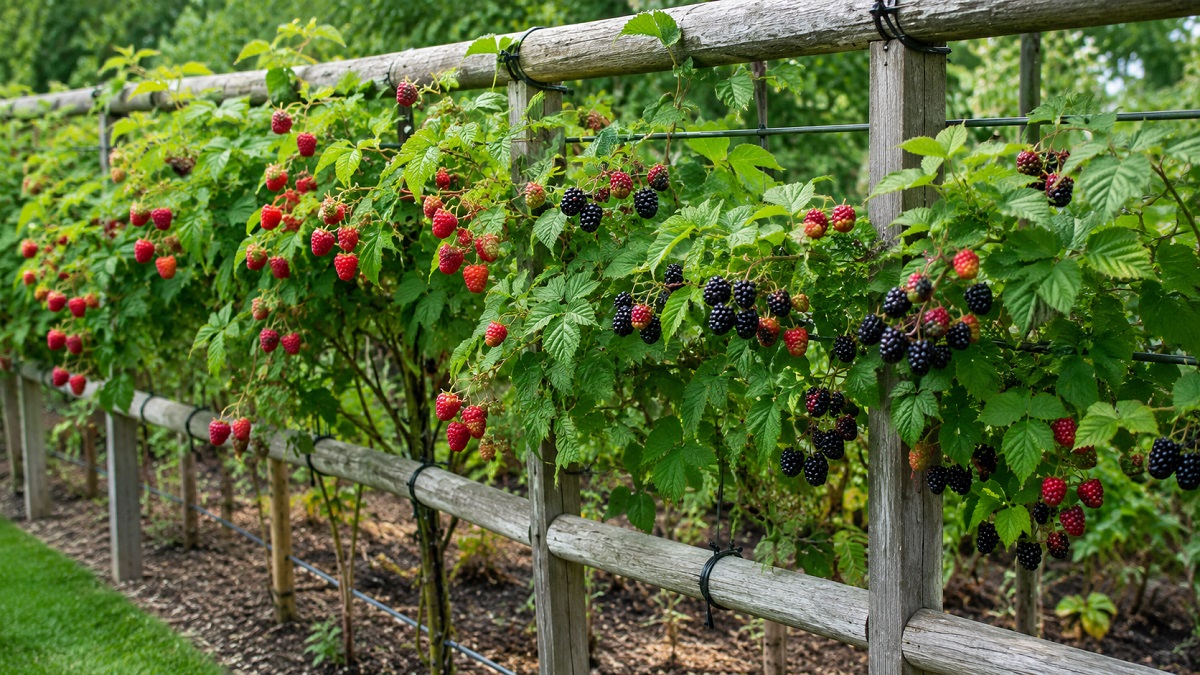
Cane berries such as raspberries, blackberries, and many hybrid brambles are among the most rewarding fruits to grow at home. Once established, a healthy planting can produce generous crops for years, but the long, flexible canes can quickly become difficult to manage without support. Trellising gives these vigorous plants structure, keeps fruiting canes organized, improves access for pruning and harvesting, and can make a berry patch much easier to maintain.
The right support system does more than prevent canes from falling over. A well-designed trellis helps separate young and fruiting canes, keeps foliage and fruit off the ground, improves air movement through the planting, and allows sunlight to reach more of the canopy. It can also make harvesting considerably more comfortable because ripe berries are easier to see and reach.
There is no single trellis design that works perfectly for every cane berry. Erect blackberries, trailing blackberries, summer-bearing raspberries, everbearing raspberries, and thornless varieties can have different growth habits and support requirements. The best system depends on the variety, the number of plants, available space, local climate, and how much pruning you plan to do each year.
Strong supports and regular training are the foundation of an easy-to-manage berry planting.
Cane berries naturally produce long shoots that may arch, bend, or spread as they grow. Some varieties remain relatively upright, while others produce canes that can extend several feet and eventually become heavy with foliage and fruit. Without support, these canes may lean into walkways, sprawl across neighboring plants, or rest on the soil.
Contact with the ground is particularly undesirable when fruiting branches become crowded and difficult to inspect. It can also make mowing, weeding, watering, pruning, and harvesting more difficult. A trellis lifts the productive part of the plant into a manageable position and creates a clearer boundary between the berry row and the surrounding garden.
Trailing blackberries and vigorous raspberry varieties usually benefit greatly from a dedicated support system. Heavy crops can also make otherwise manageable canes bend toward the ground. Thornless varieties are not necessarily self-supporting; the absence of thorns does not change the plant's need for structure.
Before choosing a trellis, learn how the berry variety grows. This is one of the most important steps because a support system designed for an upright raspberry planting may not be ideal for a vigorous trailing blackberry.
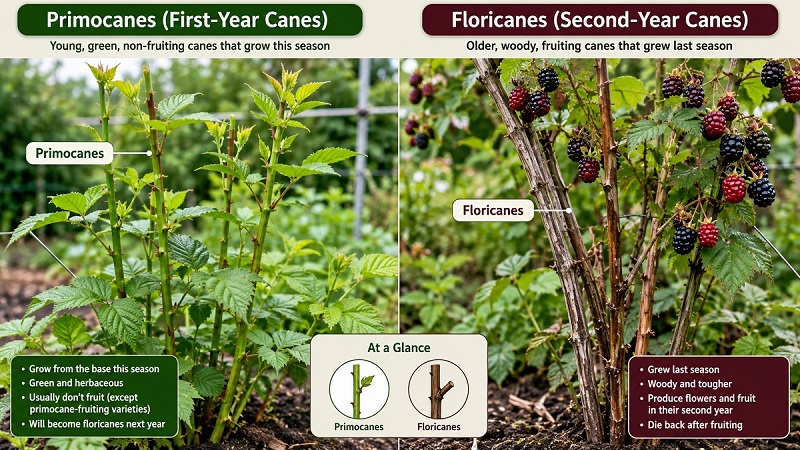
Many raspberries and blackberries produce two recognizable types of cane growth. New canes are commonly called primocanes. They develop during the current growing season. Older canes that flower and fruit are called floricanes in varieties that follow a two-year fruiting cycle.
The exact pruning behavior depends on the variety. Summer-bearing raspberries generally produce a crop on second-year canes, while many everbearing or primocane-fruiting types can produce fruit on current-season growth. Blackberries also differ considerably in their fruiting habits and growth forms.
Understanding this cycle matters because a good trellis should make it possible to manage different generations of canes without creating a tangled mass. When new and old canes are allowed to grow together randomly, pruning becomes harder and harvesting can become frustrating.
Upright blackberries tend to have relatively self-supporting canes, but they can still benefit from a central wire or other structure, particularly when plants are carrying a heavy crop. Semi-erect types often spread outward more than upright varieties and benefit from wider support.
Trailing blackberries generally require stronger and more deliberate trellising. Their long, flexible canes are commonly trained along wires rather than being allowed to stand unsupported. Raspberries can also produce long canes that benefit from a simple two-wire or multi-wire system.
A trellis does not have to be complicated. For a small home garden, two sturdy posts and a couple of strong horizontal wires may be enough. Larger plantings may benefit from specialized systems that spread fruiting canes across a wider area or allow the grower to separate different groups of canes.
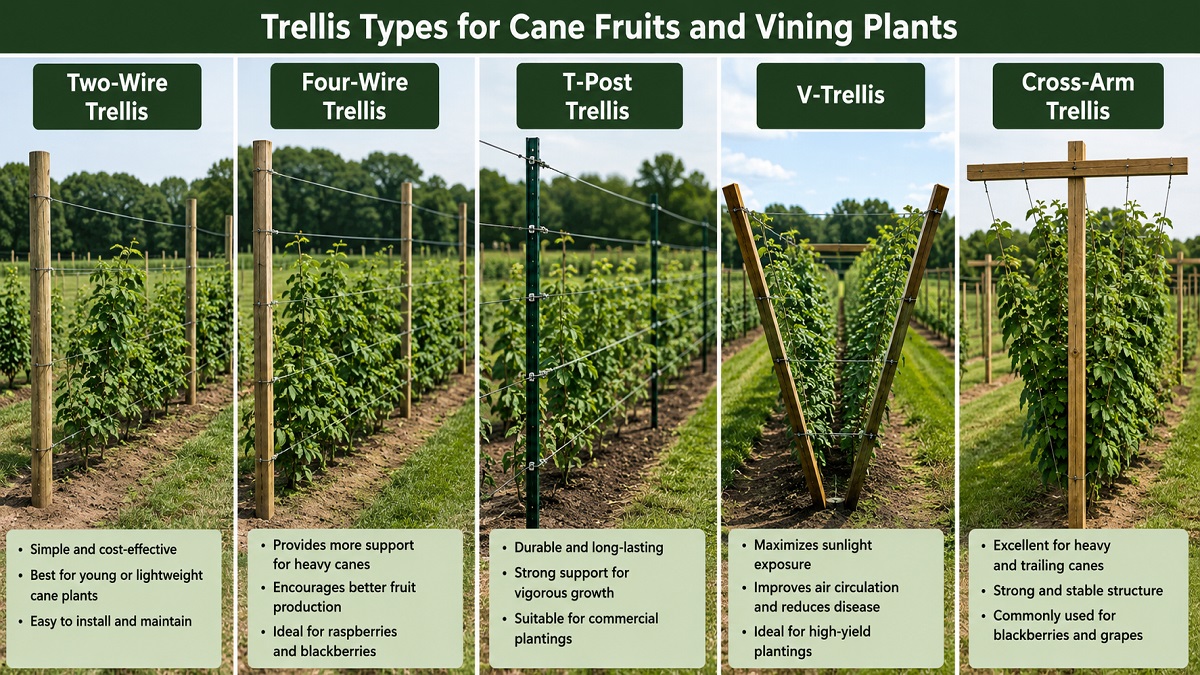
| Trellis Type | Best Use | Main Advantage | Consideration |
|---|---|---|---|
| Two-Wire Trellis | Raspberries and simple blackberry rows | Simple and inexpensive | May need more training as plants mature |
| Four-Wire Trellis | Vigorous cane berries | Provides more vertical support | Requires additional materials and tying |
| T-Post Trellis | Rows with spreading canes | Creates support on both sides | Needs sturdy end posts |
| V-Trellis | Dense plantings and cane separation | Opens the canopy | Requires careful construction and spacing |
| Cross-Arm Trellis | Raspberries and blackberries | Offers multiple training positions | Takes more room than a narrow row |
A two-wire trellis is one of the easiest systems for a home berry garden. Posts are placed at the ends of the row, and strong wire is stretched horizontally between them. The wires can be positioned at different heights so the canes have support at more than one level.
This arrangement works particularly well when the planting is relatively small and the canes are not excessively vigorous. It is also easy to repair and expand if the berry row grows over time.
A T-shaped support uses a horizontal crossbar near the top of each post. Wires run from one end of the row to the other, creating a wider support area than a single vertical post. This can help spread the canes outward and prevent the entire canopy from collapsing toward the center of the row.
A V-shaped system positions support wires so the canes occupy two slightly separated planes. This can improve access to the fruiting area and help distinguish one side of the plant from the other. It can be particularly useful where the grower wants a more open canopy.
A V-trellis does require enough space for the outward angle of the supports. It should not be installed so close to paths that mature canes become an obstacle.
Cross-arm trellises use horizontal arms attached to upright posts. Several wires can be placed at different positions along the arms. This gives the grower more flexibility when training long canes and can be useful for larger plantings.
The strongest berry trellis is not necessarily the most expensive one. What matters is that the structure can handle the weight of mature canes, foliage, fruit, and occasional wind without leaning or pulling out of the ground.
Trellis posts should be sturdy enough to resist the tension created when wire is pulled tight. Wood posts, metal posts, and other durable garden support materials can all be used. End posts deserve particular attention because they receive more pulling force than intermediate supports.
Avoid using a thin stake as the only support for a long row. A single lightweight stake may hold a young plant temporarily, but it is unlikely to provide enough stability once the canes become mature and heavily loaded.
Galvanized wire is commonly used for permanent garden trellises because it handles outdoor conditions well. The wire should be strong enough to support the intended load without excessive sagging. Very thin wire may be uncomfortable to handle and can also become difficult to keep properly tensioned.
Ties should hold canes securely without cutting into growing tissue. Flexible garden ties, soft twine, reusable plant clips, or similar materials can be useful. Avoid tightly wrapping rigid material around expanding canes.
The purpose of a tie is to guide the cane, not strangle it. Leave enough room for natural movement and continued growth.
Ideally, install the trellis before the planting becomes difficult to manage. New plants are easier to work around, and establishing the support structure early prevents the need to wrestle mature canes into position later.
Select a location with suitable sunlight, soil drainage, and room for the mature planting. Leave enough space beside the row for harvesting, pruning, weed control, and routine maintenance.
Consider where the canes will extend once they are fully trained. A trellis that looks compact when newly installed can become surprisingly wide after several seasons of growth.
Mark the positions of the main end posts. Long rows may need additional intermediate supports so the wires do not sag excessively.
Install the posts deeply and securely enough to resist the tension of the wires. End posts should be especially stable. In windy locations or long rows, additional bracing can improve durability.
Install the lower and upper wires at appropriate heights for the berry variety and the planned training method. The exact height does not have to be identical in every garden. The goal is to support the canes while keeping fruit accessible.
Pull the wire tight enough to provide useful support, but do not rely on excessive tension to compensate for weak posts. If a wire immediately pulls the posts inward, the structural problem should be corrected rather than simply tightening the wire further.
If the row is long, add intermediate posts to reduce wire sag. This creates a more consistent support line and keeps canes from forming large unsupported sections between the ends.
Trellising works best when it becomes part of the normal care routine. Instead of waiting until all the canes have become tangled, guide new growth periodically during the growing season.
Young canes are usually easier to position than old, rigid growth. Handle them gently and avoid sharply bending canes beyond their natural flexibility.
One useful strategy is to keep fruiting canes on one side of the trellis and younger replacement canes on another whenever the variety and support design allow it. This can make winter or post-harvest pruning much easier because old fruiting canes can be removed without sorting through every new shoot.
Another approach is to fan canes across several wires. This works well when the plant naturally produces long, flexible shoots. The objective is not to make every cane perfectly straight. A slight curve or fan shape is perfectly acceptable as long as the plant remains organized and supported.
Tie canes at several points rather than using one very tight tie. Several loose attachment points distribute the weight and reduce the chance that a cane will shift dramatically in wind.
Check ties periodically. A tie that was loose in spring can become restrictive later in the season as the cane thickens.
Raspberries are often easier to manage with a relatively simple trellis because their canes tend to grow in a more upright fashion than many trailing blackberries. Even so, heavily loaded canes may bend outward, particularly when exposed to wind or when the planting becomes dense.
Summer-bearing raspberries commonly fruit on older canes. A trellis can help separate these fruiting canes from younger replacement growth. The exact pruning and training method should follow the characteristics of the cultivar.
A two-wire arrangement is often sufficient for a small home planting. Canes can be distributed between the wires rather than allowing them to form a dense cluster in the center.
Primocane-fruiting raspberries can have different pruning strategies from summer-bearing types. Some gardeners remove canes according to a single-crop system, while others manage the planting for more than one period of fruiting.
Because management varies, identify the fruiting habit before deciding how aggressively to prune. The trellis should support the chosen management system rather than making it harder.
Blackberries vary widely in growth habit. Upright types may require relatively modest support, while trailing types can produce long canes that need deliberate training. Semi-erect varieties fall between these extremes.
Upright blackberries can sometimes stand without a large trellis when young, but support is useful once plants become mature and crops become heavier. A central wire or simple framework can keep branches from leaning into walkways.
Semi-erect varieties generally benefit from wider support. A T-trellis or cross-arm design can provide room for canes to spread without becoming a tangled mass.
Trailing blackberries are among the strongest candidates for trellising. Their long canes are usually trained along wires rather than expected to support themselves.
When training trailing canes, avoid forcing them into tight corners or sharp bends. A broad arch or gentle fan is usually easier on the plant and simpler to maintain. Keep enough space between major groups of canes to allow harvesting and pruning.
Trellising and pruning should be considered two parts of the same management system. A strong trellis cannot compensate for a badly overcrowded berry patch.
Remove dead, damaged, diseased, or unwanted canes according to the pruning requirements of the specific variety. After pruning, distribute the remaining canes across the available support instead of leaving them concentrated in one bundle.
The goal is a manageable canopy rather than the maximum possible number of canes. Too many canes may create a dense interior where leaves and fruit receive less light and airflow.
Once fruiting canes have completed their productive cycle, remove them according to the pruning requirements of the variety. This creates room for replacement canes and prevents the trellis from becoming overcrowded.
Spring is a good time to inspect the complete structure. Look for leaning posts, loose wire, damaged ties, broken crossarms, and other problems that developed during winter.
Complete major repairs before vigorous new growth becomes difficult to work around. As new canes emerge, guide them toward the intended part of the support system.
During the growing season, check the planting regularly. Long shoots can quickly escape the trellis, especially after periods of warm weather and strong growth.
Redirect wayward canes while they are still flexible. Harvesting also provides a good opportunity to notice branches that are overloaded, poorly supported, or interfering with neighboring growth.
After fruiting, follow the appropriate pruning routine for the cultivar. Remove spent canes where required and organize the remaining growth before winter.
In areas where plants become dormant, the leafless period can make trellis inspection particularly easy. The structure is visible without dense foliage hiding damaged posts or loose wires.
Winter is also a useful time to plan improvements. If the current trellis was too low, too narrow, or too weak during the previous season, make changes before vigorous spring growth begins.
One of the most common problems is building a strong-looking wire system around posts that cannot withstand tension. When the end posts lean, the entire trellis becomes less effective.
Waiting until mature canes are already tangled makes installation and training much harder. Installing support early gives the plants a clear framework to grow into.
A trellis is not an excuse to keep every cane that emerges. Excess growth can create a crowded canopy even when the structure itself is strong. Prune according to the plant's growth and fruiting habit.
Tight ties can damage expanding canes. Use flexible ties and inspect them during the season. The plant should remain supported without being constricted.
A narrow support may look tidy when first installed but can become difficult to manage once vigorous canes are trained across it. Consider the mature size of the plant when deciding how far apart support wires should be.
A berry row can act like a large leafy sail once foliage develops. In exposed locations, weak posts and poorly anchored supports can lean or fail. Stronger construction and appropriate bracing may be necessary.
Good spacing makes a trellis much more useful. The exact planting distance depends on the berry species, cultivar, root system, soil, climate, and management style, so follow the recommendations for the specific variety whenever available.
Leave enough room between rows to walk comfortably with a basket, pruning tools, or other garden equipment. If two rows are too close together, the canopies may eventually meet and create a difficult-to-maintain corridor.
Also consider the direction of the row. Sun exposure, prevailing winds, available space, and nearby structures can all influence the final layout. A practical trellis is one that allows you to reach the plants from the side where most routine work will occur.
One of the biggest advantages of a well-designed trellis becomes obvious when the berries begin to ripen. Instead of searching through a tangled mass of canes, the gardener can move along a clearly defined row and inspect fruiting branches more easily.
Keep the fruiting zone at a comfortable working height. If the canopy is too high, harvesting becomes awkward. If it is too low, fruiting branches may droop toward the soil.
A well-spaced canopy can also make it easier to identify ripe fruit without repeatedly moving leaves and branches out of the way. This matters because cane berries often ripen over an extended period rather than all at once.
Check the distance between supporting posts first. Long spans naturally sag more than short spans. Add an intermediate post if necessary. Also inspect the attachment points and make sure the wire has not loosened.
The posts may not be anchored deeply or securely enough for the amount of tension being applied. Reinforce or replace the posts rather than continually tightening the wire.
The problem may be insufficient support, excessive cane density, or inadequate training. Add suitable ties, redistribute the canes, and evaluate whether the trellis is wide or tall enough for the variety.
Avoid forcing stiff canes into sharp bends. Train flexible growth gradually and use a broader curve when necessary. Older canes may be less suitable for major repositioning than younger growth.
Review the pruning system rather than simply adding more wire. A larger trellis will not solve excessive cane production. Remove unwanted growth according to the cultivar's recommended pruning method and maintain enough space between productive canes.
For a small backyard raspberry patch, a basic two-wire system is often enough. It is inexpensive, straightforward, and easy to maintain. If the plants are especially vigorous or the row is long, a stronger multi-wire or T-shaped structure may be more practical.
For trailing blackberries, a wider system such as a T-trellis, cross-arm structure, or another design that accommodates long flexible canes can make a significant difference. The best design is the one that allows you to support the plant without creating a dense, inaccessible canopy.
Before building anything, observe the mature plant if possible. Look at the length and flexibility of the canes, where fruit develops, and how much the plant spreads. Designing around these characteristics usually produces a better result than choosing a trellis simply because it looks attractive in a garden catalog.
A trellis is a long-term investment in the management of a cane berry planting. Once properly installed, it can reduce the amount of effort required for pruning, harvesting, and general maintenance year after year.
The greatest benefit comes from consistency. Guide new canes when they are young, remove spent growth when appropriate, inspect the support structure regularly, and replace worn ties or damaged components before they become serious problems.
Over time, the berry row should develop a predictable structure. New growth has a place to go, fruiting growth remains accessible, and old canes can be removed without dismantling the entire plant.
Good trellising is ultimately about making the natural growth of cane berries work with the garden rather than against it. A thoughtfully designed support system keeps vigorous plants productive and manageable while making one of the best parts of growing berries—walking down the row and picking ripe fruit—much more enjoyable.
Explore more practical fruits and vegetables gardening guides covering planting, growing, pruning, seasonal care, and harvesting. Discover helpful tips for choosing the right plants, improving fruit production, and keeping your edible garden healthy and productive throughout the growing season.