20 Most Beautiful Christmas Plants for Festive Holiday Decorations
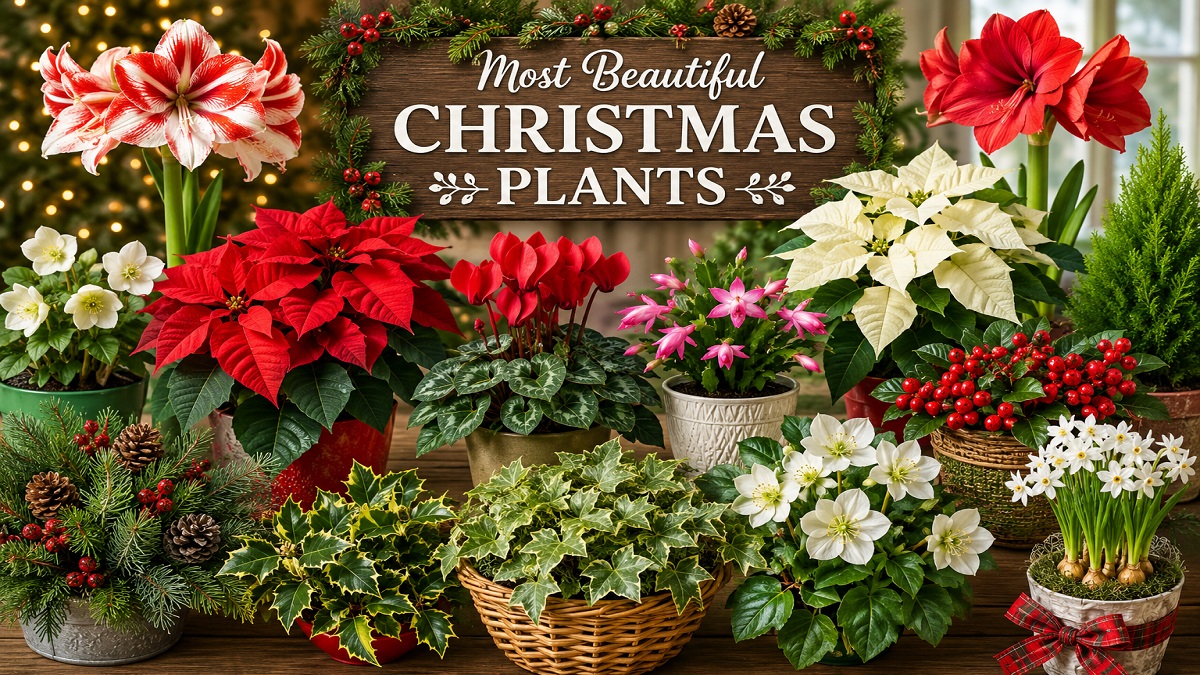
Introduction
Aside from the conventional Christmas tree, several plants reach their optimum during the holiday season. Why not add some to your Christmas decorations to brighten up the festivities even more? Some plants represent the arrival of spring, while others are usually associated with the holiday season. Here are 20 plants that will undoubtedly bring life and charm to your Christmas decorations.
1. Amaryllis
Amaryllis bulbs are commonly grown to create gorgeous interior flowers in the winter. These plants are typically hybrids of the Hippeastrum genus, which includes tropical species native to Central and South America. Although a true Amaryllis genus does exist, with two species from South Africa, it is not as widely grown in American gardens. Amaryllis, known for their huge, trumpet-like flowers, can bloom for seven weeks or more in shades of deep red, pink, white, or a combination of these colors. Be aware that the plant's bulbs, leaves, and stems contain toxic substances that can harm both people and pets.
2. Holly (Ilex)
Holly (Ilex) is a varied genus of trees and shrubs, with over 400 species found in temperate, subtropical, and tropical climates around the world. This popular landscape shrub is most known for its beautiful red berries, which brighten the winter landscape and may be used to adorn Christmas wreaths and garlands. With year-round beauty, the evergreen or deciduous foliage comes in a variety of hues and forms, with little white flowers in the spring or summer and decorative berries that feed songbirds and other wildlife.
3. Christmas Cactus (Schlumbergera)
Christmas cacti (Schlumbergera) have long been popular houseplants due to their ease of growth and stunning floral display in the winter. Flowers occur at the tip of each stem, typically in red, pink, or white. Even when not in bloom, the long, flat, segmented stems form a lovely evergreen cascade, perfect for a hanging planter or a windowsill. These plants have a lengthy lifespan, and the more stems they generate over time, the more flowers they produce.
4. Poinsettia (Euphorbia pulcherrima)
For many people, the Poinsettia embodies the Christmas spirit, illuminating homes and public spaces with rich, festive colors. Its adaptability to indoor living has made it a festive season standard well beyond its tropical roots, and its striking appearance ensures that it will remain popular. Poinsettia is a popular option among tropical flower enthusiasts and gardeners alike.
5. Mistletoe (Viscum album)
Mistletoe is a tiny woody shrub with a roughly spherical shape that can grow to be about 1 meter across. It grows on the branches of other trees, held together by a swelling known as a haustorium. The stems fork out at semi-regular intervals, resulting in long, oval-shaped pale green leaves. The little yellow-green flowers grow in clusters of three to five where the branches fork. The berries are spherical, white, and about 1cm wide. They contain a single green seed surrounded by a sticky pulp.
6. Cranberries (Vaccinium macrocarpon)
Vaccinium macrocarpon (Cranberry) is a low-growing evergreen trailing shrub that spreads and roots from its stems to an unlimited width. Beautiful pinkish-white small blooms bloom from late spring to early summer. They give way to beautiful red cranberries, which ripen in early to mid September. The foliage of small, glossy, leathery leaves is bronze in spring, matures to dark green in summer, and turns coppery or purple in winter. Cranberry is both attractive and tasty, and can be used to create a small-scale groundcover. Commercial producers cultivate this plant in wet bogs that may be flooded to control weeds and pests while also facilitating crop harvest.
7. Rosemary
Rosemary, a sun-loving Mediterranean shrub, is beautiful, drought-tolerant, and easy to grow. You may harvest sprigs all year and use them fresh or dried to season meat, bread, and a variety of other recipes. Rosemary (Salvia rosmarinus) has evergreen, fragrant leaves and little blue, mauve, pink, or white flowers. It prefers warm, well-drained soil and grows well in pots. Rosemary is generally hardy in the UK, but may require winter protection in colder areas.
8. Cymbidium Orchids
Cymbidiums are distinguished by their abundant, strap-shaped foliage and thick clusters of long-lasting flowers. Cymbidiums are semi-terrestrial orchids native to tropical and subtropical Asia, as well as parts of Australia, and are commonly produced as cut flowers or ornamentals. These orchids come in two sizes: tiny and normal. A normal Cymbidium may produce flowers up to 5" diameter, but it requires cooler temps to bloom. A small Cymbidium features flowers that are half the size but just as lovely, and it can flower at slightly higher temps.
9. Cyclamen
Cyclamen are popular gift plants due to their brightly colored blooms, beautiful foliage, and compact size. They are available in a wide range of hues, including pink, red, and white. Given the correct location and care, they can be kept blooming for several months before being raised as indoor houseplants to bloom again the following winter. Cyclamen plants should be kept in a bright, cool environment out of direct sunlight. In the winter, one to two hours of direct sunlight is sufficient as long as the temperature does not get too high. Temperatures of 60 to 70 degrees Fahrenheit during the day and 50 to 65 degrees Fahrenheit at night are optimal. The soil should remain somewhat damp at all times. When watering cyclamen, water at the outside rim of the pot to avoid wetting the plant's center, which might cause crown rot.
10. Paperwhites (Narcissus papyraceus)
Narcissus papyraceus, or paperwhite narcissus, has the strongest aroma. It is traditionally used as a cut flower or forced for winter table displays, where its exquisite aroma permeates the house for weeks. Each stem produces up to ten pure white blooms. Plant Narcissus papyraceus bulbs in containers or open ground in the autumn, just as other narcissi. If forcing the bulbs for indoor usage, place them in a vase or shallow bowl on a layer of gravel. Only add enough water to cover the top of the gravel layer. The bulbs will gladly grow and flower without soil, and once flowering, they can be put in the garden the following year.
11. English Ivy (Hedera helix)
English ivy (Hedera helix) is an evergreen perennial. It's also classified as a woody vine. English ivy can serve as a ground cover by spreading horizontally. It is also a climber, thanks to its aerial rootlets, which allow it to reach heights of up to 80 feet. The plant will eventually produce small greenish blooms, although it is usually grown for its evergreen foliage. In this way, ivy is classed as a leaf plant. The best season to plant English ivy is spring. It grows quickly and aggressively, making it invasive in many regions. Keep an eye on your children and pets because English ivy is poisonous to both humans and animals.
12. Norfolk Pine (Araucaria heterophylla)
Araucaria heterophylla, sometimes known as Norfolk Island Pine, adds a softness and refinement to indoor environments that few plants can rival. With its finely stacked branches and tiny, conifer-like needles, it feels both structured and natural – a living sculpture that looks well in modern residences, period terraces, and beach flats. Though many people first see it around Christmas, we discover that it glows well after the holidays, creeping into nooks as a softly lovely evergreen presence. Unlike many other houseplants, Norfolk Island Pine does not require tropical heat. Its affinity for cooler areas, mild light, and consistent moisture makes it ideal for British homes, particularly during the winter months when central heating is turned on and daylight becomes scarce. It's a slow-growing tree that provides consistent enjoyment, as well as a plant that adds a peaceful sense of green to any home all year.
13. Christmas Kalanchoe (Kalanchoe blossfeldiana)
Kalanchoe plants are distinguished by their small flowers and oval-shaped, scallop-edged leaves. The genus contains over 100 species, but Kalanchoe blossfeldiana, sometimes known as window's thrill, is the most popular houseplant. It produces tiny clusters of blooms in red, pink, yellow, orange, and white. Kalanchoe is a popular houseplant since it is drought resilient and easy to maintain, requiring water only every other week when kept in optimal bright lighting. In tropical and subtropical climes, it can be grown as a perennial. In colder climes, it is commonly grown as an indoor plant. With proper care, it can rebloom indoors for decades. However, keep it away from pets because the herb is harmful to cats and dogs if consumed.
14. Christmas Pepper
Christmas pepper plant is a chili pepper that may be grown indoors as an annual. The plant requires just around 2–4 hours of sunlight per day in an east or west-facing window, and rewards its owners with a plethora of fruits in ripening tints ranging from pale green to yellow, orange, and red. These plants offer a festive display with their red peppers against green leaves and their form, which resembles Christmas lights.
15. Winterberry Holly (Ilex verticillata)
Ilex verticillata is a multi-stemmed deciduous holly famed for its stunning winter display. While most hollies are evergreen, Winterberry sheds its leaf in the fall, revealing stems brimming with vibrant red berries that last until late winter unless eaten by birds. It produces little greenish-white flowers in late spring or early summer. Though they appear tiny, they are essential for berry production — and because this species is dioecious, pollination and fruit set require both male and female shrubs to occur.
16. Jerusalem Cherry (Solanum pseudocapsicum)
Jerusalem cherry plants (Solanum pseudocapsicum) are also known as Christmas cherry and winter cherry. Its name is thought to be a misnomer, as the fruit it bears are deadly berries that resemble cherries (or cherry tomatoes), and the plant may not have originated in Jerusalem, but rather was planted there by someone who had been overseas and acquired seeds. It is actually native to South America. The Jerusalem cherry houseplant grows as an erect, bushy evergreen shrub. It may be bought from the local nursery at almost any time of year and is classified as a winter-fruiting annual. Jerusalem cherry plants have dark green, lustrous, elliptical leaves that are about 3 inches (7.6 cm) long.
17. Yuletide Camellia (Camellia sasanqua ‘Yuletide’)
Camellias are a treasure when they flower in the cooler months, and their lovely leaves and forms add structure to the landscape all year. 'Yuletide' explodes with vibrant crimson blooms just in time for the holidays. Camellias are attractive evergreens with dark green, glossy leaves. Their lovely blooms, ranging from large and broad to tiny and intricate, convey appeal. Camellia sasanqua 'Yuletide' blooms throughout the Christmas season, with vivid red flowers that contrast with the dark foliage. 'Yuletide' can be used in the landscape all year, and the spectacular winter blossoms are a delight when little else is in bloom. During the calm season, the flowers serve as pollinators, attracting bees and other useful insects with their pollen and nectar. The seeds that follow provide food for songbirds and small mammals.
18. Frosty Fern (Selaginella kraussiana 'Variegatus')
Frosty ferns, while not real ferns, are beautiful perennial plants for gardens and homes. Their white or yellow tips give a luxuriant holiday effect when contrasted with the green fronds below. Frosty ferns are perennial plants from the spike moss family Selaginellaceae. Unlike real mosses, they develop roots from their fronds, allowing them to extend into new places. Frosty fern is a frequent name for spike mosses with brilliant tips. Frosty ferns produce fernlike fronds with scaly leaves. The leaves mimic conifers such as western red cedars and junipers, with each scale sprouting from the previous one. The tips produce bright white or yellow new growth that gradually turns dark green as it grows.
19. Christmas Rose (Helleborus niger)
Helleborus niger, often known as Christmas Rose, is a winter-blooming evergreen perennial with huge, bowl-shaped, dazzling white flowers that measure 3 inches (8 cm) across and are crowned with crowns of beautiful golden-yellow stamens. Unlike other hellebores, the blossoms face outward, attracting attention. They grow on short, thick stems and rarely rise beyond the foliage of palmate, deeply lobed, dark green leaves. Christmas Roses, which are native to the mountains of southern and central Europe, bloom around Christmas in mild winter locations and in early spring in cooler winter regions. Helleborus niger is an excellent shade garden plant and a favorite cut flower!
20. Bay Laurel
Bay laurel is an evergreen plant that grows as a shrub or tree and is well-known for its aromatic leaves, which are frequently used in cooking. Its pointy, oval-shaped leaves are deep green, lustrous, and have a leathery texture. Fresh bay leaves do have a mild aroma, while dried leaves are generally more fragrant for culinary use. Bay laurel thrives in a range of soils and requires plenty of sunlight, both indoors and outside. It's crucial to know that bay laurel is poisonous to pets.
Conclusion
Incorporating Christmas plants into your home or garden adds natural beauty, fragrance, and festive cheer. From traditional evergreens to colorful winter bloomers, these 20 plants can transform any space into a warm, inviting, and stylish holiday setting. Whether used for decorations, gifts, or garden displays, they bring life and joy to your celebrations.
Frequently Asked Questions
1. What is the most popular Christmas plant?
The poinsettia is considered the most popular Christmas plant due to its bright red, white, or pink bracts and its strong association with holiday decorations around the world.
2. Which Christmas plants bloom during winter?
Several plants bloom during winter, including amaryllis, Christmas cactus, Christmas rose, cyclamen, paperwhites, cymbidium orchids, and Yuletide camellia, making them perfect for festive displays.
3. What plants are traditionally used for Christmas decorations?
Traditional Christmas decorating plants include poinsettia, holly, mistletoe, rosemary, Norfolk pine, ivy, winterberry holly, and bay laurel. They are commonly used in wreaths, garlands, centerpieces, and indoor displays.
4. Which Christmas plants are suitable as indoor houseplants?
Popular indoor Christmas plants include poinsettia, Christmas cactus, amaryllis, cyclamen, kalanchoe, Norfolk pine, paperwhites, and cymbidium orchids. These plants thrive indoors with proper light and watering.
5. Are any Christmas plants poisonous to pets?
Yes. Plants such as holly, mistletoe, amaryllis, English ivy, Jerusalem cherry, bay laurel, and kalanchoe can be toxic to cats and dogs. Always keep potentially harmful plants out of reach of pets.
6. Which Christmas plants have the most fragrant flowers?
Paperwhites are famous for their strong fragrance. Rosemary also has aromatic foliage, while bay laurel offers fragrant leaves that are widely used in cooking.
7. Can Christmas plants be grown outdoors?
Yes. Plants like holly, winterberry, rosemary, Christmas rose, bay laurel, camellia, and English ivy grow well outdoors in suitable climates, while others such as poinsettia and Christmas cactus are commonly grown indoors in colder regions.
8. Which Christmas plant is easiest to care for?
Christmas cactus is one of the easiest Christmas plants to maintain. It requires bright indirect light, occasional watering, and can bloom for many years with minimal care.
9. What is a good alternative to a traditional Christmas tree?
Norfolk Island pine is a popular living alternative to a traditional Christmas tree. It has a soft evergreen appearance and can continue growing as an attractive houseplant after the holidays.
10. Which Christmas plants produce colorful berries?
Holly, winterberry holly, cranberries, mistletoe, and Jerusalem cherry are well known for their decorative berries that add festive color to holiday arrangements and winter landscapes.